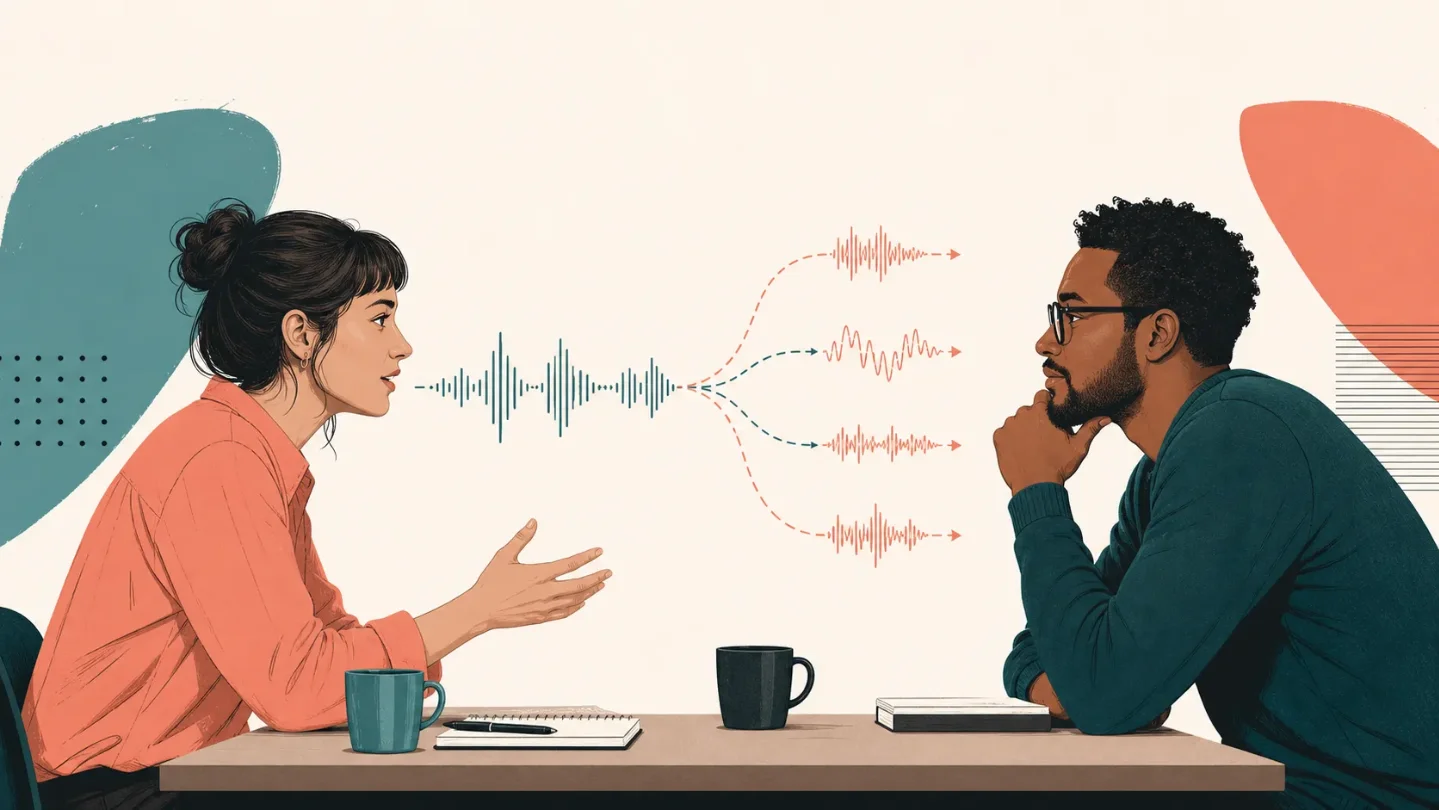
Autistic Conversation Is Not One Problem: Timing, Inference, and the Double-Empathy Lens
A research-led guide to separating turn timing, pragmatic inference, and cross-neurotype mismatch in studies of autistic communication.
The first question: what kind of communication difference?
A familiar description of autistic communication treats "social language" as one large ability: read the room, take turns, understand what people mean, and respond in the expected way. Linguistics gives us a sharper set of questions.
What happens at the boundary between turns? When does a listener infer more than the words literally say? Which judgments belong to the speaker, and which belong to the conversation partner or observer? Once those questions are separated, the evidence looks less like a single deficit and more like a set of context-sensitive mismatches.
That is the starting point for this channel. This issue brings together conversation analysis, pragmatics, and formal semantics around one claim: a result from a tightly controlled language task should not be treated as a diagnosis of how an autistic person communicates in every setting.
Conversation is organized in time
Conversation analysis begins with observable conduct. Who starts a turn? How long is the silence before the next turn? Does one speaker overlap another? When a mismatch becomes visible, how do the participants repair it?
A 2023 PLOS ONE study examined turn timing in conversations between autistic adults. The sample was small: 28 German-speaking adults, arranged into 14 autistic-autistic or non-autistic-non-autistic pairs. The participants completed a Map Task, a semi-spontaneous instruction-giving activity in which they could not see each other. Across the sample, both groups preferred very short gaps between turns. 1
The more interesting result was local rather than global. Before the first detected mismatch in the task, autistic pairs showed longer silent intervals than the comparison pairs. After that point, the study found no robust group difference in turn timing. In other words, an interaction can contain a timing difference without supporting the much broader conclusion that autistic speakers do not know how conversation works.
That distinction matters because turn timing is not just a personal trait. It is jointly produced. A pause can be planning time, a signal that a speaker has finished, a sign that the previous turn was unclear, or simply a feature of a particular task. The same measurable gap can do different interactional work.
The study also sets boundaries on its own result. It used German-speaking adults with relatively strong verbal abilities, autistic-autistic pairs rather than mixed pairs, and a task without visual contact. It did not settle how gaze, gesture, prosody, or mixed-neurotype interaction would change the pattern. Those are not minor footnotes; they define what the evidence is evidence about.
Pragmatics is not one inference
Formal semantics and pragmatics meet in the gap between what a sentence contributes and what a listener works out in context.
Take the sentence "Some students came." Its ordinary semantic content allows a situation in which all of the students came. In many contexts, however, a listener derives the additional inference "not all." That extra step is a scalar implicature: a context-sensitive inference associated with choosing a weaker expression such as "some" when a stronger alternative such as "all" was available. Metaphor involves a different kind of interpretive work, because the listener must map an expression away from its literal sense.
These distinctions let researchers ask a better question than "Are autistic people literal?" They can ask which inferences are difficult, under which instructions, with which linguistic materials, and at what processing cost.
A 2025 study tested scalar implicatures and metaphor comprehension in the same group of autistic children. It compared 23 autistic children with 237 neurotypical children, using tablet-based tasks designed to address concerns about earlier methods. The autistic group performed less well on scalar implicatures but was similar on the metaphor measure; the contrast appeared in both accuracy and response times. 2
That is a result about a contrast between task types, not proof of a general inability to infer meaning. The authors discuss a possible difference between guided pragmatic processes, where the task makes the relevant reasoning explicit, and spontaneous pragmatic processes, which unfold in everyday interaction. The sample is also uneven in size and limited to children, so the finding should travel cautiously into claims about autistic adults or natural conversation.
The formal-semantics payoff is methodological. If a study does not distinguish semantic content, scalar alternatives, metaphor, reference, presupposition, and social inference, its label of "pragmatic difficulty" may hide several different mechanisms. A linguistic analysis can make the hidden steps visible.
The conversation partner is part of the data
The double-empathy problem shifts the unit of analysis from an isolated autistic person to the relation between participants. It proposes that communication breakdowns between autistic and non-autistic people can be mutual: the participants may use different cues, expectations, and norms for deciding what counts as an adequate response.
A 2024 study tested one part of that proposal with 102 non-autistic undergraduate observers. The observers rated videos of autistic-autistic, non-autistic-non-autistic, and mixed autistic/non-autistic "get to know you" conversations. The mixed interactions were rated as the least successful. Observers also judged non-autistic participants more favorably, while the conversation partners themselves tended to evaluate autistic participants more positively than outside observers did. 3
This does not show that every cross-neurotype conversation is doomed, nor that interactional differences disappear among autistic people. It shows that judgments of conversational success are themselves socially situated. An observer who does not share the participants' expectations may read the same pause, amount of disclosure, facial expression, or topic shift differently from the person who is actually in the exchange.
The result also creates a useful tension with the turn-timing study. The first study asks what happens inside autistic-autistic conversations at a fine-grained temporal level. The second asks how mixed interactions are evaluated from the outside. They are not competing answers. They examine different layers of the event.
What the older frame misses
A 2010 post on the linguistics blog Language Log discussed autism through the then-familiar language of "mind blindness" and conversational rules. As a historical snapshot, it is useful because it makes the older framing easy to see: the problem is located mainly in the autistic person's ability to recognize the hidden rules of interaction. 4
More recent research news has helped carry a different question to a wider audience. The Transmitter's overview of the double-empathy theory describes communication breakdown as a mismatch in perspective, while also warning that the empirical case was still developing when the article was published. That combination is important: a better frame is not the same thing as a settled theory. 5
The shift is not from "autistic people have no communication differences" to "all differences are caused by society." It is from a one-sided model to a relational one. An autistic person may have difficulty with a particular inference, timing demand, or non-literal expression. A non-autistic partner may also misread an autistic signal, penalize a style difference, or fail to provide the time and explicitness that would make the exchange work.
A practical reading rule
When a paper or headline says that autistic people have a communication problem, ask four questions:
- What is the unit of analysis? A sentence, a response time, a turn transition, a whole conversation, or an observer's impression?
- What kind of meaning is involved? Literal content, scalar implicature, metaphor, reference, emotion, politeness, or conversational alignment?
- Who is doing the judging? The participant, a conversation partner, a trained coder, or an outside observer?
- What interactional conditions are present? Same or mixed neurotype, scripted or open-ended task, visual contact, time pressure, and access to AAC or other supports?
A 2025 action-focused review of communication in autistic adults makes the same methodological point from a broader angle. Reviewing research from mainly 2020 through 2024, it treats literal and non-literal language, nonverbal communication, augmentative and alternative communication, and double empathy as connected but distinct areas. It emphasizes that communication outcomes depend not only on an individual's skills and preferences but also on the communicative partner and environment. 6
That is the editorial promise of Linguistics on the Autism Spectrum: follow the smallest analyzable unit without losing the social setting around it. We will look for the difference between a pause and a failure, between a semantic contribution and a pragmatic inference, and between a person's performance and another person's judgment of it.
The best work in this area does not make conversation less complicated. It tells us exactly where the complexity is.
참고 출처
- 1Turn-timing in conversations between autistic adults: Typical short-gap transitions are preferred, but not achieved instantly
- 2Some (but not all) Pragmatic Inferences are Difficult for Autistic Children
- 3Non-autistic observers both detect and demonstrate the double empathy problem when evaluating interactions between autistic and non-autistic adults
- 4The art of conversation
- 5Double empathy, explained
- 6Communication in Autistic Adults: An Action-Focused Review
관련 콘텐츠
- 로그인하면 댓글을 작성할 수 있습니다.