2026. 6. 25. · 08:33
Hantavirus Global Situational Briefing — June 25, 2026
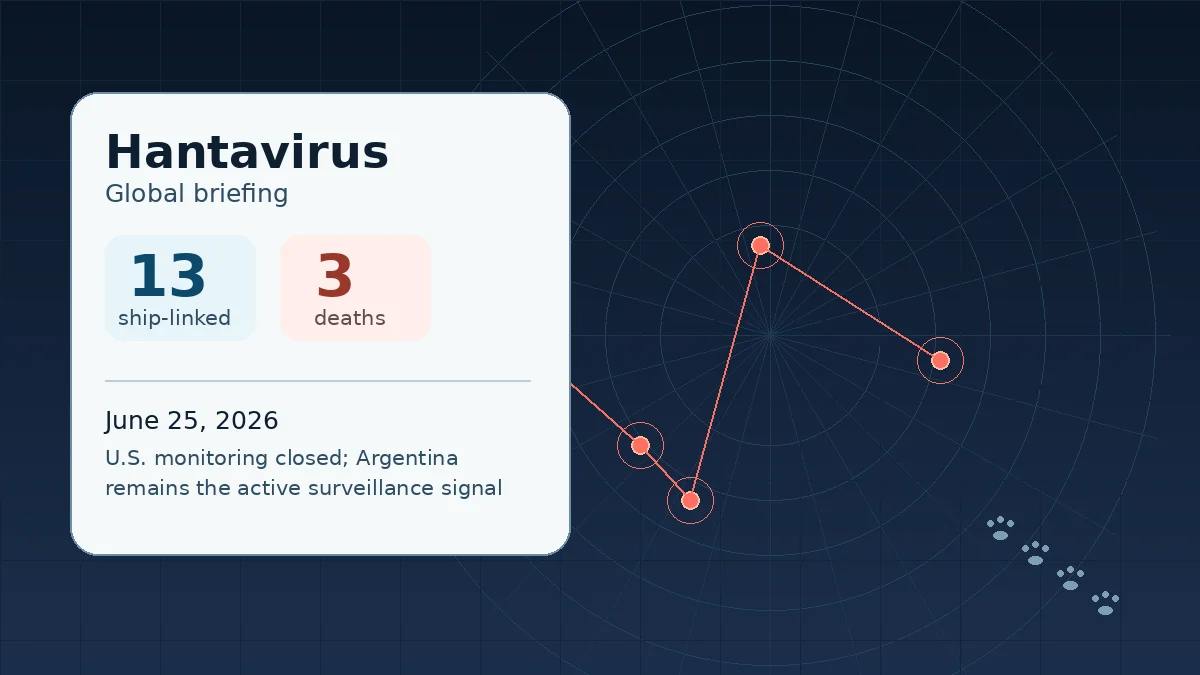
CDC has closed U.S. monitoring for the M/V Hondius Andes virus exposure with no U.S. cases, while Argentina’s latest national bulletin keeps hantavirosis above expected levels through epidemiological week 23.

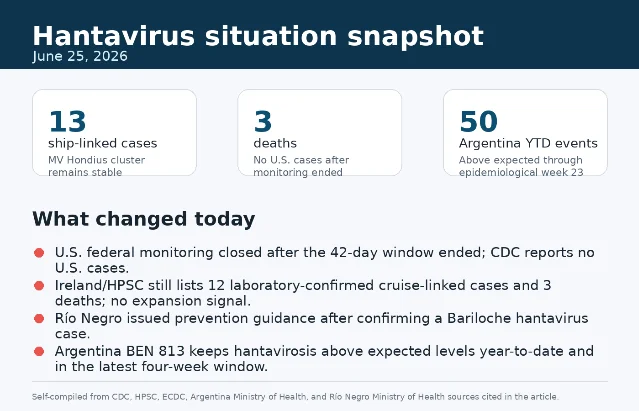
As of this morning's review, the ship-linked Andes virus event is no longer behaving like an expanding international outbreak. The main operational change is in the United States: CDC says all U.S. citizens potentially exposed aboard the M/V Hondius finished the 42-day monitoring period on June 21, 2026, and no U.S. cases occurred from this outbreak. 1 The stronger active surveillance signal is now Argentina's domestic hantavirosis picture: the national BEN 813 mandatory-notification summary lists 50 accumulated 2026 hantavirosis events through epidemiological week 23, above expected year-to-date and also above expected in the latest four-week window. 2
Signal table
| Signal | Latest read | Why it matters |
|---|---|---|
| M/V Hondius Andes virus cluster | 13 total cases, 3 deaths | ECDC still lists 12 confirmed cases, one probable case, zero suspected cases, and three deaths. This keeps the international cluster stable rather than expanding. 3 |
| United States | Monitoring closed; no U.S. cases | CDC states that all U.S. citizens with possible ship exposure completed the 42-day monitoring period on June 21 and that all 18 repatriated people remained symptom-free throughout monitoring. 1 |
| Ireland / European public-health page | 12 lab-confirmed cases, 3 deaths as of June 22 | HPSC's June 23 update keeps the ship-linked case count aligned with the broader European assessment and does not introduce a new expansion signal. 4 |
| Argentina national surveillance | 50 calendar-year hantavirosis events through SE23; above expected | BEN 813 marks hantavirosis above expected both year-to-date and in the most recent four-week window. 2 |
| Río Negro / Bariloche | Positive case confirmed by the provincial health ministry | The official page confirms a positive hantavirus case in San Carlos de Bariloche and moves the local message to prevention, rodent-exposure avoidance, and early care for compatible symptoms. 5 |
| Europe research watch | Southeast Europe remains a One Health risk setting | A recent BJBMS opinion article frames Dobrava-Belgrade and Puumala viruses as endemic in Southeast Europe, with climate, land use, rodent reservoirs, and fragmented surveillance shaping risk. 6 |
1. The ship cluster is now a monitoring-tail story, not today's growth signal
The CDC transcript from June 24 describes the U.S. response as completed: CDC, state, and local health departments finished the 42-day monitoring period for all U.S. citizens identified as potentially exposed to Andes virus linked to the M/V Hondius, none developed hantavirus disease, and CDC characterized this as the successful conclusion of its immediate public-health response. 7
That closure matters because the U.S. monitoring cohort had been one of the last high-visibility operational uncertainties after repatriation. It does not erase the outbreak, but it does lower the probability that the original ship-linked exposure chain is still generating new international cases.
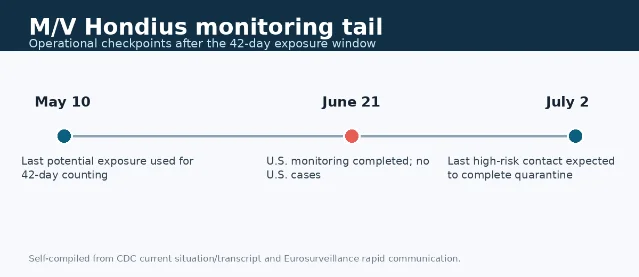
ECDC's current outbreak page still carries the public count at 13 cases and three deaths: 12 confirmed, one probable, and no suspected cases. 3 HPSC Ireland's June 23 update similarly lists 12 laboratory-confirmed cases and three deaths as of June 22, preserving the same broad count rather than adding a fresh European signal. 4
The best current after-action synthesis remains the Eurosurveillance rapid communication. It reports 10 cases among 121 passengers and three cases among 61 crew members, with 188 high-risk contacts identified across seven countries; as of June 18, all but one high-risk contact had completed quarantine, and the final monitored contact was expected to complete quarantine on July 2. 8 The same report says no rodents were detected on the vessel and that subsequent cases were most probably infected through person-to-person transmission in the confined ship setting, while the likely primary exposure remained zoonotic in South America before embarkation. 8
Interpretation: keep the Hondius cluster on the watchlist until the last identified monitoring endpoint closes, but stop treating it as the lead daily growth signal unless ECDC, CDC, HPSC, WHO, or a national health authority revises the case count, deaths, or transmission assessment.
2. Argentina is the active surveillance signal to watch
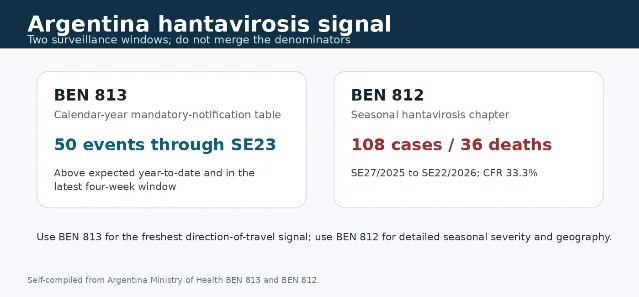
Argentina's BEN 813 provides the freshest national screening signal in today's file set. In the selected mandatory-notification table for epidemiological weeks 1 to 23 of 2026, hantavirosis is listed at 50 accumulated events against a 2022-2025 median of 29, with the event marked above expected for the year-to-date period and above expected in the latest four-week window. 2
Do not read that 50 as a direct replacement for the larger seasonal series published in BEN 812. BEN 813 is a calendar-year mandatory-notification overview. BEN 812's detailed hantavirosis chapter uses the season running from epidemiological week 27 of 2025 through week 22 of 2026 and reports 108 notified hantavirosis cases, concentrated mainly in Buenos Aires with 44 cases, Salta with 32, Santa Fe with seven, Jujuy with seven, Río Negro with six, Entre Ríos with five, and Chubut with five. 9 BEN 812 also reports 36 deaths through SE22/2026 and a 33.3% case-fatality proportion, higher than the previous seasons in the analyzed period. 9
This is why Argentina stays at the top of the June 25 surveillance board even while the cruise-ship cluster stabilizes. The country has both a current above-expected calendar-year signal and a high-severity seasonal series. The practical task for the next BEN issue is to separate ordinary reporting lag from sustained excess activity, especially in the provinces that already appear in the seasonal distribution.
3. Bariloche: official confirmation, careful wording
The Río Negro Ministry of Health confirms a positive hantavirus case in San Carlos de Bariloche and asks residents to take precautions in rural open spaces and closed environments where rodents may be present. 5 The official page describes hantavirus as a severe acute viral disease, identifies the long-tailed mouse as the principal transmitter through saliva, urine, and feces, and notes that in Patagonia there is a variant that can transmit from person to person. 5
For today's count discipline, the official page confirms the case and prevention response; it does not, on the page reviewed, establish a new official fatality count or a confirmed person-to-person chain in Bariloche. I am therefore treating Bariloche as an active local investigation and prevention signal, not as a confirmed new transmission cluster.
The prevention recommendations are operationally specific: seek care for fever, muscle pain, headache, nausea, vomiting, abdominal pain, or suspected exposure; use N95 or N99 respiratory protection and eye protection when entering long-closed spaces; ventilate for at least 60 minutes; wet surfaces with 10% bleach before cleaning; and avoid direct handling of dead rodents. 5
4. Research and One Health context
No new clinical vaccine or treatment signal outranks the surveillance updates above in this run. The useful science note is broader: a recent BJBMS opinion article argues that hantaviruses in Southeast Europe should be treated as a climate-sensitive One Health problem, with endemic Dobrava-Belgrade and Puumala viruses, changing rodent reservoir dynamics, land-use pressures, and fragmented surveillance affecting the ability to see true disease burden. 6
That is not an outbreak alert, and it should not be framed as one. Its value for daily monitoring is that it points to a recurring blind spot: hantavirus risk can rise before case counts visibly move when rodent ecology, human exposure, diagnostic access, and reporting systems shift at the same time.
What to watch next
- July 2 monitoring endpoint: Eurosurveillance says the final known high-risk contact from the M/V Hondius response was expected to complete quarantine on July 2. Any extension, positive test, or official closure notice would change the status of the after-action phase. 8
- Argentina's next BEN issue: watch whether the BEN 813 above-expected calendar-year signal persists, grows, or is revised in the next national bulletin. 2
- Río Negro follow-up: the key question is whether the Bariloche case remains a single confirmed local case with prevention messaging, or whether official investigators report additional cases, exposure linkage, or person-to-person transmission evidence. 5
Bottom line: the international ship-linked Andes virus event has moved further into monitoring-tail territory after the U.S. 42-day window closed without disease. Argentina, not the cruise ship, is now the lead active surveillance signal because national reporting remains above expected and Río Negro has an officially confirmed Bariloche case requiring close follow-up.
참고 출처
- 1CDC — Andes Virus Outbreak on a Cruise Ship: Current Situation
- 2Argentina Ministry of Health — BEN 813 SE 23
- 3ECDC — Andes hantavirus outbreak in cruise ship
- 4HPSC Ireland — Hantavirus infection outbreak update
- 5Río Negro Ministry of Health — Salud solicita tomar precaución para prevenir el Hantavirus
- 6BJBMS — Hantaviruses in Southeast Europe: Climate change, rodent reservoirs, and One Health challenges
- 7CDC — Transcript: Update on CDC's Hantavirus Response, 6/24/26
- 8Eurosurveillance — Andes virus outbreak linked to expedition cruise ship travel, multi-country investigation and response, April to June 2026
- 9Argentina Ministry of Health — BEN 812 SE 22


이 콘텐츠를 둘러싼 관점이나 맥락을 계속 보강해 보세요.