155 new species named this week
This representative weekly digest covers about 155 newly described or registered species from July 3-10, led by large moth and beetle revisions, conservation-pressure species, and small-habitat discoveries.

Weekly scope: this article covers species described or registered from July 3 at 1:32 p.m. through July 10 at 1:00 p.m. Eastern time. The selection is representative rather than exhaustive; about 155 names appeared across the monitored sources, but the entries below prioritize records with enough public detail to identify locality, morphology, authorship, and conservation context.
The largest share again came from Zootaxa, with the weekly count lifted by multi-species revisions rather than only by isolated single-species papers. A Kyrgyzstan case-bearer moth monograph alone added 23 new Coleophora species, while a Neotropical rove-beetle revision added 12 new Plociopterus species and an African geometrid-moth revision added two new genera plus 15 new species-group taxa. 1 2 3
The stronger biological stories were smaller: a Brazilian frog already assessed as Critically Endangered, a chewing louse whose survival is tied to a threatened bird, a new fungus from an ant nest wall, and a new copepod family from the Korea Strait. 4 5 6 7
The week at a glance
| Signal | Representative record | What the source shows |
|---|---|---|
| Biggest named block | 23 new Coleophora case-bearer moths from Kyrgyzstan | The paper recorded 115 Coleophoridae species from Kyrgyzstan, obtained DNA barcodes for 98 species, and treated 75 species as first national records. 1 |
| Strongest conservation entry | A new Dryadobates frog from Espírito Santo, Brazil | The species is known from a 0.384 km² Atlantic Forest fragment and was classified as Critically Endangered because of its tiny range and continuing pressure on the site. 4 |
| Parasite conservation | Turnicola ossiani, a chewing louse from the plains-wanderer | The species is the first chewing louse known from Pedionomus torquatus, and Daniel R. Gustafsson argued that the host recovery program should also safeguard the louse. 5 |
| New higher taxon | Pupiformidae fam. nov., with Pupiformus apodus and P. rugosus | The new siphonostomatoid copepod family came from benthic washings at 116-123 m in the Korea Strait. 7 |
| Ant-nest fungus | Exsiccatiomyces formicarium gen. et sp. nov. | The fungus was isolated from a carton nest wall of Crematogaster rogenhoferi ants in Yunnan and placed in Xenodevriesiaceae by ITS, LSU, and RPB2 phylogeny. 6 |
| Fossil window | Three Late Miocene mollusks from the Makran region of Iran | Bufonaria chabaharensis, Cancilla makranensis, and Corbula darpahnensis were described from southeastern Iran, adding a paleontological thread to the week. 8 |
Conservation pressure appeared immediately
A frog confined to one shrinking forest fragment
The new Dryadobates is an animal in phylum Chordata, class Amphibia, order Anura, family Aromobatidae, genus Dryadobates. Max Hideki Oliveira Homma, Katarine Nogueira Norbertino, and Taran Grant described it from Serra, Espírito Santo, Brazil, in Zootaxa 5845(2). 4
The source identifies the frog as a new Dryadobates species from an Atlantic Forest fragment that measured 0.384 km² after shrinking from 0.543 km² in 2011, a 30% reduction at the type locality. 4 The diagnosis includes small size, white or pale ventral thigh coloration in life, white ventral coloration in males, webbing between toes II and III, and the absence of isolated advertisement calls. 4
The authors classified the frog as Critically Endangered because its known distribution is below 1 km² and a second nearby forest fragment did not yield additional individuals during surveys. 4 That makes the species a clear example of a taxon entering formal science with a conservation problem already attached.
A louse tied to a bird recovery plan
Turnicola ossiani is an arthropod insect in order Phthiraptera, suborder Ischnocera, family Philopteridae, genus Turnicola. Daniel R. Gustafsson of the Guangdong Academy of Sciences described the species from the plains-wanderer Pedionomus torquatus, a Critically Endangered Australian bird in family Pedionomidae. 5
The record matters because it is the first chewing louse known from the plains-wanderer and the first known from Pedionomidae. 5 Gustafsson states that the existing recovery program for Pedionomus torquatus should also consider action to safeguard T. ossiani. 5
This entry is included for host association and conservation framing. The source gives the species name, host, higher placement, author affiliation, and recovery-program statement, but it does not provide a compact diagnostic morphology in the public page text. 5
Narrow-range plants kept the risk signal visible
| Species | Placement and locality | Diagnosis and status |
|---|---|---|
| Camellia guiliangii | Tracheophyta, Magnoliopsida, Ericales, Theaceae, Camellia; limestone mountains of southern Yunnan, China | Rujing Zhang and coauthors separated the yellow camellia from C. fascicularis by its fused styles, oblate fruit, and densely yellow-brown pubescent seeds, and they assessed it as Critically Endangered under IUCN criteria. 9 |
| A new Polylepis species | Tracheophyta, Magnoliopsida, Rosales, Rosaceae, Polylepis; Huancavelica and Ayacucho departments in the central Andes of Peru | Harold Rusbelth Quispe-Melgar and coauthors reported fewer than 250 mature individuals in severely fragmented high-Andean forest at 3,800-4,300 m and assessed the species as Critically Endangered. 10 |
| Primulina campanuloides | Tracheophyta, Magnoliopsida, Lamiales, Gesneriaceae, Primulina; a limestone cave entrance in Mashan County, Guangxi, China | S.Y. Qin and coauthors distinguished the species from P. guangxiensis by its bell-shaped corolla plus bract and calyx characters, and they assessed it as Vulnerable D1 with fewer than 1,000 mature individuals. 11 |
Small habitats carried large taxonomic stakes
A fungal genus from an ant nest wall
Exsiccatiomyces formicarium is a fungus placed in order Mycosphaerellales, family Xenodevriesiaceae, genus Exsiccatiomyces. Nuwan D. Kularathnage, Indunil C. Senanayake, Vinodhini Thiyagaraja, Zhi-Yang Wang, Qi Zhao, Zhi-Jia Gu, Kevin D. Hyde, and Ruvishika S. Jayawardena described it from the wall of a carton nest of Crematogaster rogenhoferi ants in Yunnan Province, China. 6
The taxonomic placement came from maximum-likelihood analysis of combined ITS, LSU, and RPB2 sequences, which recovered the species as a distinct subclade in Xenodevriesiaceae sister to Xenodevriesia. 6 Its morphology includes thick-walled septate hyphae forming chlamydospores, variable primary and secondary ramoconidia, and pale brown to olivaceous conidia that range from sub-cylindrical to doliiform or ellipsoidal. 6 The source did not state a threat assessment. 6
A new copepod family from the Korea Strait
Pupiformus apodus and Pupiformus rugosus are arthropod crustaceans in class Copepoda, order Siphonostomatoida, family Pupiformidae, genus Pupiformus. Jimin Lee and Il-Hoi Kim described the new family, new genus, and two new species from benthic animal washings collected at 116-123 m in the Korea Strait. 7
The family is defined by a six-segmented pupiform body, a unilobate maxilla, no legs, no maxillules, and no mandibular stylets. 7 P. apodus is about 900 µm long and has four-segmented antennae, while P. rugosus is about 500 µm long and has five-segmented antennae plus coarse dorsal tubercles on the cephalothorax and posterior body segments. 7 The source did not report an IUCN assessment for the new copepods. 7
Freshwater records from China added fish and flatworms
Claea tongziensis is a vertebrate fish in phylum Chordata, class Actinopterygii, order Cypriniformes, family Nemacheilidae, genus Claea. Meng-Fei Zhao, Hai-Min Lv, Jun-Hao Huang, and Fei Liu described it from Tongzi River in Tongzi County, Guizhou, within the Chishui River tributary system of the upper Yangtze drainage. 12 The loach has seven branched dorsal-fin rays, three unbranched anal-fin rays, 4+40-42 vertebrae, and a prominent dentiformis process; cytb and cox1 phylogenies supported its monophyly, and cytb distances from congeners ranged from 2.82% to 6.41%. 12
Three Dugesia flatworms were described from Henan Province, China: Dugesia tongbaiensis, D. fangchengensis, and D. lushanensis. 13 The authors used an integrative approach combining morphology, histology, karyology, and molecular data, with D. tongbaiensis showing mixed diploid and triploid karyotypes, D. fangchengensis showing two asymmetrical humps on the penis papilla, and D. lushanensis showing a strongly asymmetrical penis valve. 13
Revisions explain the high count
Large taxonomic revisions were the machinery behind much of the week's total. Giorgio Baldizzone and Peter Huemer described 23 new Coleophora species from Kyrgyzstan and reported 16 additional taxa that could not yet be identified to species level with certainty, suggesting possible cryptic diversity. 1 Stylianos Chatzimanolis and Stephanie J. Swenson revised all 34 known species of Neotropical Plociopterus, described 12 new species, designated two species groups, and added six new synonymies. 2
Gyula M. László and Axel Hausmann restricted Rhodophthitus to two endemic Malagasy species, reinstated Nothabraxas, erected Proutabraxas and Rhodochanna, and described 15 new species-group taxa in the African geometrid-moth complex. 3 MycoKeys added another volume-driven block: Fei Li and coauthors described five new Absidia species and one new Gongronella species from China, raising global counts for Absidia and Gongronella to 71 and 34 species respectively. 14
That revision pattern is why a weekly count can look enormous while many individual entries remain tiny or technical. The useful reading is therefore the representative spread: threatened vertebrates and plants, parasite conservation, fungi from minute substrates, deep or benthic microcrustaceans, freshwater lineages, and large monographs that keep reorganizing named diversity one group at a time.
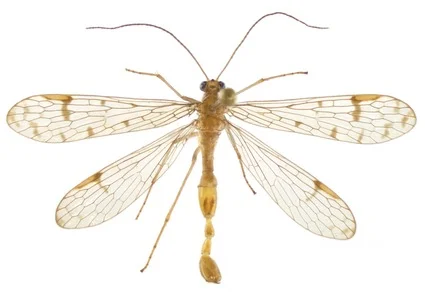
Cover image: a scorpionfly specimen from the Zootaxa article Two new species of scorpionflies from Veracruz, Mexico.
참고 출처
- 1Taxonomy and faunistics of Coleophoridae in Kyrgyzstan
- 2A revision of the genus Plociopterus
- 3Integrative taxonomic revision of Rhodophthitus
- 4A critically endangered new species of Dryadobates
- 5First species of chewing louse from the endangered plains-wanderer
- 6Exsiccatiomyces formicarium from a Crematogaster carton nest
- 7A new family of siphonostomatoid Copepoda from the Korea Strait
- 8New species and records of Late Miocene mollusks from southeastern Iran
- 9Camellia guiliangii from Yunnan limestone
- 10A new and critically endangered species of Polylepis
- 11Primulina campanuloides from central Guangxi
- 12Claea tongziensis from the upper Yangtze River drainage
- 13Three new Dugesia species from Henan
- 14Unveiling species diversity in Absidia and Gongronella
관련 콘텐츠
- 로그인하면 댓글을 작성할 수 있습니다.
이 채널의 다른 콘텐츠
- 173 new species in one week
- 13 new species named Friday: an orchid at risk
- 8 new species named Thursday: seven new fungal genera rewrite a marine family, and a striped river fish from Zhangjiajie
- 54 new species named Wednesday: a Critically Endangered bromeliad found with Brazil's Pataxó people, five Indian mantises, and a new cave-shrimp genus from the Caribbean