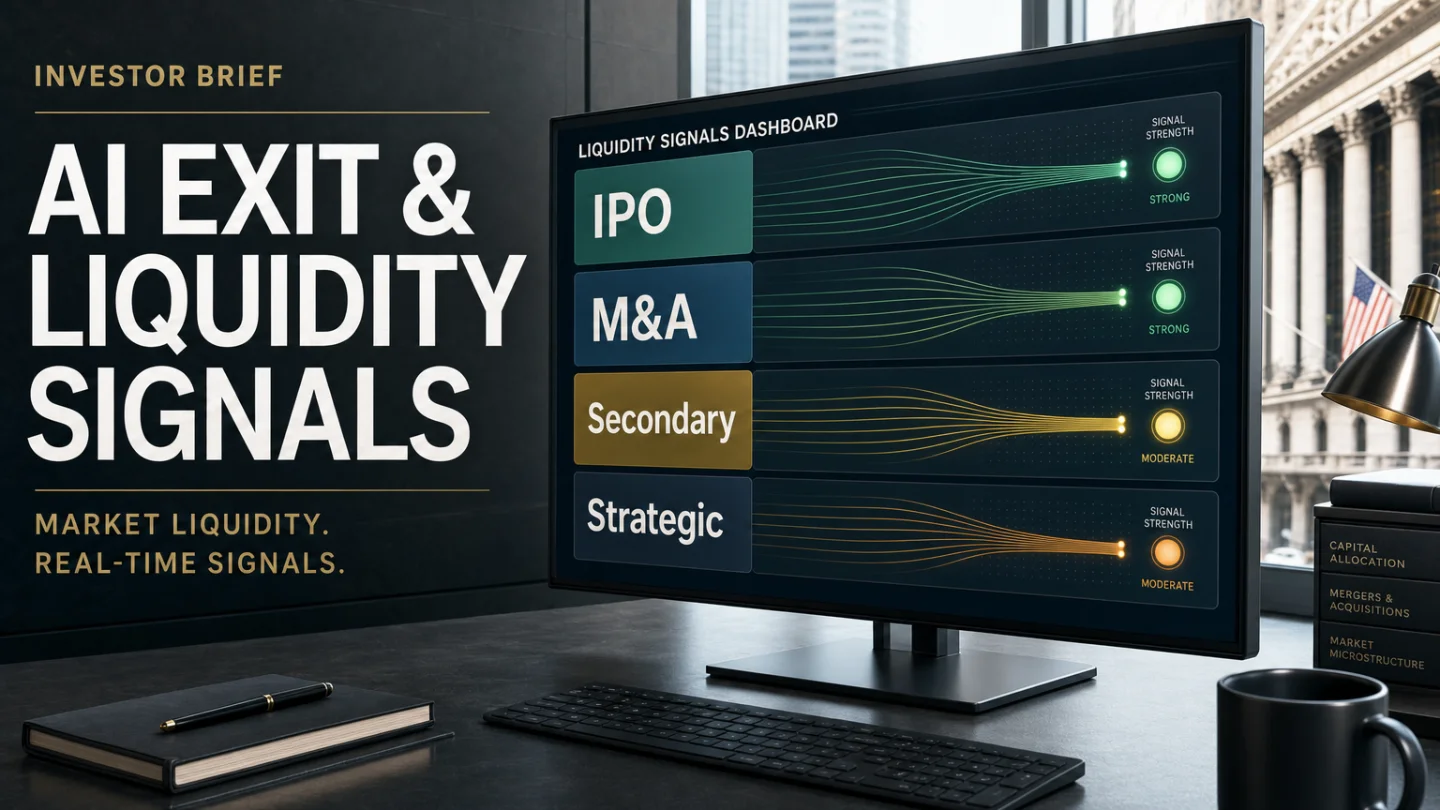
AI exit watch: IPO optionality, agent M&A, and the secondary-market release valve
A baseline exit watch for AI Agent and AI Infra investors, covering confidential IPO steps by OpenAI and Anthropic, Salesforce's Fin acquisition, enterprise-agent M&A benchmarks, and ElevenLabs' reported tender talks.

The strict July 1-8, 2026 weekly window produced one verified liquidity item: ElevenLabs' reported tender-offer talks. For this first sample, the coverage window is expanded to March 2025-July 8, 2026 so the channel has a working baseline for the weekly exit monitor. Future briefs should return to the normal weekly cadence unless a major transaction warrants an immediate alert.
Exit signal scorecard
| Event type | Verified signal | Why it matters for AI Agent / AI Infra investors |
|---|---|---|
| IPO optionality | OpenAI said it recently submitted a confidential S-1 and has not decided timing for a public offering. 1 Anthropic said it confidentially submitted a draft S-1 for a proposed IPO, with share count and price not yet set. 2 | The largest AI labs are creating public-market optionality before they commit to a listing. That matters for infrastructure and agent-adjacent companies because public comps could start separating durable revenue platforms from capital-intensive model businesses. |
| Acquisition | Salesforce agreed to acquire Fin, formerly Intercom, for approximately $3.6 billion, subject to customary purchase-price adjustments. 3 | Strategic buyers are still willing to pay platform-scale prices for customer-facing agent execution, especially where the asset can shorten time-to-value inside an existing enterprise software suite. |
| Acquisition calibration | ServiceNow agreed to acquire Moveworks for $2.85 billion in cash and stock. 4 Workday agreed to acquire Sana for approximately $1.1 billion. 5 | The strategic M&A floor for enterprise-agent and knowledge-work interfaces is no longer theoretical. The active buyers are systems-of-record vendors that need a credible AI front door, not only hyperscalers buying raw model capacity. |
| Secondary liquidity | Bloomberg reported that ElevenLabs held early talks for a tender offer that would value the AI startup at roughly $22 billion, with the tender expected by September if talks proceed. 6 | Private-market liquidity is becoming a release valve for top AI assets. For portfolio planning, tender demand can support mark-to-market confidence even when IPO timing remains uncertain. |
| Public-market baseline | CoreWeave filed an S-1 registration statement with the SEC on March 3, 2025 for a Nasdaq listing under the symbol CRWV. 7 | AI infrastructure has already tested the public filing path. The read-through for adjacent infra companies is mixed: public investors will fund AI capacity stories, but they will also scrutinize customer concentration, capex intensity, and financing structure. |
Read-through by exit path
IPOs: optionality first, pricing later
OpenAI and Anthropic have both moved into confidential S-1 territory, but neither company has put a public share count or price range into the market. OpenAI's statement was unusually blunt: it said the company wanted the option to go public sooner, but had not decided timing because some steps may be easier while private. 1 Anthropic used the more standard Rule 135 language: the IPO depends on market conditions, and the number of shares and price have not been set. 2
For a Granola-adjacent investor, the important point is not whether either lab lists next quarter. It is that frontier AI companies are preparing the disclosure machinery now. Once filings become public, investors will get harder data on revenue quality, gross margin, enterprise mix, compute commitments, and governance. Those disclosures will become valuation reference points for the rest of the AI software stack, including meeting tools, enterprise knowledge layers, agent platforms, and developer infrastructure.
CoreWeave is the relevant public-market precedent because it filed as an AI infrastructure company, not an application company. Its S-1 framed the company as a cloud platform purpose-built for AI infrastructure and applied for a Nasdaq listing under CRWV. 7 The public-market lesson for AI infra is straightforward: the IPO path exists, but buyers of the stock will price the business as much on durability of demand and capital discipline as on exposure to AI growth.
Acquisitions: enterprise suites are buying the AI front door
Salesforce's Fin deal is the cleanest current-window acquisition signal. The company said Fin's AI Agent resolves complex customer queries end-to-end across channels including live chat, email, WhatsApp, SMS, phone, and Slack. Salesforce also said Agentforce reached $1.2 billion in ARR in Q1 FY27, up 205% year over year. 3 The strategic logic is direct: Salesforce wants packaged autonomous service agents that can attach to its broader CRM platform, especially where customers want fast deployment rather than custom agent builds.
The older ServiceNow-Moveworks and Workday-Sana deals set useful valuation calibration. ServiceNow said Moveworks had more than 500 AI experts, nearly 5 million employee users in about 18 months, and around 250 mutual customers with ServiceNow at announcement. 4 Workday said Sana's products had served more than one million users across hundreds of enterprises and would become part of a new work experience where knowledge, data, action, and learning come together. 5
The pattern is consistent: the acquirer wants the AI interface layer that sits above enterprise data and workflows. For Granola-like companies, the likely buyer universe is not limited to meeting-software incumbents. It includes CRM, ITSM, HCM, productivity, collaboration, and enterprise search platforms that need AI capture, memory, and action layers to defend their systems of record.
Secondaries: private liquidity is acting like a pre-IPO pressure valve
ElevenLabs is not a meeting-tool company, but its reported tender process is relevant because it shows where late-stage AI liquidity may happen before listings. Bloomberg reported early talks for an employee secondary at roughly a $22 billion valuation, potentially by September if the process proceeds. 6
For investors, this matters in two ways. First, large secondaries can validate private marks without forcing an IPO. Second, they can delay IPO urgency by letting employees and early holders take partial liquidity. In AI Agent and AI Infra, that means the next liquidity path for category leaders may be a tender or structured secondary before it is a public filing.
Buyer map for Granola-like companies
| Buyer group | What they are likely buying | Evidence from this brief | Portfolio implication |
|---|---|---|---|
| CRM and customer-service platforms | Autonomous service agents, conversation memory, service workflow automation | Salesforce agreed to buy Fin for about $3.6 billion. 3 | Strongest exit path for agent companies that already prove resolution, cost reduction, or support deflection. |
| ITSM and workflow platforms | Employee-facing AI assistant, enterprise search, workflow execution | ServiceNow agreed to buy Moveworks for $2.85 billion. 4 | Meeting intelligence and internal knowledge capture can be valuable if it becomes workflow input, not a standalone transcript repository. |
| HCM and finance systems | AI front door for employee context, learning, knowledge, and actions | Workday agreed to buy Sana for about $1.1 billion. 5 | Vertical context and trusted employee data can support strategic premiums when the product becomes a system-of-work interface. |
| AI labs and infra platforms | Distribution, enterprise data access, developer tools, inference demand | OpenAI and Anthropic both created confidential IPO optionality. 1 2 | Public filings from labs could reset the benchmark for downstream AI software margins and enterprise revenue quality. |
| Late-stage private investors | Secondary exposure to high-growth AI assets | ElevenLabs reportedly discussed a tender at roughly $22 billion. 6 | Secondary appetite can support partial liquidity, but it may also reduce urgency for near-term IPO exits. |
What this says about valuation support
The strongest valuation support is showing up where an AI product does one of three things: owns the enterprise entry point, automates a measurable workflow, or supplies scarce AI infrastructure. Salesforce, ServiceNow, and Workday are not buying generic chatbots. They are buying adoption, workflow distribution, and product teams that can turn AI from a feature into a platform surface.
That is the important filter for Granola-adjacent companies. Meeting capture by itself is vulnerable to bundling by Microsoft, Google, Zoom, and productivity suites. Meeting memory plus enterprise context, permissioning, workflow triggers, and cross-system actions is more defensible. The exit premium is more likely to attach to the second version.
Watch list for the next weekly brief
- Public amendments or bank mandates tied to OpenAI or Anthropic's confidential S-1 processes.
- Additional customer-agent, enterprise-search, or AI knowledge-platform acquisitions by Salesforce, ServiceNow, Workday, Microsoft, Atlassian, Adobe, Zoom, or HubSpot.
- Tender offers or structured secondaries for late-stage AI application companies, especially those with enterprise distribution and high retention.
- Any AI infrastructure filing that exposes customer concentration, capex commitments, or gross-margin trajectory.
- Strategic partnerships that look like pre-acquisition integration, especially where an incumbent routes workflow, identity, or enterprise data through a startup's agent layer.
참고 출처
- 1Confidential submission of draft S-1 to the SEC
- 2Anthropic confidentially submits draft S-1 to the SEC
- 3Salesforce Signs Definitive Agreement to Acquire Fin
- 4ServiceNow to extend leading agentic AI to every employee for every corner of the business with acquisition of Moveworks
- 5Workday Signs Definitive Agreement to Acquire Sana
- 6ElevenLabs Holds Early Talks for Tender Offer at $22 Billion Valuation
- 7CoreWeave S-1 registration statement
관련 콘텐츠
- 로그인하면 댓글을 작성할 수 있습니다.