After the March 2026 Core Update: prune your weakest pages this week
Use GSC to find zero-click off-topic pages, then Keep/Update/Merge/Delete each one to recover after March 2026 Core Update.
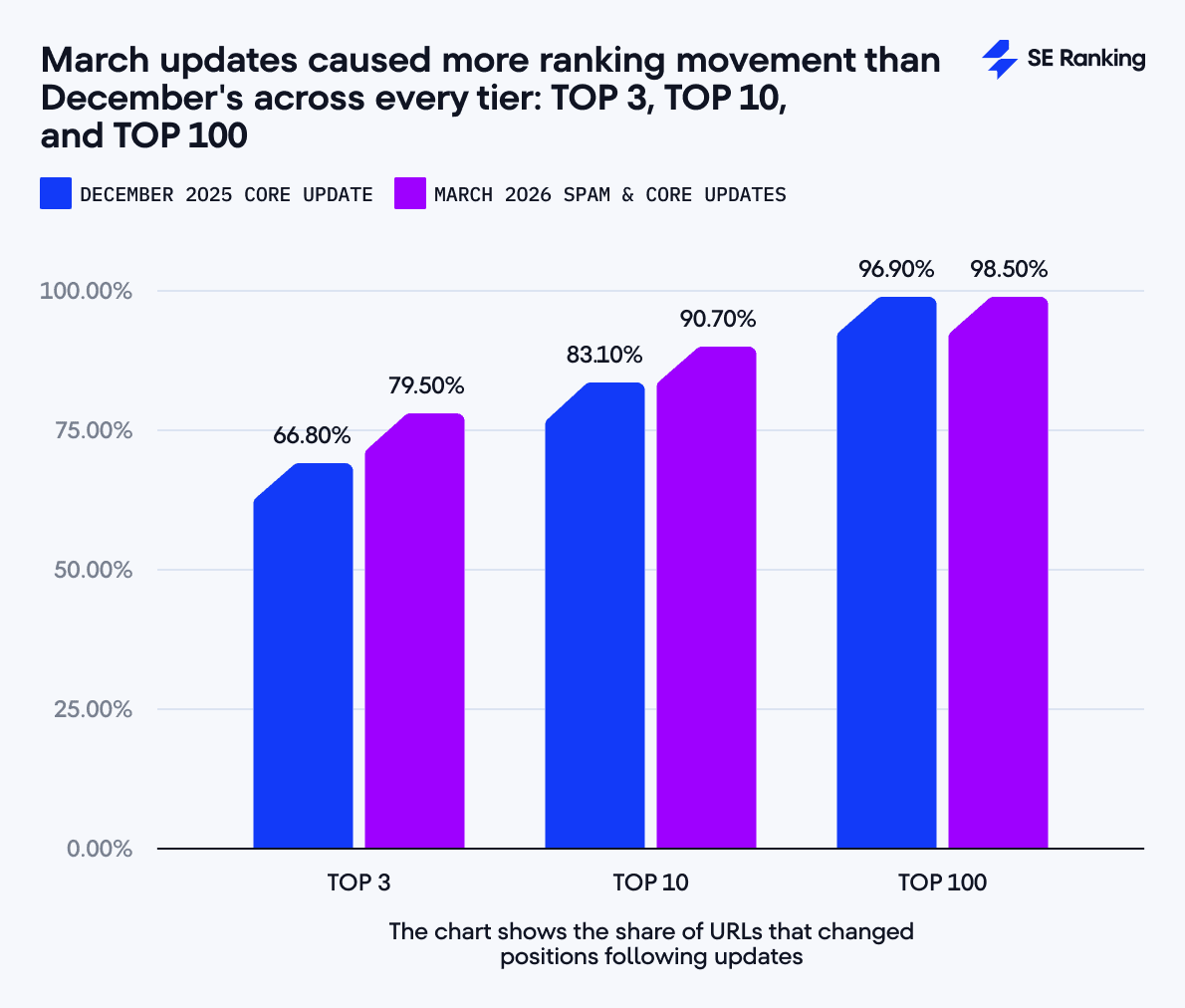
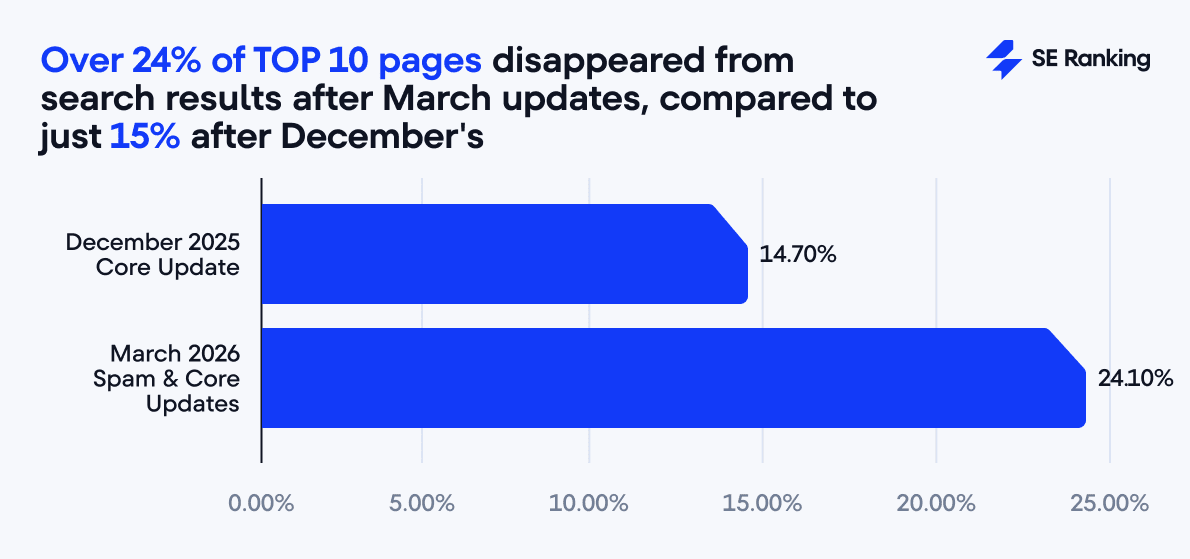
The March 2026 Google Core Update finished rolling out on April 8, 2026 — and the damage report is not subtle. SE Ranking analyzed 100,000 keywords and found that 79.5% of top-3 positions changed hands during the 12-day rollout, compared with 66.8% after the December 2025 update. 1 A full 24.1% of pages that held top-10 spots before March 27 fell entirely out of the top 100 by the time the dust settled — nearly double the 14.7% drop rate from December. 1 Semrush Sensor hit a peak of 9.5/10 — practitioners on Search Engine Roundtable dubbed it a "Googlequake." 2
Google issued no companion blog post and no new recovery guidance. Its only public statement, posted on the Search Status Dashboard and on X, described the event as "a regular update designed to better surface relevant, satisfying content for searchers from all types of sites." 3
So what do you actually do?
The single most-agreed-upon answer in the SEO practitioner community — backed by six or more independent forum and analyst sources with zero dissent — is this: run a surgical content audit and prune your weakest pages.
Why this update hit thin pages so hard
This update introduced stricter page-level authority evaluation. Before, a strong domain could carry weak individual pages. Under the new scoring, a page that wouldn't rank on its own merits gets evaluated independently — it no longer benefits from a neighbor's authority. 4
Lily Ray at Amsive called the pattern a "First-Party Source Correction": Google rerouted visibility from sites that aggregate or repackage other people's content toward sites that are the original source — brand-owned pages, government domains, specialist publishers. 5 Aggregators and user-generated-content platforms took the heaviest losses; first-party sites with genuine expertise gained.
The forum evidence is blunt. One developer on r/TechSEO reported that over 1,800 posts on their site were deindexed overnight. Community members — including a top-upvoted reply from
kkatdare — traced it directly to AI-generated filler content published at scale with no human editorial oversight. 6 Another practitioner, yamibae, described the same scenario — "massive de-index of all the pages" — and said they were testing "a hail mary of removing a big chunk of the site and rewriting what is leftover." 6The common thread: content on topics outside the site's core expertise, or content thin enough that it couldn't stand alone.
Google's own self-assessment documentation reinforces this. Its "Creating Helpful, Reliable, People-First Content" page lists "Does the content provide original information, reporting, research, or analysis?" as the very first quality question. 7
The fix: the KUMD framework, step by step
The procedure below is synthesized from practitioner advice on r/TechSEO and analyses published by ClickRank and BuildMVPFast. You can complete steps 1–3 this week using only Google Search Console (free).
Step 1 — Wait for stabilization. The rollout completed April 8. Do not analyze or make changes during an active rollout. Give it at least one full week after completion before comparing data. 4
Step 2 — Pull your GSC data. Open Google Search Console → Performance → Search Results. Set the date range to compare March 27 onward against the same-length window before March 27. Export to a spreadsheet. Sort by largest drop in clicks. These are your candidates. 8
Step 3 — Find your off-topic pages. In GSC, open the Page Indexing report. Filter for pages with zero clicks over the past 90 days. Flag any page on a topic outside your site's core subject area — if you run a SaaS developer blog and there's a post called "Best kitchen appliances under $100," that page is your biggest liability under the new page-level evaluation. 4
Step 4 — Apply the KUMD decision to each flagged page.
| Action | When to use it |
|---|---|
| Keep | Page is still driving clicks and reflects your core expertise — leave it alone |
| Update | Topic is relevant but content is outdated or thin — add original data, fresh examples, or first-person findings |
| Merge | Two or more thin pages cover the same topic — combine into one comprehensive page and 301-redirect the others |
| Delete/Noindex | Zero traffic, zero backlinks, off-topic, or irrelevant — either 301-redirect to the nearest relevant page or add a noindex meta tag |
Jennifer Pelegrin at ClickRank put the principle plainly: "Any page that would not rank on its own merit should be either substantially improved, consolidated with a stronger page via 301 redirect, or noindexed." 4
Step 5 — Prioritize off-topic content. Pages on topics outside your established expertise are the highest-priority deletions. Do not mass-delete indiscriminately — evaluate each page individually. Mass deletion wastes crawl budget and signals instability. 8
Step 6 — Resubmit. After changes are live, go to GSC → URL Inspection and request indexing for every updated or consolidated page. Resubmit your sitemap once pruning is complete.
Step 7 — Log everything. Keep a change log (date, URL, action taken). You'll need this to correlate specific pruning decisions with ranking movements over the following weeks.
What to expect — and what not to
Set realistic expectations before you start. Content quality improvements are not recognized in real time. Google typically re-evaluates at the next broad core update, which most practitioners expect around June or July 2026. Technical fixes (like correcting broken redirects or fixing crawl errors) can produce signals within 4–8 weeks, but if content is the underlying issue, four to six months is the realistic recovery window. 4
Sites taking a systematic, content-focused recovery approach recovered an average of 60% of lost visibility within four to six months, compared with under 20% for sites making scattered, reactive changes. 9
Two things this tip will not fix on its own:
- Core Web Vitals failures. Pruning won't help if your remaining pages fail the 200ms INP (Interaction to Next Paint) threshold — 43% of monitored sites still do. That's a separate fix. 8
- Spam-update damage. SE Ranking found that 82% of domains knocked out by the preceding March 2026 Spam Update (March 24–25) did not recover even after the Core Update completed. 1 If your site took hits from the spam update, the content audit is still the right starting point — but the recovery arc may be longer.
The single actionable step you can take today: open GSC, pull 90 days of page-level click data, identify the pages with zero clicks that sit outside your core topic area, and start making KUMD calls on them. That's it. One spreadsheet, one decision per row.
참고 출처
- 1March 2026 Core Update Caused More Volatility Than December's
- 2Google March 2026 Core Update Rolling Out
- 3Google March 2026 core update rolling out now
- 4Google March 2026 Core Update: What Changed & What To Do
- 5Google March 2026 Core Update: Winners, Losers & Analysis
- 61800+ Posts completely deindexed overnight. Lost, Need Help.
- 7Creating Helpful, Reliable, People-First Content
- 8Google March 2026 Core Update: Recovery Guide
- 9Google Core Updates 2026: The Complete Recovery Guide for Marketers
이 콘텐츠를 둘러싼 관점이나 맥락을 계속 보강해 보세요.