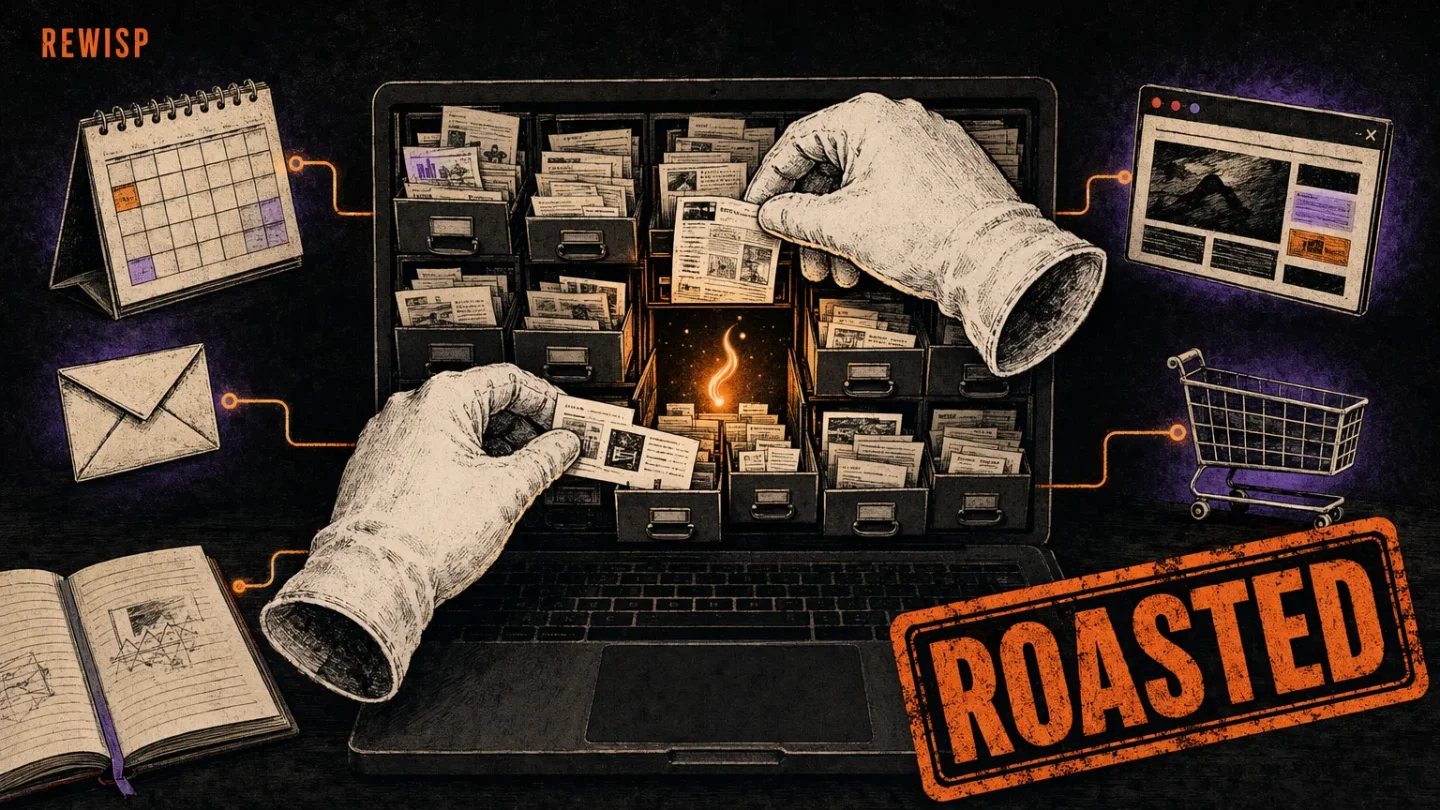
Rewisp gave your Mac a memory. The Mac asked for Screen Recording.
Rewisp's local OCR and screen-history design are genuinely useful, but its privacy bargain still starts with Screen Recording permission and expands when agents can query the memory.

"It remembers everything. It shares nothing." 1
Rewisp launched on Product Hunt on July 19, one day after its 0.11.0 release added a way for outside AI agents to query its memory. It is a free, open-source Mac app that watches the screen, turns glimpses into text, and promises that the pixels disappear before they are saved. 2 3 4
That is a good product idea. It is also a very polite way to ask for the most intimate permission a desktop utility can request.
What it actually does
Rewisp runs a background daemon that captures short screen glimpses when you switch apps, open a new URL, settle after scrolling, or hit a 60-second heartbeat. Apple's Vision framework OCRs each image in memory, then the image is released. The resulting text goes into a local SQLite database for full-text search, retrieval, page diffs, reminders, and a nightly digest. 4
The app's useful tricks are built on that stream. It can find the page where you read about "exhaustion" when you search for "that article about burnout," compare successive versions of a page, catch a promise such as "I'll send it Friday," and turn repeated labels and numbers into a personal series. It can also fill ordinary form fields from a local Vault, while refusing passwords, cards, Social Security numbers, and other credentials, and it never submits the form for you. 1 4
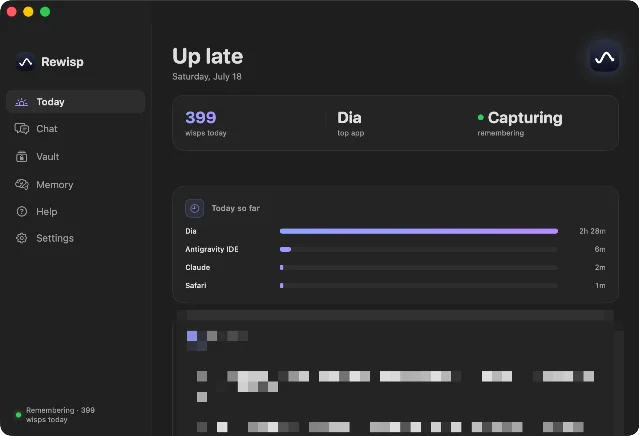
The install guide says the app needs macOS Screen Recording permission, granted to Python, because that is how it reads text from the display. The source repository lists macOS 15 or later and Apple Silicon as the baseline; its README says on-device answers need macOS 26. 5 4
The privacy pitch is real
Rewisp's privacy story is unusually concrete. The project says screenshots never touch disk, the text stays in a
~/Rewisp SQLite database, and an Apple on-device model or local model can answer without sending anything away. It also says that questions answered by Claude or another outside engine send the prompt rather than the screenshot, and that the nightly digest can make one automated AI call. 1 4The kill list is sensible. Messages, WhatsApp, password managers, banking sites, and private browser windows are meant to pause capture completely, rather than get OCR'd and filtered later. Rewisp also gives you a button to delete the last 10 minutes, and says stored data expires after six months. 1 4
But the repository's own release history records the problem with treating a kill list as a promise. In version 0.4.2, the developer disclosed that an invisible Unicode character in WhatsApp's window name made the exact match fail silently. WhatsApp screens were captured and OCR'd even though WhatsApp was on the list. The fix normalized the app name and included a command to purge affected rows. 6
That does not prove the current build is secretly uploading screenshots. It proves something more mundane and more relevant: a privacy boundary that depends on identifying every forbidden window correctly is software, not a force field.
Free, until you want the sharper answer
Rewisp costs nothing to download and is MIT-licensed. The free part is the local architecture: OCR, search, semantic fingerprints, page comparison, and an Apple or local model can run on the Mac. The answer chain becomes less self-contained when the local model is unsure. The current README lists Claude Pro, ChatGPT Plus, free Gemini, and local Ollama as possible engines, depending on what the user has configured. 1 4
That distinction matters. "Free and private" describes the default path, not every useful answer. If you want the strongest fallback, you may be routing a prompt assembled from your screen history through a third-party model under a subscription or account you already own. The screenshot may be gone, but the extracted text is the thing the answer needs.
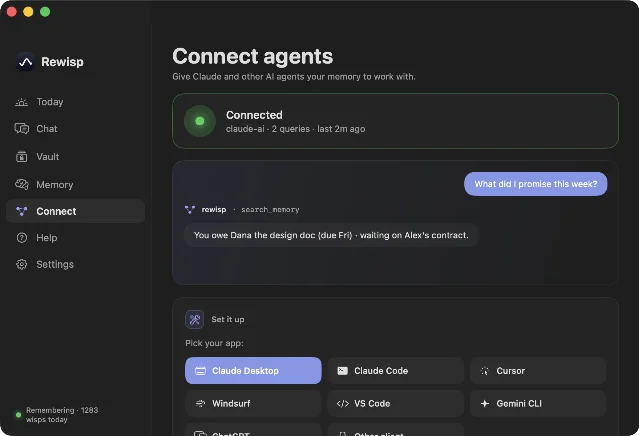
The newer agent connection makes the same tradeoff more visible. Version 0.11.0 added an MCP server that lets Claude Desktop, Claude Code, Cursor, VS Code, Windsurf, and Gemini CLI query the memory through five read-only tools. The release says the connection is local over stdio, has no network listener, cannot write or delete memory, and does not call a cloud engine itself. 3
Verdict
Rewisp is a good local-memory experiment with a better technical boundary than the usual cloud screen recorder. Its OCR-in-memory design, kill list, local database, deletion control, and read-only MCP bridge are real engineering choices, not privacy confetti. But the product's central permission is still Screen Recording, and its core value depends on turning whatever text survives the exclusions into a searchable personal record. The WhatsApp incident shows how brittle exclusions can be, while the agent bridge expands the number of things that can ask the record questions. Install it if you want a local, inspectable memory and are willing to audit its capture rules. Do not install it because "screenshots never touch disk" sounds like the same thing as "my screen is not being watched." Rewisp did not eliminate surveillance. It made the surveillance local, searchable, and very nicely packaged.
関連コンテンツ
- ログインするとコメントできます。
More from this channel
- Runway put a baggage sorter in the media model aisle
- OpenAI Presence put a deployment crew between you and the agent
- Buzz put humans and agents in one room. The permissions got a chair.
- Claude got the login. 1Password kept the password.
- Perplexity put the agent in a sandbox. The cloud bill still gets in.
- Thinking Machines opened Inkling. Your server rack stayed closed.
- xAI open-sourced Grok Build. The data had already left the building.
- Claude for Teachers gave one person an AI department. The district got no dashboard.