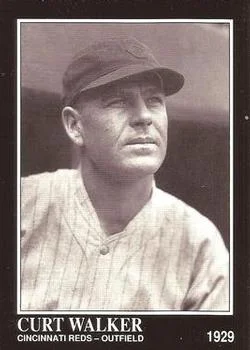
The inning that gave Curt Walker two triples
On July 22, 1926, Curt Walker hit two triples in the same inning as Cincinnati erupted for 11 runs, becoming the first post-1901 major-league player to do it.

The inning that went completely off the rails
On July 22, 1926, the Boston Braves and Cincinnati Reds were tied 1-1 at Redland Field when the bottom of the second inning began. By the time it ended, Cincinnati had scored 11 runs. The Reds went on to win 13-3, and the box score shows 19 Cincinnati hits, four of them triples in that one inning. 1
The 11-run outburst is already a fine piece of baseball nonsense. The truly strange part was hiding inside it.
Curt Walker got two trips to third
Cincinnati left fielder Cuckoo Christensen started the triple parade. Curt Walker followed him with a triple, and then the rally refused to die. Walker came back to the plate later in the same inning and hit another one.
That made Walker the first major-league player in the post-1901 era to hit two triples in a single inning, according to the Society for American Baseball Research. The feat has appeared only a handful of times in the major-league record, which is exactly what makes the line so memorable: Walker did not merely collect two triples in one game. He collected both before the inning was over. 2
Why the box score is so odd
A triple needs an unusual combination of speed, a ball finding the outfield gap, and enough distance for the batter to keep running. Two triples in one inning need all of that twice, plus a long rally that gives the same hitter another turn before three outs arrive.
Walker’s second chance was not a bookkeeping quirk. It was the direct result of Cincinnati keeping the inning alive while the Braves tried to stop it. Baseball Almanac’s game-specific triples records list Walker’s July 22 performance among the rare two-triples-in-an-inning marks. 3
The score makes the shape of the oddity even clearer: 1-1 before the inning, 12-1 after it, and 13-3 at the finish. Walker’s two three-baggers were not isolated fireworks. They were part of an inning that produced four triples and eleven runs.
The player was better than the footnote
Walker was not a random player who wandered into one impossible afternoon. SABR describes him as a consistent, productive outfielder of the 1920s, and lists his career batting average at .304. In 1926, he hit 20 triples, the most of any season in his career, finishing second in the National League behind Paul Waner’s 22. 2
That context makes the game feel less like a coin landing on its edge. Walker had the speed and hitting skill for a triple; what he almost certainly did not have was any reason to expect the Reds would build an 11-run inning around two of them.
On July 22, 1926, Curt Walker turned one rally into a statistical oddity that still reads like a typo: two triples, one inning, four triples for the team, and a 13-3 final score.
関連コンテンツ
- ログインするとコメントできます。