2026/6/29 · 8:17
Your earbuds are not harmless. Here's the hearing plan before the next concert.
A practical guide to protecting your hearing from earbuds, clubs, concerts, fireworks, and loud everyday noise without giving up music or nights out.
You can do everything right at a concert and still walk out with your ears feeling like they got stuffed with cotton. That muffled, buzzy after-show feeling is not just annoying. It is your ears saying they got overloaded.
The sneaky part: hearing damage does not always feel dramatic. Noise-induced hearing loss can happen right away after one huge sound, or build slowly after repeated loud exposure. NIDCD says the damage can be temporary or permanent, and human inner-ear hair cells do not grow back once they are gone. 1
This does not mean you need to become the person who hates fun. It means your earbuds, clubs, concerts, sports games, power tools, and fireworks all need the same basic rule: loud plus long equals risk.
The volume number is less useful than the dose
Sound is like sun exposure in one way: the dose matters. A few minutes at one level can be fine, while hours at a higher level can be a bad idea.
NIDCD says sounds at or below 70 dBA are generally safe, but long or repeated exposure at or above 85 dBA can cause hearing loss. The same page lists music through headphones at maximum volume, sporting events, and concerts around 94 to 110 dBA, and fireworks displays around 140 to 160 dBA. 1
WHO gives the cleaner everyday translation: you can safely listen around 80 dB for up to 40 hours a week, but at 90 dB that drops to four hours a week. 2 That is why one loud week can catch up with you: subway commute on earbuds, gym playlist, gaming headset, then a show on Saturday.
Your quick reality check:
- If someone an arm's length away has to shout for you to understand them, the place is probably too loud for casual unprotected hanging out. WHO uses that as a no-app warning sign. 2
- If your ears ring, buzz, or feel muffled after leaving, treat that as a warning, not a cute proof that the night was good.
- If you keep turning your volume up because the train, gym, or street is loud, the problem may be the environment, not your playlist.
Your earbud plan: make quiet easier
The worst headphone habit is not having bad taste. It is using volume to fight background noise.
WHO's safe-listening advice is simple: keep your device volume below 60% of maximum, use well-fitted noise-canceling headphones so you do not need to crank the sound in noisy places, and take breaks from loud listening. 2
A realistic setup:
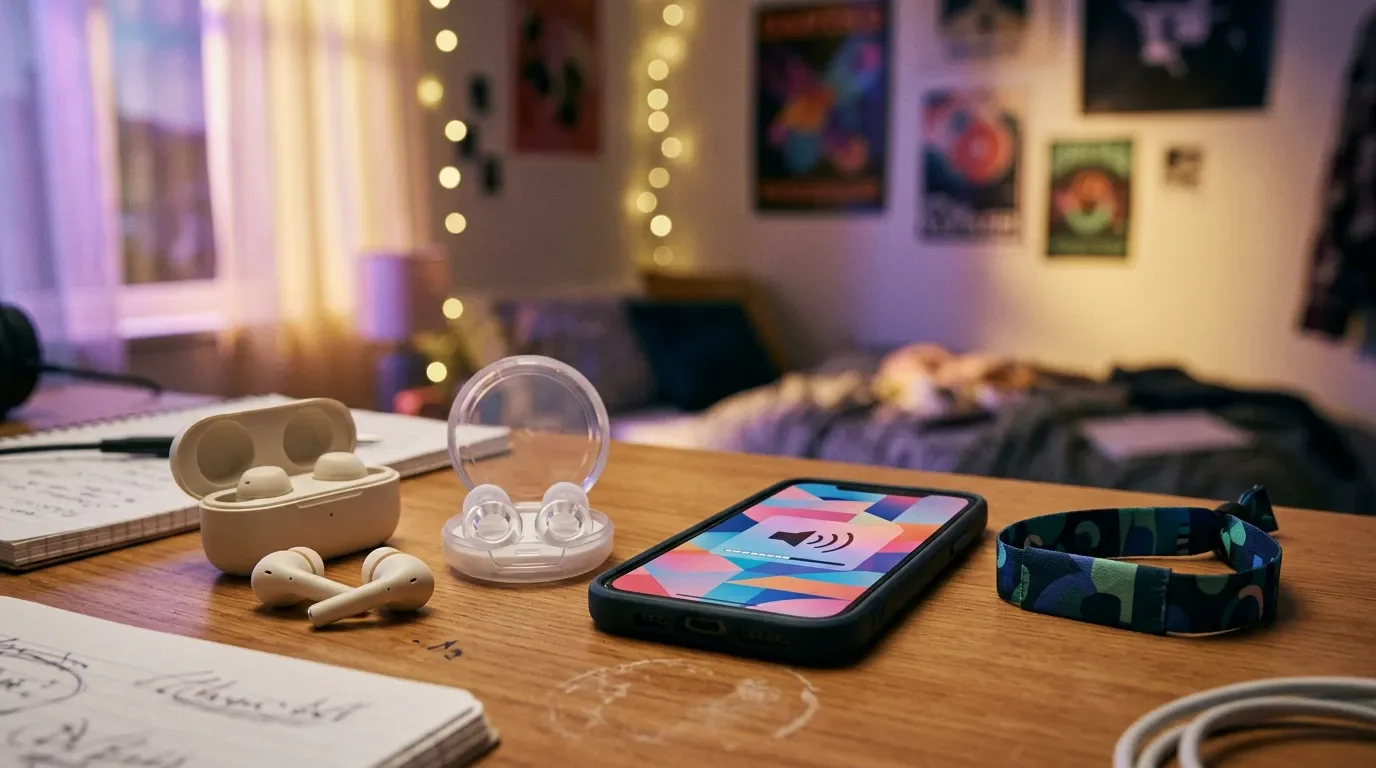
- Turn on headphone safety alerts. Most phones can track loud listening and warn you. Do not treat the alert like a pop-up ad.
- Use noise canceling or better-sealing headphones on transit. The goal is not silence. The goal is not needing max volume over engine noise.
- Give your ears quiet breaks. If you have headphones on for classes, work, gaming, and scrolling, build in no-audio gaps. Your ears do not know the difference between "productive" sound and "fun" sound.
- Do not sleep with audio blasting in your ears. If you need sound to fall asleep, use a speaker, sleep timer, or very low volume.
If 60% still sounds too quiet in a loud place, that is a sign to change the setup, not to keep pushing the slider.
Your concert, club, and fireworks plan
Earplugs are not an overreaction. They are the hearing version of sunscreen.
NIDCD recommends hearing protectors for concerts, sporting events, fireworks displays, band rehearsals, shooting sports, and other loud settings. It also says high-fidelity earplugs can lower sound intensity more evenly across pitches, which is why they are useful when you still want music to sound like music. 3
For a loud night out:
- Bring earplugs before you need them. Foam ones are cheap. Reusable clear concert plugs are small enough to live in a bag or keychain case.
- Do not stand right by the speakers. WHO specifically recommends staying away from loudspeakers and amplifiers because sound intensity drops as you move away. 2
- Take quiet breaks. WHO suggests resting your ears in a quiet space for 10 minutes after every hour in clubs, loud games, or concerts. 2
- Be extra serious with fireworks. NIDCD's average range for fireworks displays is far above ordinary loud music levels. Distance matters a lot here. 1
If you hate the feeling of foam plugs, try reusable high-fidelity ones. The best earplug is the one you will actually wear.
The after-loud-event checklist
After a loud night, your ears may feel muffled or ring for a while. NIDCD notes that temporary hearing loss after loud noise can disappear 16 to 48 hours later, but it also says newer research suggests there may still be residual long-term damage even when hearing seems to recover. 1
So the move is not panic. It is recovery and pattern recognition.
Do this:
- Give your ears a quiet day. Skip the max-volume gym playlist and loud bars the next night.
- Notice whether speech sounds weird. Trouble following conversations in noisy places is one of the warning signs WHO lists for possible hearing loss. 2
- Do not dig around in your ears. Ringing after noise is not earwax you need to attack with cotton swabs.
- Upgrade your plan before the next event. If your ears rang after the last show, bring earplugs and stand farther back next time.
When it is not a wait-it-out situation
Most post-concert ringing improves, but a few signs deserve real attention.
Get your hearing checked if you have persistent ringing, trouble hearing high-pitched sounds, trouble understanding speech over the phone, or trouble following conversations in noisy places. WHO says those are warning signs of hearing loss. 2
Treat sudden hearing loss as urgent, especially if it affects one ear, comes with ear fullness, dizziness, or ringing, or seems to appear all at once or over a few days. NIDCD says sudden deafness symptoms should be considered a medical emergency and that delaying diagnosis and treatment can reduce the chance of recovery. 4
That is the line: mild ringing after a loud show can be a warning to protect your ears better. Sudden hearing loss is not a "sleep it off" problem.
The simple rule to keep
You do not need to measure every sound in your life. Use this instead:
If it is loud enough that you have to shout, it is loud enough to plan for.
For headphones, lower the volume and make quiet easier with better fit or noise canceling. For concerts and clubs, bring earplugs and step away from speakers. For fireworks and other sudden loud sounds, add distance and protection.
Your future self still wants to hear the music clearly. Do them a favor now.
このコンテンツについて、さらに観点や背景を補足しましょう。