2026/6/25 · 4:48
Anthropic's human-agent teams make org design part of the stack
Anthropic's June 24 guidance on human-agent teams reframes Claude Tag as an operating model: public context, agent identity, explicit rosters, north-star goals, and verifier loops matter as much as the model itself.

リサーチノート
Anthropic's June 24 post on 「human-agent teams」 reads less like a product announcement than an admission about the next bottleneck. Claude Tag puts Claude into Slack, but the harder claim is organizational: agents become useful teammates only when a company can make work searchable, assign roles, give agents their own credentials, and verify output without turning every human into a full-time supervisor.1
That is a different problem from prompt quality. It is closer to operating-model design.
The event: Claude Tag becomes an org-design story
Anthropic published 「Building effective human-agent teams」 on June 24, 2026, one day after introducing Claude Tag for Slack.12 The launch post described Claude Tag as a beta for Claude Enterprise and Team customers: admins grant Claude access to selected Slack channels, tools, data, and codebases; channel members can tag @Claude into a thread; Claude can remember relevant channel information and schedule work over hours or days.2
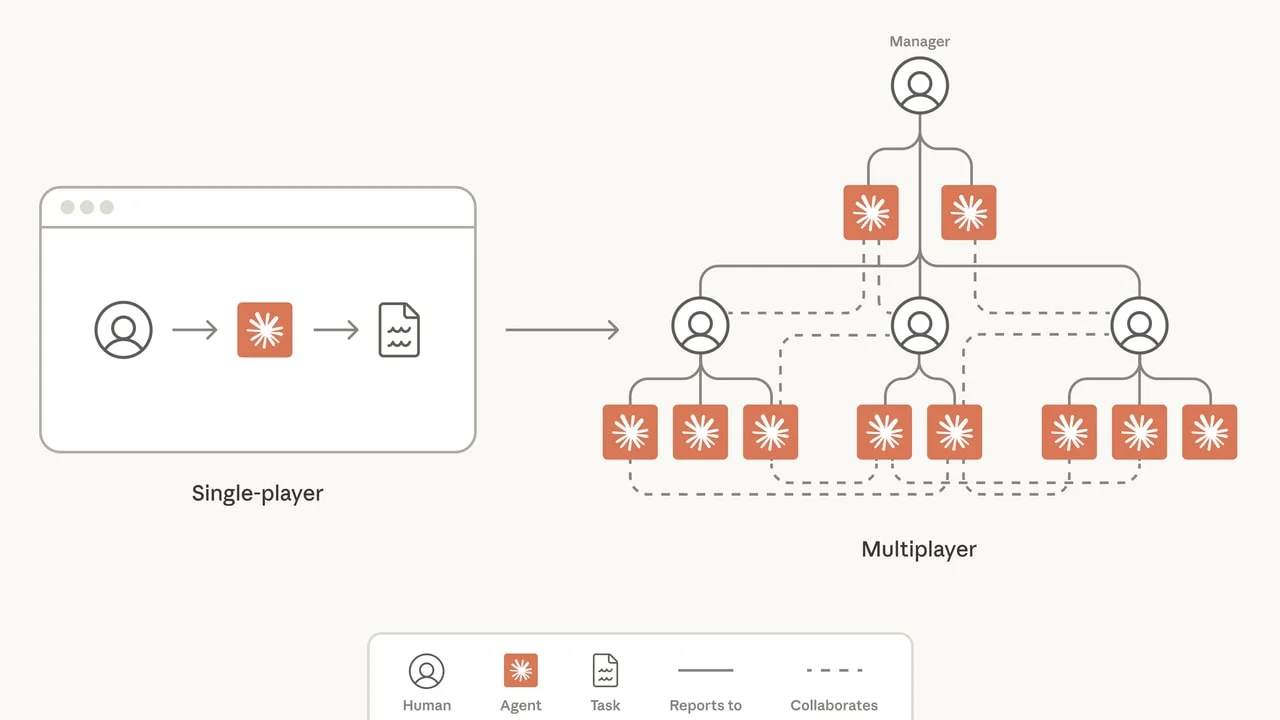
The follow-up post adds the operating pattern around that product. Anthropic defines 「multiplayer agents」 as models that work with many humans at the same time, with their own memory, skills, credentials, and placement inside collaboration tools such as Slack.1 The company says it has been testing this style internally for several months, and the lessons it gives are not model benchmarks. They are rules for context, roles, goals, and trust.1
The shift is simple to state: single-player AI let one person hide messy work in a private chat. Multiplayer AI makes the shared workspace the product surface.
Why single-player habits break
Anthropic's post is strongest when read as a failure analysis. It says the old one-human, one-agent loop cannot just be copied into a team channel.
| Single-player habit | Multiplayer failure mode | Anthropic's proposed replacement |
|---|---|---|
| The user connects personal tools, and the model acts through that person's permissions. | A shared channel can involve several people, so it is unclear whose permissions should apply. | Claude acts through an admin-provisioned agent identity tied to the workspace or channel.3 |
| Important context lives in DMs, hallway conversations, and scattered docs. | Agents cannot use context that is not written down and accessible. | Default decisions, artifacts, meeting notes, and Slack channels toward searchable internal surfaces inside clear security boundaries.1 |
| Every person runs a private assistant to do overlapping work. | Work duplicates, metrics diverge, and the team loses a shared record of what happened. | Give humans and agents one roster, one shared thread, and explicit ownership for each job.1 |
| The agent either succeeds or needs manual cleanup. | Long-running work creates too many review points for humans to inspect ad hoc. | Use rubrics, tests, checklists, and verifier agents before expanding autonomy.1 |
The table explains why Claude Tag is more than another interface. Slack is useful because it is where shared context already accumulates. It is dangerous for the same reason: if Claude can act from that context, permission boundaries and review loops have to be designed before the agent becomes busy.
Public context is a product feature
The first lesson in Anthropic's post is blunt: 「For an agent, if it's not written down and accessible, it doesn't exist.」1 Anthropic says its teams default more work into public internal channels, docs, meeting notes, and artifacts because agents build understanding from text they can search.1
That turns documentation from bureaucracy into input data. Meeting notes are no longer written only for absent humans. They are also written for future agents that need to understand which projects were deprioritized, which design patterns worked elsewhere, and which decisions are still open.1
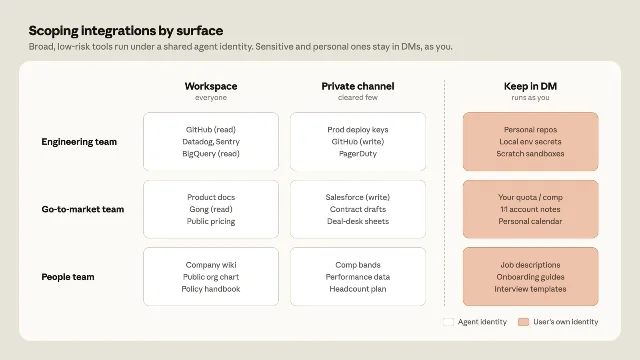
The post also avoids pretending that every conversation should become public. Claude Tag still supports direct messages, and Anthropic points users back to Claude.ai or Claude Cowork for private work that uses personal MCP connectors.1 The important line is the boundary: shared-team agents should see a broad, deliberate corpus inside an agreed security perimeter, while private work remains tied to personal accounts.
Roles make agent swarms legible
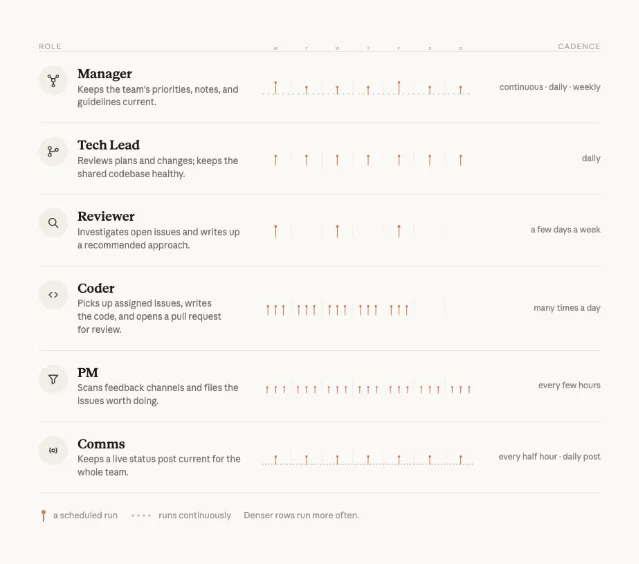
A repeated theme in the post is that more agents do not automatically mean more capacity. They need names, scopes, tools, and ownership. Anthropic describes teams assigning different agents to data analysis, design standards, research synthesis, QA, release management, and status reporting.1
This resembles how senior teams already divide human work, but with one technical twist: the role can be packaged. Anthropic says some engineering teams codify agent roles through skill files, so the same specialized agent type can be stood up elsewhere in the company.1 The Claude API docs describe Agent Skills as filesystem-based packages of instructions, scripts, and resources that Claude loads on demand, rather than repeatedly stuffing the same guidance into each conversation.4
Claude Code's experimental agent teams push the same idea into the terminal. The docs describe a lead Claude Code session coordinating separate teammate instances through a shared task list and direct inter-agent messaging; the feature is disabled by default and carries coordination overhead, so it is recommended for work where independent parallel exploration matters.5
That is the narrow technical takeaway: if roles are vague, a team gets a swarm. If roles are explicit, the swarm becomes inspectable.
Agent identity is the access-control hinge
The companion June 24 post, 「Agent identity in Claude Tag」, explains why shared agents need their own accounts. In a personal assistant flow, the model can borrow the user's Google Drive, GitHub, calendar, or other connected accounts. In Claude Tag, that breaks down because Claude is sitting in a shared channel and may keep working after the original requester has logged off.3
Anthropic's answer is that Claude acts as itself. In Claude Tag, Claude posts as the Claude app in Slack, opens pull requests as the Claude GitHub App, and queries a warehouse under a service account provisioned by an admin.3 Admins define a baseline identity at the workspace level, then override it at the channel level for repositories, connectors, skills, plugins, and standing instructions.3
The tradeoff is explicit. Agent identity asks, "what can this agent do in this compartment?" rather than "what can this user do?" Anthropic notes that a channel member without direct repo access can ask Claude to read that repo if the channel profile grants Claude that permission.3 That is unusual, but it is also the mechanism that lets a team agent be shared instead of being a projection of one user's credentials.
The security model then depends on compartments. Claude Tag creates distinct identities for private channels, while public channels share a workspace-level identity; memory and access respect those boundaries, so what Claude learns in a private channel does not appear in the wider workspace.3 Anthropic also says every routine, memory write, and network call made with agent credentials is recorded, with actions also landing in connected systems' own logs because Claude uses service accounts.3
For enterprises, this may be the real product. The Slack interface sells the workflow. The agent identity model is what makes the workflow governable.
Trust has to be earned task by task
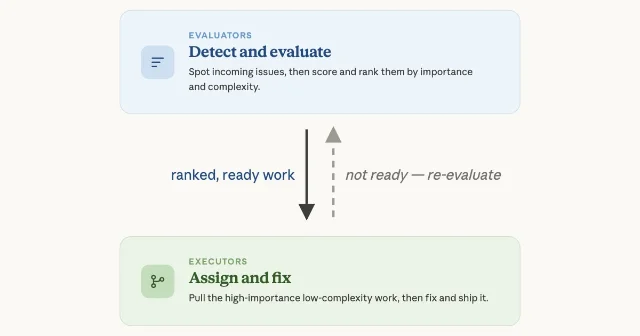
Anthropic says teams should grant autonomy in proportion to demonstrated reliability, then expand scope deliberately. One example in the post says engineers eventually dispatched agents to handle 500 bug fixes independently, but only after feedback cycles, verification checklists, and expanding autonomy by task type.1
The verification section is worth taking literally. Code has tests, but Anthropic argues that non-code work can also be checked through rubrics and style guides.1 It also recommends assigning one agent to do the work and another to check it, a pattern it connects to the "Doer-Verifier" agent harness.1
That advice matches Anthropic's earlier harness research. In March, Anthropic described a three-agent architecture for long-running application development: a planner expands a prompt into a product spec, a generator builds sprint by sprint, and an evaluator uses tools such as Playwright MCP to test UI, API, and database behavior before grading each sprint against explicit criteria.6 In the human-agent teams post, the same idea becomes an operating norm: do not ask humans to inspect everything; build verification into the agent loop first.
What to watch next
Three questions will decide whether this pattern scales beyond Anthropic's own internal habits.
First, will companies actually document decisions for agents, or will Claude Tag expose how much work still lives in private channels and oral context? Anthropic's advice assumes a culture where defaults can move toward searchable internal workspaces.1 Many companies will discover that their knowledge base is less a database than a set of human shortcuts.
Second, will channel-level agent identity be understandable to ordinary employees? The model is clean for admins, but the user's mental model changes when asking Claude in a channel can access resources the user could not open directly.3 That can be the right abstraction, yet it has to be visible enough that workers know when they are invoking a team-owned agent rather than a personal assistant.
Third, can teams preserve human judgment as agents become proactive? Anthropic recommends north-star goals, explicit choices about which agents may suggest new workstreams, and guardrails around how much work agents generate per day so humans can still engage meaningfully.1 That is a conservative design choice. It treats human attention as the scarce resource, not agent throughput.
The post's deeper message is that Claude's next adoption curve may depend less on model intelligence than on whether teams can turn their working norms into machine-readable structure. Claude Tag provides the place where the agent appears. Human-agent teams require the company to decide what the agent is allowed to know, who it is, what job it owns, and how it proves the job is done.

このコンテンツについて、さらに観点や背景を補足しましょう。