
2026/7/3 · 8:23
Hantavirus Global Situational Briefing — July 3, 2026
July 3, 2026 daily hantavirus briefing: WHO now describes the M/V Hondius Andes virus outbreak as contained after all contacts completed follow-up, while Argentina remains above expected surveillance levels and Nepal becomes a new watch item after a reported first hantavirus-related death.

The M/V Hondius Andes virus event has crossed the line from active international outbreak monitoring into documented containment. WHO's 2 July Disease Outbreak News keeps the event total at 13 cases and three deaths, but changes the operating status: all identified contacts have completed the 42-day follow-up period, no additional secondary cases were detected, and WHO says the outbreak no longer poses a public health risk and no further related transmission is expected.1
Other signals still need attention. Nepal has a new public-warning signal after its first reported hantavirus-related death, while Argentina's domestic surveillance remains above expected levels. The ship outbreak is now an after-action and science story; the field risk watch shifts back to endemic rodent-borne transmission.
Signal table as of 3 July 2026, 08:00 UTC+8
| Signal | Latest verified status | Operational read | Source |
|---|---|---|---|
| M/V Hondius Andes virus outbreak | 13 linked cases: 12 laboratory-confirmed and one probable; three deaths; eight discharged among the ten hospitalized cases; two still receiving medical treatment. | Contained, but not fully closed scientifically: source investigation and sequencing remain pending. | WHO DON, 2 July |
| International contact follow-up | WHO reports 317 high-risk contacts completed quarantine and monitoring, and 336 low-risk contacts completed self-monitoring. | The main transmission-control milestone has been met; no off-ship secondary chain was detected. | WHO DON, 2 July |
| EU/EEA risk language | ECDC's public page still lists 12 confirmed, one probable, zero suspected, three deaths and says EU/EEA general-population risk is very low; the European Commission page also describes general-population risk in Europe as very low. | Europe remains in response documentation and preparedness mode rather than escalation mode. | ECDC outbreak page; European Commission page |
| United States and Canada | CDC says no U.S. hantavirus disease occurred from the outbreak after U.S. monitoring ended; PHAC says Canada's linked case recovered and Canadian contacts completed isolation/monitoring by 26 June. | North American ship-linked follow-up is effectively closed, with no public sign of onward spread. | CDC current situation; PHAC health-professionals page |
| Argentina domestic surveillance | BEN 814 lists 50 accumulated 2026 hantavirosis events through epidemiological week 24 versus a 2022-2025 median of 29, above expected year-to-date and in the latest four-week window. | Argentina remains the main active official surveillance signal outside the ship event. | Argentina BEN 814 PDF |
| Nepal alert | Nepalese media, citing the Ministry of Health and Population, reported a public alert after the country's first reported hantavirus-related death. | Treat as a new watch item until an official case note gives location, exposure setting, diagnostic basis and strain information. | myRepublica, 2 July |
The ship event: contained, with two scientific loose ends
WHO's new posting makes three changes that matter for risk assessment. First, a previously probable Tristan da Cunha case has now been laboratory-confirmed after delayed sample shipment and testing in the United Kingdom. Second, all 13 cases remain among people who travelled on board the M/V Hondius. Third, completion of contact follow-up without additional secondary cases is now the basis for WHO's containment conclusion.1
That does not mean all investigation questions are settled. WHO says the currently available information suggests initial infections were probably acquired on land before embarkation, but the exact source and route of exposure remain undetermined. It also says investigations continue, including genomic sequencing of Andes virus samples from surveillance cases in Chile and Argentina.1
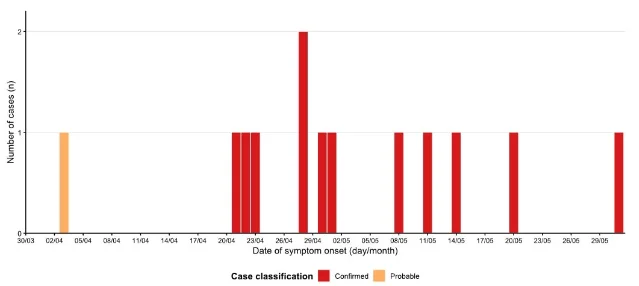
For daily monitoring, the interpretation is narrow: the Hondius event should no longer be treated as an expanding multinational outbreak unless a later official source changes the case count, reports a new transmission chain, or revises the source investigation. The more relevant follow-up now is scientific: final patient outcomes, environmental findings, genomic relationships to South American surveillance strains, and the operational lessons from quarantine, repatriation and cross-border tracing.
Contacts: the public-health control test was passed
WHO's contact figures are now more precise than earlier briefings: 317 high-risk contacts completed quarantine and monitoring, and 336 low-risk contacts completed self-monitoring under updated guidance.1 The key point is the control outcome: no additional secondary cases were detected after that follow-up window.
National pages point in the same direction. CDC's current situation page says all potentially exposed U.S. citizens aboard the M/V Hondius finished their 42-day monitoring period on 21 June, and no U.S. hantavirus disease occurred from the outbreak.2 In a 24 June response transcript, CDC also said its scientists had returned from Argentina after working with Argentine partners on rodent trapping and testing connected to the source investigation; preliminary information from the rodents they identified was negative.3
Canada's health-professionals page says PHAC concluded its response, that Canada's one laboratory-confirmed Andes hantavirus case linked to the ship recovered, and that all Canadian contacts who may have been exposed completed self-isolation and monitoring by 26 June.4
Argentina: separate domestic activity remains above expected levels
Argentina's domestic signal should be kept separate from the ship-linked cluster. BEN 814, covering epidemiological week 24, lists hantavirosis at 50 accumulated events in 2026 against a 2022-2025 median of 29. The bulletin classifies the event as above expected so far this year and above expected in the latest four-week window.5
The more detailed BEN 812 seasonal chapter gives the context. For the 2025-2026 season through epidemiological week 22, Argentina reported 108 confirmed hantavirosis cases, a national incidence of 0.23 per 100,000 inhabitants, and 36 deaths, giving a reported lethality of 33.3%.6 The same chapter says the season sat above the outbreak threshold for most of the period analyzed, excluding the exceptional 2018-2019 Epuyén outbreak from the comparison band.6
The provincial distribution still explains why Argentina stays on the watchlist: through SE22, Buenos Aires had 44 confirmed seasonal cases, Salta 32, Santa Fe and Jujuy seven each, Río Negro six, Entre Ríos five and Chubut five.6 Salta carried the highest provincial incidence in that table at 2.11 per 100,000, while Río Negro and Buenos Aires reached their highest values in the period compared by the bulletin.6
The calendar-year quick table and the seasonal chapter are different cuts of the data. BEN 814 is best for the current classification signal; BEN 812 is best for geographic distribution and mortality context. Combining them as if they were the same denominator would overstate precision.
Nepal: new alert, still thin on epidemiological detail
The only new non-Hondius human-case signal located in this run is Nepal. myRepublica reported from Kathmandu on 2 July that Nepal's Ministry of Health and Population urged the public to stay alert after the country's first reported hantavirus-related death. The report says MoHP advised people to reduce rodent contact, use gloves and masks when cleaning potentially contaminated areas, wash hands after such activities, and seek care for fever, severe headache, muscle pain, fatigue or breathing difficulty.7
This should be carried as an emerging signal rather than a fully characterized outbreak. The report does not provide the patient's district, exposure setting, diagnostic assay, hantavirus species or whether any contacts are being followed. Those are the next facts needed before assigning risk beyond a general rodent-exposure warning.
Clinical and research watch
WHO's latest DON keeps the research thread active. It describes a prospective natural-history study across 21 participating countries to study Andes virus transmission dynamics, incubation periods, immune responses, viral kinetics and determinants of severe disease.1 It also says WHO plans a consultation on medical countermeasures and encourages continued investment in diagnostics, therapeutics and vaccines.1
The European Commission's page notes that, as of 28 May, it supported emergency delivery of Favipiravir, an experimental antiviral identified by the European Medicines Agency as a potential option under clinical-trial or compassionate-use protocols, with use to be decided by the Member States concerned.8 Canada's clinical guidance remains more conservative for routine care: it says ribavirin improves outcomes for haemorrhagic fever with renal syndrome, but has not been investigated for hantavirus pulmonary syndrome; treatment is supportive, including oxygen support and management of dehydration and cardiopulmonary complications.4
Watchlist for the next 24 hours
- WHO/ECDC/EU closure documentation. Watch for ECDC updating its public outbreak page to match WHO's 2 July containment language, and for any final EU Health Security Committee detail after the 29-30 June senior-level meeting.
- Nepal case clarification. The priority is an official MoHP note with location, diagnostic basis, exposure setting and species/strain if available.
- Argentina BEN 815 or provincial updates. The next national bulletin should show whether the BEN 814 above-expected quick-look signal persists, rises or normalizes.
- Residual Hondius science. Pending items are final hospitalization outcomes, environmental sampling, rodent/ecological findings and genomic comparison with Andes virus sequences from Argentina and Chile.
このチャンネルのその他のコンテンツ
関連コンテンツ
- ログインするとコメントできます。