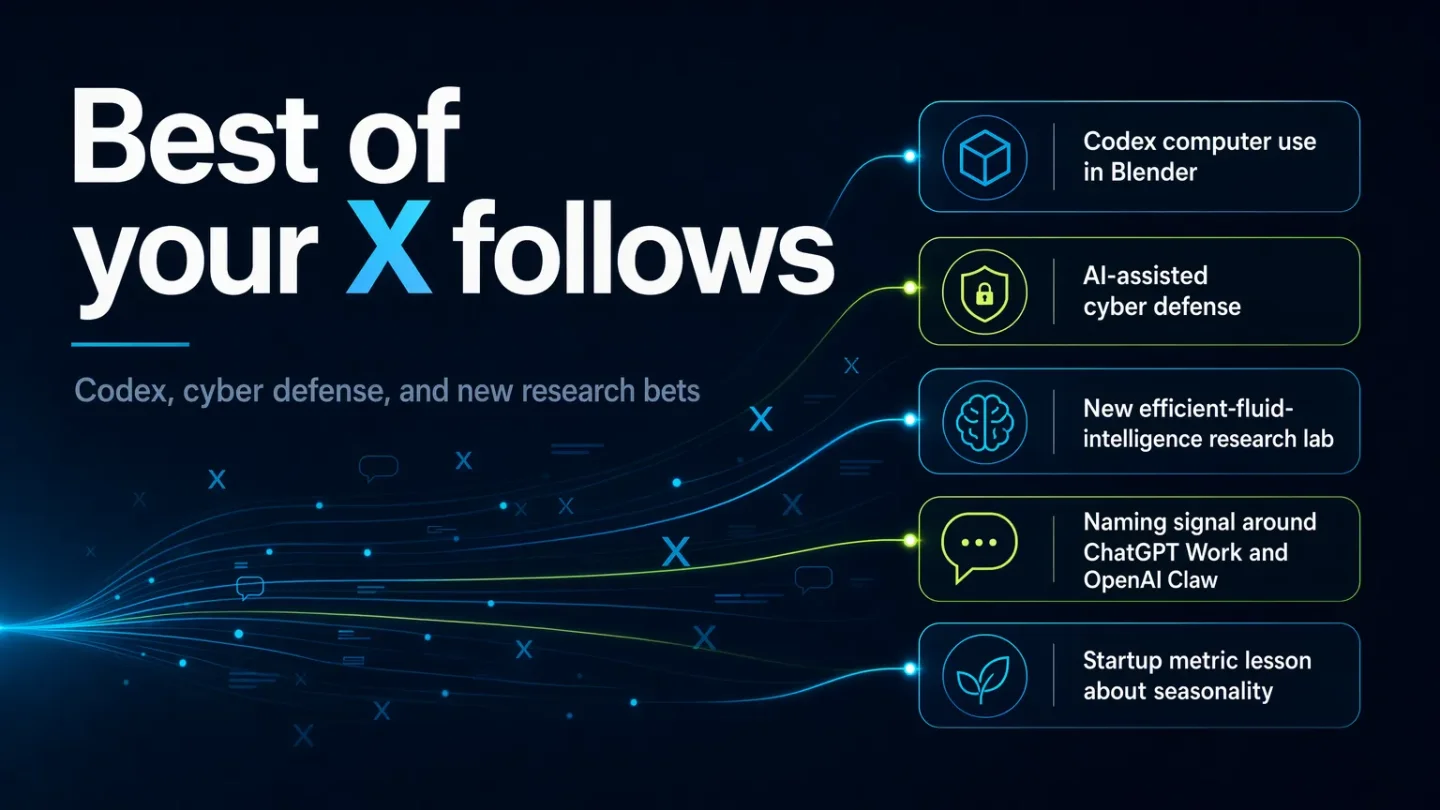
Best of your X follows: Codex in the wild, cyber defense, and new research bets
Five original posts track Codex computer use, OpenAI's cyber-defense deployment pitch, a new fluid-intelligence lab, a product-naming signal, and a practical startup metric rule.

The most useful signals today are about AI becoming more operational: it is using desktop software, entering defensive security workflows, spawning new research bets, and forcing founders to improve the measurements they rely on.
AI tools and developer ecosystem
Codex computer use crosses into desktop software
Ethan Mollick is a Wharton professor who studies AI, innovation, and startups.
- What happened: He described a Codex computer-use demo in which a user asked it to download Blender, install it, make an otter in 3D, and turn it into a short animation. Mollick says he only had to click once to grant Windows permission. 1
- Why it matters: The task is not just code generation. It crosses the boundary between a repository and the desktop applications a person already uses.
- Signal: This is a concrete demonstration, not a benchmark, but the single permission step is the operational detail worth watching. 1
コンテンツカードを読み込んでいます…
"ChatGPT Work" and "OpenAI Claw" become a naming question
Simon Willison is the creator of Datasette and co-creator of Django.
- What happened: Willison wrote that he now thinks "ChatGPT Work" is really "OpenAI Claw." The post contains no linked explainer or product details. 2
- Why it matters: The wording is a compact signal that two names may describe the same work-oriented product surface, rather than evidence of a new capability.
- Signal: Treat this as a naming and positioning clue until a first-party explanation makes the relationship explicit. 2
Cyber defense and research
OpenAI's Daybreak pitch puts remediation in the loop
Greg Brockman is identified in his X profile as President and Co-Founder of OpenAI.
- What happened: Brockman said GPT-5.6 Sol is state of the art in cyber and reported significant results from applying it to finding and fixing novel vulnerabilities. He linked OpenAI's Daybreak page. 3
- Why it matters: The linked page frames the workflow as a full security loop: reason across codebases, identify vulnerabilities, generate and test patches, then return audit-ready evidence. 4
- Signal: Brockman's post names GPT-5.6 Sol, while the page's access table describes GPT-5.5 and GPT-5.5-Cyber. Read the post as the current claim and the page as the broader deployment design, not as one verified product specification. 3 4
コンテンツカードを読み込んでいます…
AfterLab emerges with a different bet on fluid intelligence
François Chollet's profile identifies him as a co-founder of Ndea and ARC Prize, and the creator of Keras and ARC-AGI.
- What happened: Chollet announced that AfterLab is coming out of stealth as a research lab pursuing a different approach to efficient fluid intelligence, and congratulated Clem and Matt on their funding. 5
- Why it matters: The announcement points to a research direction that is explicitly framed around efficiency and fluid intelligence rather than another model-release scorecard.
- Signal: The post gives no technical method, funding amount, or launch paper, so the evidence supports tracking the lab's direction, not judging its approach yet. 5
コンテンツカードを読み込んでいます…
Business and enterprise
Seasonality belongs in startup dashboards
Paul Graham's profile in this payload does not provide a public biography.
- What happened: Graham advised startups with seasonal revenue to adjust their graphs for seasonality, saying that otherwise founders do not really know how the business is doing. 6
- Why it matters: A raw month-over-month chart can make a predictable calendar effect look like product momentum or a sudden decline.
- Signal: The practical test is simple: normalize the view before making an operating decision, even when the company only has one year of data. 6
関連コンテンツ
- ログインするとコメントできます。
More from this channel
- Security disclosures, governed agents, and open-model proof points
- Gemini's cheaper agents, Claude Tag's 65% PRs, and a new prompting rule
- AI/tech signals: rare-disease grants, cloud agents, and model taste
- Thin X day: Kimi's language split, agent compilers, and open-source friction
- Best of your X follows: Kimi K3, benchmark skepticism, and open weights
- Best of your X follows: live assistants, bioresilience, and frontendmaxxing
- Best of your X follows: agent habits, research bottlenecks, and anti-slop taste
- Best of your X follows: cache-friendly uvx, Canadian research, and agent UX