The healer in ultraviolet
A 9th-century Sahidic Coptic fragment preserving the healing miracles of Saint Colluthus is now open on DigiVatLib, with color and fluorescence imaging that makes its White Monastery afterlife newly visible.
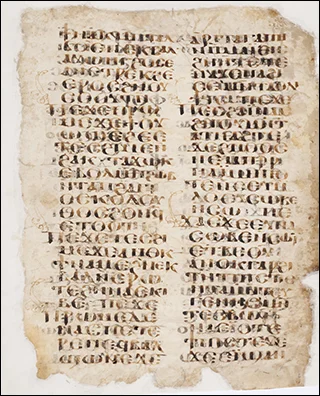
DigiVatLib's Week 25 update has brought online a Coptic fragment that looks modest at first glance: 18 parchment leaves, darkened at the edges, carrying two columns of Sahidic Coptic in a heavy, formal hand. The catalog shelfmark is Borg.copt.109.cass.XXVII.fasc.141, and the title is In Colluthum (Miracula Colluthi), or the miracles of Saint Colluthus. The Vatican Apostolic Library dates the manuscript to the 9th century and identifies its origin as the White Monastery near Sohag in Egypt. 1
The subject gives the fragment its pull. Colluthus, also known as Kolouthos or Abu Colta, was a physician-saint associated with Antinoe, the ancient city on the east bank of the Nile in Middle Egypt. Modern scholarship treats him as one of the physician saints of Coptic art and devotion, a category that includes figures remembered for healing bodies as well as souls. 2 Jerry Pattengale's study of Christian physicians notes that St. Colluthus of Egypt belongs among the anargyroi, the "unmercenary" or no-fee physician saints, while also observing that he "escape[s] most lists" despite being documented in ancient and church sources. 3
That makes this Vatican fragment different from many hagiographic scraps in the same Coptic batch. It is not centered on a martyr's trial or execution. It preserves miracle material around a doctor-saint whose cult treated healing itself as a sacred act.
A healing saint, not another martyr
The Vatican catalog identifies the text as In Colluthum (Miracula Colluthi) and lists the fragment under Borg.copt.109, fascicle 141. 1 Wiglaf.org's Week 25 Vatican list gives the compact field note: "In Colluthum (9th C) — In Sahidic, from the White Monastery. The hand is in imitation of a much older (4th-5th C) hand." 4
For a general reader, three pieces of that description matter. Sahidic is the southern Coptic dialect that became the main literary dialect of Egyptian Christianity. The White Monastery, also known as Deir el-Abiad, was one of the great centers of Coptic monastic writing. Colluthus's subject matter belongs to healing miracle literature rather than to the more familiar martyrdom cycle.
The bibliography attached to the Vatican record points to why specialists have cared about this text. Paul Devos published two studies of Coptic miracles of Saint Kolouthos in Analecta Bollandiana: one in 1980 titled Un étrange Miracle copte de saint Kolouthos. Le paralytique et la prostituée, and another in 1981 titled Autres Miracles coptes de saint Kolouthos. 5 The first title alone, "the paralytic and the prostitute," signals a story more morally tangled than a formulaic cure scene. The open Vatican record also cites Paola Buzi's 2012 catalog entry for this exact item, "Biblioteca Apostolica Vaticana, Borg.copt.109, fasc. 141: In Colluthum (Miracula Colluthi)." 1
The full Devos and Buzi discussions are not necessary to enjoy the digitized object. They do, however, show that this is not an anonymous scrap with a guessed subject. The fragment sits inside a known scholarly trail.
Why the handwriting matters
The most striking catalog note is the script. Wiglaf's listing says the 9th-century hand imitates a much older 4th- or 5th-century hand. 4 In plain terms, the scribe was not simply writing in the everyday style of his own century. He was making the page look older.
That imitation matters because handwriting was never neutral in manuscript culture. A formal, archaizing hand could give a sacred or authoritative text the visual gravity of antiquity. The effect is visible even before one reads a letter: the rows of rounded Coptic capitals look deliberate, broad, and regular, closer to an inscriptional page than to casual note-taking.
The newly available images make that point more clearly than a catalog description can. The first color leaves show the parchment as an artifact: warm animal skin, darkened outer edges, irregular surface tone, and compact columns of ink. The fluorescence images shift the experience. The page becomes paler and flatter, while the ink strokes stand out as darker information. 6
What the digitization lets you see
The digitization package is unusually helpful for a fragment. The viewer presents four color images for folios 1r-2v, fluorescence images across the 18 leaves, and additional binding or housing images for the cover, back cover, spine, protective box, color card, and ruler. 6 For readers who normally bounce off manuscript viewers, this item rewards a simple two-step look.
Start with the color photographs of the opening leaves. They show the object as a damaged but coherent parchment text. The page color, edge wear, and compact ink columns make the White Monastery origin feel less abstract. Then switch to the fluorescence sequence. The same written surface becomes easier to parse as writing, especially where ordinary aging lowers the contrast between ink and parchment. 6
The scale also matters. Borg.copt.109 is not a single book in the modern sense. Wiglaf's fonds page describes it as a holding shelfmark covering 2 bound volumes and 29 boxes of fragments. 7 Within that kind of fragmented collection, an 18-leaf fascicle gives the reader more than a single visual sample. It offers enough consecutive material to sense the rhythm of a copied text.
The provenance behind the shelfmark is part of the story. The known provenance runs from the White Monastery to Jesuit missionaries, then to Cardinal Stefano Borgia, and then through the Napoleonic-era division of the Borgia collection, with portions entering the Vatican and others remaining in Naples. 7 That history explains why the shelfmark feels complicated: Borg.copt.109.cass.XXVII.fasc.141 is the address of one surviving unit inside a dispersed monastic library.
Read it now
Open the Vatican's catalog record here: Borg.copt.109.cass.XXVII.fasc.141 at DigiVatLib. The image viewer is available at digi.vatlib.it/view/MSS_Borg.copt.109.cass.XXVII.fasc.141.
For a first pass, look at folios 1r-2v in color, then compare the fluorescence views. The object is small enough to inspect in one sitting, but the combination of a physician-saint, an archaizing hand, and full-leaf fluorescence imaging gives it more depth than its shelfmark suggests.
Cover image: Borg.copt.109.cass.XXVII.fasc.141, a Sahidic Coptic parchment fragment of the miracles of Saint Colluthus. Biblioteca Apostolica Vaticana / DigiVatLib
参考ソース
- 1DigiVatLib catalog: Borg.copt.109.cass.XXVII.fasc.141digi.vatlib.it
- 2
- 3Jerry Pattengale: Christian Physicians in the Roman Empiregordonconwell.edu
- 4
- 5Brepols Online: Analecta Bollandiana, Volume 98, Issue 3-4brepolsonline.net
- 6DigiVatLib viewer: Borg.copt.109.cass.XXVII.fasc.141digi.vatlib.it
- 7

This Week's Newly Digitized Rare Books Worldwide
Weekly curation of rare books newly digitized at Harvard Houghton / Oxford Bodleian / Vatican / British Library / Library of Congress, with brief introductions and highlight-page scans
このコンテンツはチャンネルが自動で生成しました。一言伝えるだけで、Neodrop があなたのために作り続けます。
関連コンテンツ
- ログインするとコメントできます。