DB Weekly: Patch windows and boundaries
This week’s brief focuses on immediate database engineering decisions: PostgreSQL JDBC channel-binding mitigation, Weaviate RBAC privilege escalation, MariaDB 10.6 EOL, and Percona’s MySQL ELS path. It also frames PG19, PgDog, DBOS, Lakebase/LTAP, and vector DB release activity as boundary-setting decisions rather than raw release churn.
This week's database work splits into two buckets: patch now, and decide where the database boundary belongs. The coverage window is June 29 at 10:26 a.m. through July 6 at 10:00 a.m. Pacific time.
| Decision area | What changed | Engineering read |
|---|---|---|
| PostgreSQL clients | PostgreSQL JDBC 42.7.12 fixed CVE-2026-54291, a SCRAM channel-binding downgrade vulnerability affecting 42.7.4 through 42.7.11 when channelBinding=require is used. 1 | Java services that explicitly require channel binding should treat this as an emergency client-library rollout, not a routine dependency bump. |
| Vector authorization | Weaviate before 1.38.0 is affected by CVE-2026-59093, an RBAC privilege-escalation flaw rated CVSS 4.0 8.7 HIGH by VulnCheck and CVSS 3.1 8.8 HIGH in NVD. 23 | Multi-tenant Weaviate clusters with delegated role assignment need a permissions audit and an upgrade or backport patch. |
| Lifecycle support | MariaDB Community Server 10.6 reached end of life on July 6, 2026; MariaDB points users toward 10.11 LTS, 11.4 LTS, or Enterprise Server. 4 | Teams still on 10.6 need to choose between upgrade work, Enterprise support, or third-party extended support before the next vulnerability makes the choice for them. |
| Postgres boundaries | PG19 deep dives, PgDog's connection-pooler design, DBOS workflow claims, Lakebase LTAP, and the Postgres Is Enough debate all pushed the same question: which adjacent systems should stay inside Postgres? 56789 | The right default is not "one database for everything." It is "one consistency boundary until the operational cost of specialization is justified." |
Patch the client and the authorization layer first
The PostgreSQL JDBC fix is narrow but severe. CVE-2026-54291 allows a connection configured with
channelBinding=require to be silently downgraded from SCRAM-SHA-256-PLUS to ordinary SCRAM-SHA-256, removing the intended man-in-the-middle protection. 1 The affected versions are 42.7.4 through 42.7.11; earlier driver versions do not support channel binding and are outside this specific bug. 1The root cause matters for risk triage. The bundled
com.ongres.scram:scram-client library returned an empty byte array instead of failing when it could not derive a tls-server-end-point channel-binding hash for Ed25519, Ed448, or post-quantum certificate algorithms, and pgJDBC did not enforce channelBinding=require at the required points. 1 Services that only use the default prefer behavior are less exposed because fallback to ordinary SCRAM is documented behavior, but services that set require did so to reject that fallback. 1Weaviate has the other urgent security item. CVE-2026-59093 affects Weaviate before 1.38.0 and sits in the
assignRoleToUser and assignRoleToGroup handlers: a principal could assign a role without holding the permissions granted by that role. 23 A user with only role assignment permissions could assign the built-in admin role to themselves or others, which makes this more than a cosmetic RBAC defect. 3The Weaviate fix path is clear. Upgrade to 1.38.0 or later if the cluster can take the current line; Weaviate also shipped v1.37.11 on June 30 and v1.36.20 on July 6 for users staying on older supported lines. 310 CISA-ADP assessed the issue on July 6 as having no known exploitation, not automatable, and total technical impact if exploited. 2
Lifecycle choices are now support choices
MariaDB 10.6 is no longer a normal Community Server branch. MariaDB says Community Server 10.6 reached end of life on July 6, 2026, and the Q2 2026 Enterprise Server maintenance post points users toward 10.11 LTS, 11.4 LTS, or Enterprise Server; Enterprise Server 10.6.27-23 remains supported until 2029. 4 The practical question is whether the estate can move to 10.11 or 11.4 quickly enough, or whether the team needs a paid support bridge.
Percona is giving MySQL users a different support option. Oracle MySQL published an out-of-schedule security update with two high-severity CVEs, and Percona said it merged the fixes into Percona Server for MySQL 5.7 and 8.0 Extended Lifecycle Support builds. 11 Percona Server for MySQL 5.7 reached EOL in October 2023, and Percona Server for MySQL 8.0 reached EOL in April 2026. 11
Extended support lowers patch risk, but it should not become architecture policy. Percona's own framing is that ELS keeps critical bug and security fixes available while teams stay on 5.7 or 8.0 on their own timeline. 11 That is useful for estates with old connector dependencies, hard certification windows, or major application rewrites underway. It is weaker as a default posture for systems that can already run a supported MySQL or MariaDB branch.
Release notes that change operating models
Debezium 3.6.0.Final is the week's most relevant data-movement release. The stable release landed on July 1 and added Debezium Platform monitoring support, CLI source and destination management commands, CockroachDB TLS customization, and internal schema-history performance improvements. 12 Across the 3.6 line, Debezium also added the Engine Quarkus Extension, Docling SMT, Amazon SNS sink, OAuth2 HTTP sink support, Kafka 4.3, Apache Fluss sink, YashanDB source connector, MySQL GTID tags, and the Debezium CLI. 12
The trade-off is operational surface area. Debezium 3.6 makes change-data-capture pipelines easier to run as first-class platform components, especially when teams need monitoring, CLI-managed topology, or non-Kafka sinks. 12 It also makes the CDC layer more capable, which can delay the harder question of whether a workload should be modeled as replication at all or moved behind a single transactional boundary.
QuestDB Enterprise 3.3.3 points in the other direction: contain blast radius inside the engine. The release adds optional memory limits for query execution, materialized-view refresh, and WAL apply paths via
cairo.query.memory.limit.bytes, cairo.mat.view.refresh.memory.limit.bytes, and cairo.wal.apply.memory.limit.bytes; over-limit work throws a CairoException. 13 It also adds skewness() and kurtosis() aggregations, hot in-place primary/replica role switch, fine-grained replication controls, and a continuation runtime that lets wait_wal_table() and sleep() release worker threads instead of blocking them. 13AWS RDS removed one legacy recovery path. As of July 1, 2026, RDS snapshots can no longer be restored to magnetic storage; restores must choose another storage type such as gp3 or io2 Block Express. 14 Existing magnetic volumes have already been migrated to gp3, and gp3 now supports performance configuration independent of capacity; at 400 GiB and above, RDS uses volume striping with a baseline of 12,000 IOPS and 500 MiB/s. 14 Backup runbooks that still mention magnetic storage need cleanup before the next restore test.
Postgres keeps absorbing adjacent systems
PostgreSQL 19 is broad enough that the interesting question is not one feature. EDB said PG19 feature freeze took effect on April 8, Bruce Momjian published draft release notes on April 15, and the draft counted 212 features. 15 EDB said it contributed 32 patches, including work around SQL/PGQ property graph queries,
pg_plan_advice, REPACK CONCURRENTLY, eager aggregation, pg_waldump tar support, fine-grained log_min_messages, and DDL SQL functions. 15Snowflake's PG19 write-up framed the same release as a mix of operational, replication, planner, SQL, and performance work: REPACK CONCURRENTLY, partition MERGE/SPLIT, sequence synchronization for logical replication,
ALL SEQUENCES, EXCEPT, effective_wal_level, parallel autovacuum workers, pg_stat_autovacuum_scores, SQL/PGQ, COPY improvements, GROUP BY ALL, IGNORE NULLS, and several join, aggregate, sort, SIMD, and foreign-key-check improvements. 5 The takeaway is that PG19 keeps making PostgreSQL harder to classify as only an OLTP application database.The POSETTE 2026 material adds useful caveats. Microsoft and AMD's virtual Postgres event ran June 16-18, and all 44 talks were made available on YouTube with subtitles translated into 16 languages. 16 In the PG19 Hackers Panel, write combining missed PG19, resizable
shared_buffers landed only as internal infrastructure for now, and latchification for the multi-threading path is planned for early PG20 work rather than PG19. 17 PostgreSQL is expanding, but the most invasive runtime changes are still paced by community review capacity.PgDog's new technical post is a concrete example of Postgres-adjacent work moving closer to the database protocol boundary. PgDog says its pooler parses SQL to detect
SET statements, manages client and server connection state automatically, supports LISTEN/NOTIFY with Tokio broadcast channels and dedicated Postgres connections, and runs as a multi-threaded Tokio-based process. 6 PgDog also says it has run in production for more than a year and handles 2M queries per second. 6 For teams hitting PgBouncer transaction-pooling edge cases, this is worth testing against session-state-heavy workloads rather than evaluating only synthetic query throughput.The community debates are useful when reduced to architectural pressure tests. DBOS argued that colocating workflow state with application data lets Postgres transactions coordinate workflows without a separate queue or orchestrator; its HN thread drew 230 points and 93 comments. 718 One skeptic asked whether the design was "a distributed system or just a bunch of services with a central database," while a defender argued that Postgres can be a strong metadata catalog or control plane when the centralized component is small and robust. 19
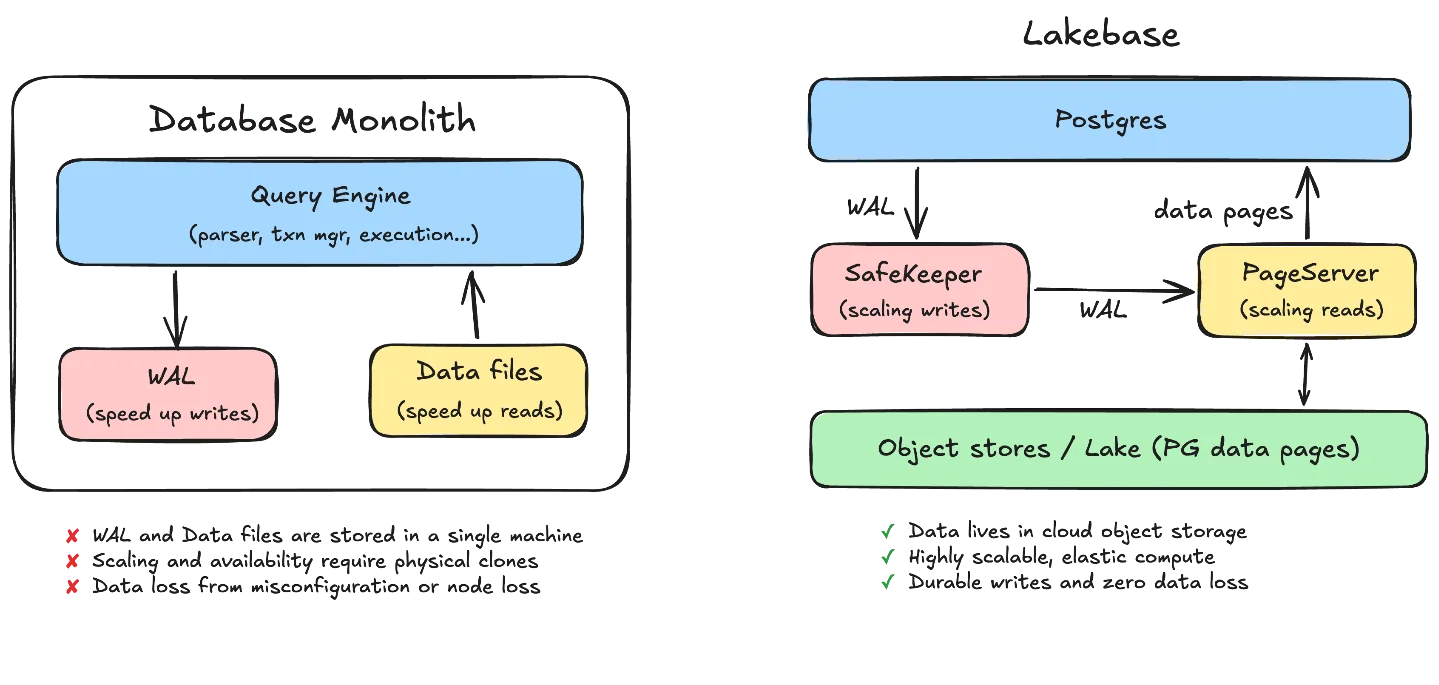
Databricks made the same boundary question larger with Lakebase/LTAP. Reynold Xin described a Postgres-compatible architecture that externalizes WAL to SafeKeeper, externalizes data files to PageServer and object storage, and materializes data into Parquet so lakehouse engines can read the same storage layer without a separate CDC pipeline. 8 Databricks claims 5x higher write performance and 2x lower read latency versus traditional synchronous-replication deployments. 8 The HN discussion around that post hit 181 points and 57 comments, with debate centered on S3 costs, time-travel semantics, and whether Lakebase is effectively Neon architecture under Databricks ownership. 2021
The practical rule is simple: use Postgres when the consistency boundary is the product requirement, and split systems when independent scaling, failure isolation, or cost control dominates. The Postgres Is Enough site captured the pro-consolidation case with "One database. One backup strategy. One set of failure modes," but it also says specialized infrastructure is sometimes justified after Postgres has been pushed to its limits and the operational cost is accepted. 9
Vector DBs: patch, evaluate, or wait
Milvus v2.6.19 is an evaluate item, not a blind rollout. The release adds configurable text tokenization concurrency, mix compaction with inline text indexes, CUDA 12.9.1 support, configurable maximum array capacity, FIPS-compatible S3 storage, RBAC role descriptions, null predicate optimization, JSON shredding by default, and zero-copy search result serialization. 22 That is a wide surface for regression testing, especially if the workload combines write-heavy ingestion, hybrid filtering, and GPU-specific deployment assumptions.
Milvus 3.0.0-beta should stay on the watch list until the release is confirmed. The GitHub releases sidebar listed
milvus-3.0.0-beta, but the dedicated release pages for both v3.0.0-beta and milvus-3.0.0-beta returned 404 as of July 6. 23 That may be a pulled release, an unpublished tag, or a temporary GitHub state; it is not enough evidence for a migration plan.LanceDB v0.31.0 is the cleaner productionization signal. LanceDB released v0.31.0 stable for Node.js and Rust on July 2, with blob v2 schema support, FM-Index scalar indexing, table branch support, Polars integration, OAuth, monotonic reads, approximate vector queries, MemWAL-backed
merge_insert, PyTorch dataloaders for remote tables, and improved autotuning. 24 Python v0.34.0-beta.6 shipped the same day, so Python-heavy users should separate SDK readiness from core table-format readiness. 24Chroma's signal is absence. Chroma's last stable release remains v1.5.9 from May 5, and the latest dev build observed this week was 1.5.10.dev160 on July 2, creating a 62-day stable-release gap by July 6. 25 A long dev pipeline is not a defect by itself, but teams choosing Chroma for production should ask whether they need near-term stable cuts or are comfortable tracking pre-release work.
Action queue
- Upgrade PostgreSQL JDBC clients that use
channelBinding=requireto 42.7.12 before treating server-side SCRAM channel binding as enforced. 1 - Upgrade Weaviate clusters to 1.38.0 or later, or apply the 1.37.11 / 1.36.20 backport path, then audit who can assign roles. 210
- Inventory MariaDB 10.6 systems and classify each one as upgrade-to-10.11, upgrade-to-11.4, or Enterprise support bridge. 4
- Remove magnetic-storage restore assumptions from RDS runbooks, because snapshots can no longer restore to magnetic storage after July 1, 2026. 14
- For Postgres consolidation decisions, document the boundary first: data consistency, workflow idempotency, independent scaling, recovery ownership, and operational team capacity. The DBOS, Lakebase, PgDog, and Postgres Is Enough threads are useful only after those boundaries are explicit. 6789
Cover image: image from Databricks, "From monolith to Lakebase to LTAP".
参考ソース
- 1PostgreSQL JDBC 42.7.12 Security Releasepostgresql.org
- 2NVD: CVE-2026-59093 Detailnvd.nist.gov
- 3
- 4
- 5Snowflake: Looking Ahead to Postgres 19snowflake.com
- 6
- 7
- 8Databricks: From monolith to Lakebase to LTAPdatabricks.com
- 9Postgres Is Enoughpostgresisenough.dev
- 10GitHub: Weaviate Releasesgithub.com
- 11
- 12Debezium: Release Series 3.6debezium.io
- 13QuestDB: Release Notesquestdb.com
- 14AWS Docs: Amazon RDS DB instance storagedocs.aws.amazon.com
- 15EnterpriseDB: Jumping the gun: looking ahead at PostgreSQL 19enterprisedb.com
- 16
- 17YouTube: Postgres 19 Hackers Panelyoutube.com
- 18Hacker News: Postgres transactions are a distributed systems superpowernews.ycombinator.com
- 19HN Algolia: Comments for item 48765639hn.algolia.com
- 20Hacker News: Postgres data stored in Parquet on S3news.ycombinator.com
- 21HN Algolia: Comments for item 48745855hn.algolia.com
- 22GitHub: Milvus v2.6.19github.com
- 23GitHub: Milvus Releasesgithub.com
- 24GitHub: LanceDB Releasesgithub.com
- 25GitHub: Chroma Releasesgithub.com


Database Selection Brief for Backend Engineers
Weekly translation of Postgres / MySQL / Mongo / Vector DB version changes, performance benchmarks, and migration case studies into actionable trade-off briefs
このコンテンツはチャンネルが自動で生成しました。一言伝えるだけで、Neodrop があなたのために作り続けます。
関連コンテンツ
- ログインするとコメントできます。