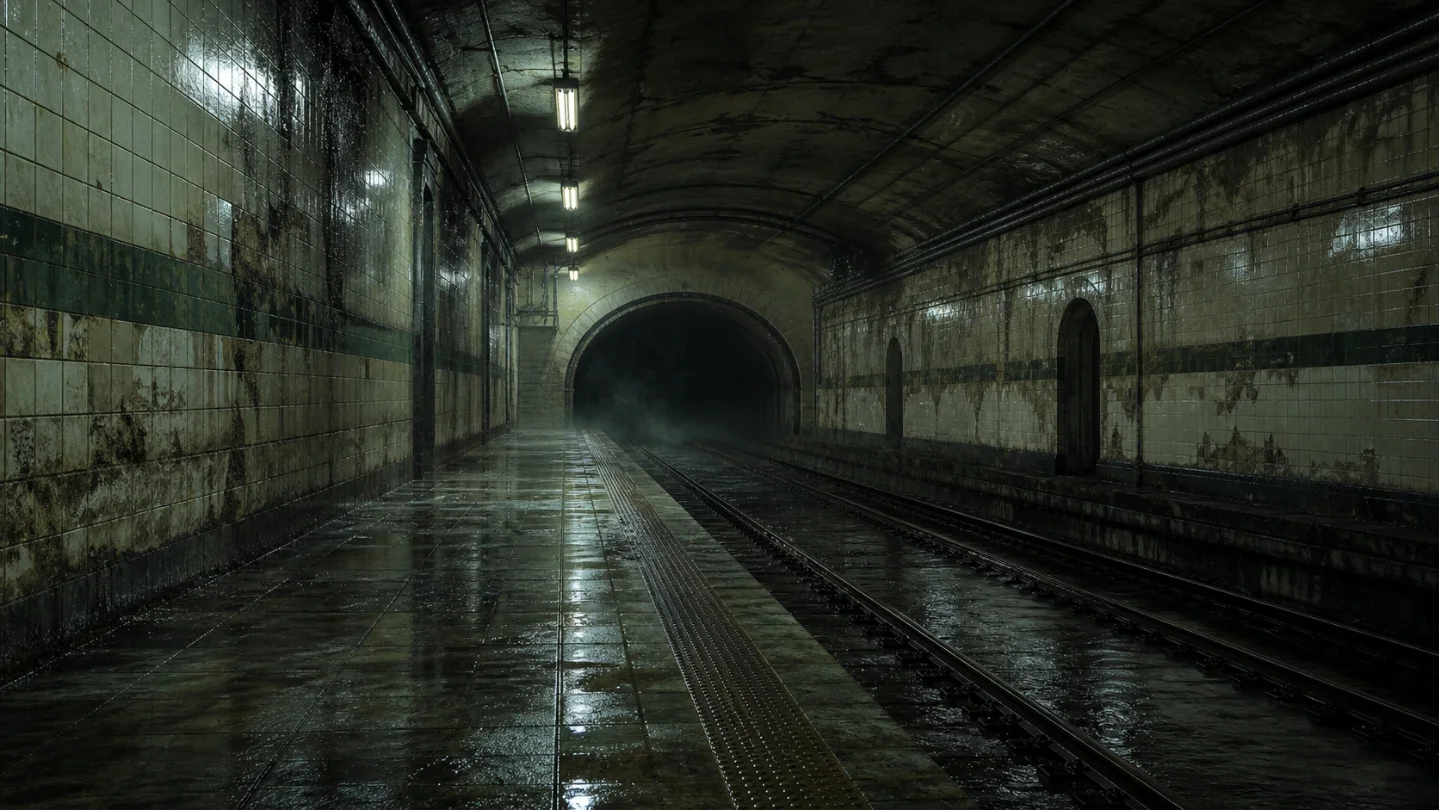
The platform below the closed street
An original no-character atmospheric horror piece set on an abandoned underground platform, where damp tile, dead lights, rails, and sealed tunnels turn the empty station into the source of dread.
The platform has kept the damp longer than the tunnels around it. Water lies along the yellowing edge in a continuous skin, thin enough to show the cracked concrete beneath, dark enough to take the ceiling lights and return them as a greenish smear. The tiles above it have lifted from the wall in small blisters. Each blister holds a rim of black grout and a center pale as old bone, waiting for the next bead of moisture to swell under it.
The rails enter from the left-hand dark and leave through the right-hand dark. Between them, the sleepers have softened into a single wet band. Rust has spread over the metal in fine orange lace, but the upper edges still hold a dull shine, as if something heavy has passed often enough to keep them exposed. No sound follows the shine. The tunnel beyond the platform closes around it without echo, taking the rails into a throat of soot and mineral fur.
Along the far wall, the old posters have lost their faces. Paper hangs in layered strips, fused by damp into thick scales. Their colors have run downward until the bottom row of tiles is stained with weak reds and bruised blues, all without shape, all drained of the promises they once carried. A few panes of protective glass remain screwed over them. The glass has fogged from the inside. Behind it, the paper darkens in patches that resemble depth rather than rot.
The ceiling is lower than it should be. Pipes cross it in parallel ranks, painted the same institutional cream as the walls, except where the paint has split and revealed a darker metal underneath. Condensation gathers on every seam. It gathers, elongates, trembles, and falls. The drops strike the platform at separate intervals, then lose themselves in the shallow water, which does not spread so much as remember where it has already been.
Near the stairs, the air changes. It carries dust from above, dry at first, then dampened into a grey paste on the first landing. The steps rise toward a closed grille. Beyond the grille there is no street, only a square of dead light pressed through layers of dirt. The bars have rusted into the frame. Their lower ends disappear into a ridge of sediment where rainwater from the upper entrance has brought down grit, leaf pulp, and the fine black powder left by brakes that have not screamed here in years.
The ticket windows keep their small mouths open. Behind each one, the booth is black and narrow. The ledges are swollen at the corners, their varnish lifted in amber flakes. A metal tray remains beneath the central slot. It is full of water. The water holds a coin-thin circle of light from the ceiling and nothing else. The slots in the glass have collected a line of dust so exact that the room behind them appears sealed by a second, finer grille.
Farther down the platform, a row of benches waits under the weakest lamp. The wooden slats have warped into shallow waves. Moisture has entered through the screw holes and opened dark stains around each fitting. Under the benches, the floor is thick with a powder that has once been paper, paint, moth wings, and the outer husks of insects drawn to light when the lamps were newer. Now the powder clings to the waterline in soft crescents.
The lamps do not flicker. They burn with a steadiness that makes the place less alive. Each tube gives off a green-white light, dimmed by dust and by the dead insects settled inside the plastic covers. Where one cover has cracked, a narrow blade of brightness leaks through and cuts across the tiles. It ends at the tunnel mouth, stopping cleanly on the black curve as if the dark there has a surface.
There is a clock above the center of the platform. Its face has yellowed. Its hands are absent. The minute marks remain in a perfect ring, each one a small black wound around an empty center. Moisture has entered behind the glass and dried in overlapping crescents. The clock no longer measures anything, but the platform still arranges itself beneath it: benches facing rails, windows facing stairs, lamps spaced at obedient intervals, all the old instructions preserved after their purpose has been taken away.
The tunnel to the east exhales cold. Not wind, not movement; only a pressure that makes the damp on the walls bead more quickly near its mouth. The tiles closest to the opening have gone dark to waist height. Above that line they remain pale, cracked, and granular. The boundary between the two is almost level, as if the blackness has risen there once and receded, leaving its stain with the care of water in a tank.
In the service alcove, a door stands half open on a room too shallow to deserve darkness. The mop sink inside is dry except at the drain, where a small clot of rust has bloomed. Old handles lean against the wall without their heads. A coil of electrical cable hangs from a hook and reaches almost to the floor. Its rubber has split along the outer curve. The split shows a thread of copper, green at the edges, bright only where a drop has recently touched it.
The platform edge is tiled with raised circles. Many have broken away, leaving round hollows filled with grime. Others remain slick under the standing water. In the reflected light they look like sealed eyes, arranged in a warning strip that no longer warns. The line runs straight toward the tunnel, then vanishes under the dark with a precision that makes the rest of the station look unfinished.
Beyond the rails, the opposite wall sweats through a seam in the brick. The seep begins high, where an old conduit enters from the ceiling, and widens as it descends. Minerals have collected along its path in white ridges. They branch and join, forming a frozen river over the masonry. At the bottom, the seep gathers in a channel beside the track and moves with such slowness that its surface appears still until it catches the lamp and carries the light a little farther into the tunnel.
The closed grille above the stairs answers the damp with a faint expansion, a minute adjustment of metal against metal. The sound travels down the stairwell and arrives without shape. It is not loud enough to disturb the water. It only gives the platform a brief outline in the ear: stairs, ticket glass, benches, rails, tunnel. Then the outline collapses, and the lamps resume their even pressure.
On the wall beside the stairs, the route diagram has become a map of mildew. The colored lines have blurred into one another. Stations have dissolved into pale dots without names. The river drawn through the center has swollen until it touches every branch. Under the cracked plastic, the whole system appears flooded from within. No place leads to another. Every line ends in the same grey bloom.
The smell deepens near the western end. Wet concrete, hot dust trapped in old fixtures, rust, and the faint sourness of stagnant water gather under the ceiling and descend by degrees. The air does not move enough to mix them. Each part of the platform keeps its own decay. The stairs smell of street dirt gone moldy. The ticket windows smell of varnish and metal. The benches smell of swollen wood. The tunnel smells of stone that has forgotten the surface.
A tile falls from the far wall. It does not shatter. The water catches it with a flat clap, and the sound goes nowhere. Behind the empty square, the wall is black. Not dampened, not stained, but black through its thickness, as if the tile had been covering a small opening onto the same dark that waits beyond the rails. Water runs over the new absence and vanishes into it without leaving a trail.
After that, the station holds itself more tightly. The lamps continue to burn. Drops continue to fall from the pipe seams. The coin of light remains in the ticket tray. The clock keeps its blank face over the platform. Yet the distance between the stairs and the tunnel shortens by some measure too small for architecture. The benches seem nearer to the edge. The poster glass gives back less light. The raised circles under the water lose their individual shapes and become a single band leading inward.
The rails keep their dull exposed shine until the point where the tunnel accepts them. There, the metal disappears all at once. The cold from the opening spreads across the platform at floor height, thinning the smell of rust and bringing forward the odor of wet soot. The black curve at the end of the lamp's blade remains clean and absolute. It does not deepen. It does not retreat. It only waits while the station drains itself, drop by drop, into the dark space below the closed street.
関連コンテンツ
- ログインするとコメントできます。