2026/6/23 · 12:14
Claude Desktop moves inside the enterprise cloud boundary
Anthropic's June 22 Desktop launch brings Chat, Cowork, and Code into managed AWS, Google Cloud, and Microsoft Foundry deployments. This deep dive explains why the important shift is not a new model, but a new control boundary for inference routing, MDM policy, egress, telemetry, and enterprise rollout.

Claude's June 22 launch is easy to misread as another packaging update. The actual move is narrower and more important: Claude Desktop can now be deployed as a managed desktop client whose inference path, identity, egress, telemetry, and rollout controls live inside an enterprise cloud and device-management boundary.
Organizations using Claude Desktop through AWS, Google Cloud, and Microsoft Foundry now get Chat, Claude Cowork, and Claude Code in one app; Anthropic says those deployments previously exposed only Claude Cowork and Claude Code. 1 That sounds like a product-completeness milestone. In practice, it changes who owns the operational perimeter around Claude.
The event: one Desktop app, three enterprise surfaces
The launch puts three surfaces into the same managed Desktop deployment: Chat for interactive work, Cowork for delegated research and deliverables, and Code for agentic coding. Anthropic says each surface has its own policy key, so an admin can expose Chat to one population, Cowork to another, Code to engineers, and apply hard-deny rules across the app. 1
The policy split matters because these surfaces carry different operational risk. Chat is mostly a conversation surface. Cowork can work with local files, run tools, and produce deliverables. Code brings software execution and developer workflows into the same governed client. Anthropic's feature matrix lists Cowork, Code, Chat, Projects, code execution for analysis, file access, MCP, skills, plugins, hooks, artifacts, memory, and scheduled tasks as available in Claude Desktop on third-party inference. 4
| Surface | What changed in the managed deployment | The control question it raises |
|---|---|---|
| Chat | It is now part of the full Desktop experience in AWS, Google Cloud, and Microsoft Foundry deployments. 1 | Which employees can use Claude for everyday knowledge work without routing through a separate Anthropic account? |
| Cowork | It remains the delegated-work surface for research, analysis, files, and deliverables inside Desktop. 2 | What file folders, tools, connectors, and network destinations can an agent touch? |
| Code | Claude Code is available as a Desktop tab, with admin controls around provider configuration, tools, plugins, and policy. 4 | Can engineering teams get agentic coding while IT keeps endpoint, identity, and egress policy in one place? |
This is why the launch is better understood as endpoint distribution than as a model release. Nothing in the announcement claims a new frontier model. The change is that the same Claude experience can be packaged for organizations that want cloud-provider billing, cloud-region selection, local storage, MDM rollout, and identity-driven access.
The architecture: Claude moves closer to the customer's boundary
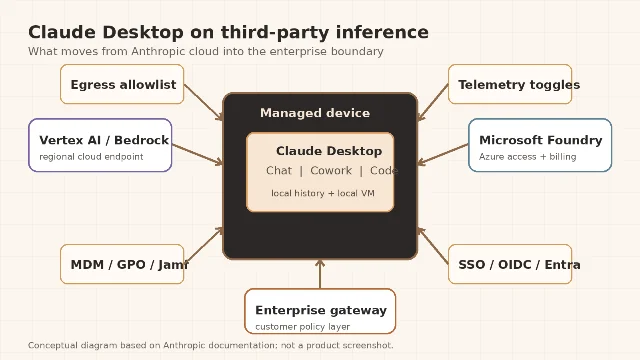
Anthropic's overview describes Claude Desktop on third-party inference as a beta deployment mode that routes model inference through a configured provider: Google Cloud Vertex AI, Amazon Bedrock, Microsoft Foundry, a compatible enterprise gateway, or Anthropic's API. The app runs from a bundled local web application, and conversation history is stored on the user's device. 2
That local-device detail is easy to overlook. Standard SaaS AI products usually ask security teams to evaluate a vendor-hosted application, a vendor-hosted data store, and a vendor-hosted inference endpoint together. This mode separates those layers. The Desktop app can be distributed like managed software. Inference can be pointed at the provider endpoint. Conversation history can stay on local disk. Device configuration can come from the same MDM stack that already governs laptops. 23
The catch is that the provider choice changes the data story. Anthropic's docs say the "no conversation data sent to Anthropic" and data-residency statements apply for Vertex AI and Bedrock, and for a customer gateway only if that gateway does not route to Anthropic infrastructure. They do not apply to Microsoft Foundry or direct Anthropic API mode; in the Foundry preview, Claude models run on Anthropic infrastructure even though access and billing are through Azure. 2
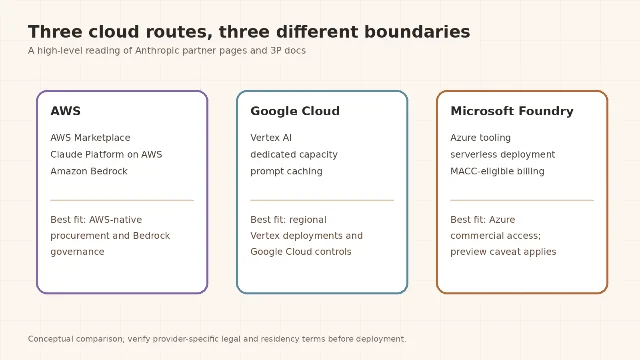
So the launch does not create one uniform compliance posture. It creates a menu of deployment postures:
| Route | What the public pages say | Practical read |
|---|---|---|
| AWS | Anthropic's AWS page distinguishes Claude Platform on AWS, Claude on Amazon Bedrock, and Claude Enterprise in AWS Marketplace. 5 | AWS customers can choose between API-style access, Bedrock governance, and Marketplace procurement. |
| Google Cloud | The Google Cloud page frames Claude around Vertex AI, dedicated capacity, prompt caching, governance, and production agent deployment. 6 | Vertex AI becomes the main path for organizations that want regional cloud inference with Google identity and infrastructure. |
| Microsoft Foundry | The Foundry page emphasizes Azure tooling, serverless deployment, Azure billing, and MACC eligibility. 7 | Foundry is commercially convenient for Azure customers, but the preview has a different data boundary than Vertex or Bedrock. |
The sharpest product decision is not adding Chat. It is making Claude Desktop configurable enough that IT can treat the app as a managed endpoint.
The control plane: MDM, SSO, egress, and telemetry
The deployment guide reads like an enterprise endpoint playbook. Anthropic recommends that an admin first evaluates a single machine, opens the required egress hostnames, exports a validated configuration to MDM, and then distributes the app. The guide names Jamf, Intune, Group Policy, and other MDM tools as deployment paths, with
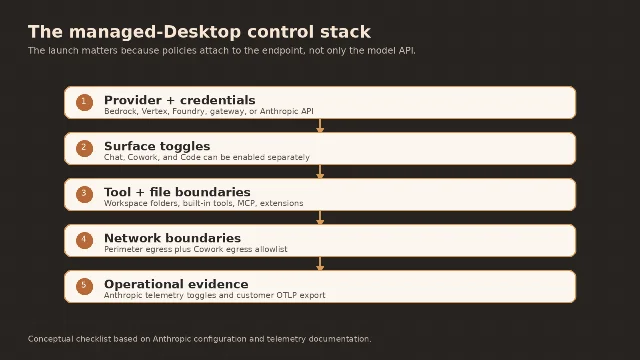
.mobileconfig, .reg, ADMX, and plist exports depending on platform. 3Configuration is handled through OS-native managed preferences. The configuration reference lists keys for provider selection, credentials, model discovery, Chat enablement, Code enablement, Cowork enablement, disabled built-in tools, per-tool approval policy, allowed workspace folders, Cowork egress hosts, managed MCP servers, desktop-extension controls, telemetry toggles, auto-update policy, OpenTelemetry export, per-device token caps, banners, bootstrap URLs, and organization plugins. 8
This is a big surface area, but it is not random complexity. It maps to the four questions enterprises ask when they let an agent act on a user's machine:
- Where does inference happen? Provider keys select Bedrock, Vertex, Foundry, a gateway, Anthropic API, or related credential mechanisms. 8
- What can the agent reach? Workspace-folder limits and Cowork egress hosts constrain files and network access from Cowork and Code. 8
- Which extensions are trusted? Admins can push managed MCP servers, disable local developer MCP, require extension signatures, or disable desktop extensions. 8
- Who sees operational data? Anthropic-bound telemetry can be reduced or disabled, while full session activity can be exported to the customer's own OpenTelemetry collector. 9
The telemetry page is particularly explicit. For Vertex AI or Bedrock, it says conversation content never reaches Anthropic, while the app may send operational telemetry such as crash reports, performance timings, and product analytics by default. Each category can be disabled independently, and the customer can send full session activity to its own OpenTelemetry collector with
otlpEndpoint. 9That design creates a trade-off. A locked-down deployment can minimize Anthropic-bound runtime connections, but then the customer owns more support, logging, and update distribution. Anthropic's docs say disabling essential telemetry opts the customer into a manual support model, and disabling auto-updates means IT must redistribute new builds. 9
Why this matters for Claude's enterprise strategy
Anthropic has spent the past month turning Claude from a web app and API into a set of governed work surfaces: artifacts for reviewable team state, managed authorization for MCP connectors, Claude Design for brand-controlled creation, and now a Desktop deployment that can sit inside cloud-provider and MDM boundaries. This launch is the endpoint version of the same strategy.
The useful question for buyers is no longer "Can employees access Claude?" It is "Can Claude inherit the controls we already use for identity, devices, cloud regions, tool access, logs, and procurement?" The June 22 Desktop launch answers more of that question than a model announcement would have.
There are still boundaries to watch. Microsoft Foundry preview access is not the same data-residency posture as Vertex AI or Bedrock. Public Anthropic plugin marketplace behavior differs from organization-distributed plugins in third-party mode. Claude Enterprise still has hosted admin UI, user management, RBAC, Compliance API, and Analytics API surfaces that third-party Desktop does not replicate directly. 24
The direction is clear enough: Anthropic is making Claude less dependent on Anthropic as the only operating boundary. For regulated enterprises, that may be the difference between a pilot and a real rollout. For Anthropic, it is a bet that the next stage of AI distribution will be won not only by model quality, but by whoever can make agents look like managed infrastructure.
参考ソース
- 1The full Claude Desktop experience on AWS, Google Cloud, and Microsoft Foundry
- 2Overview - Claude.ai Documentation
- 3Installation and setup - Claude.ai Documentation
- 4Features - Claude.ai Documentation
- 5Claude on AWS
- 6Claude on Google Cloud
- 7Claude in Microsoft Foundry
- 8Configuration reference - Claude.ai Documentation
- 9Telemetry and egress - Claude.ai Documentation

このコンテンツについて、さらに観点や背景を補足しましょう。