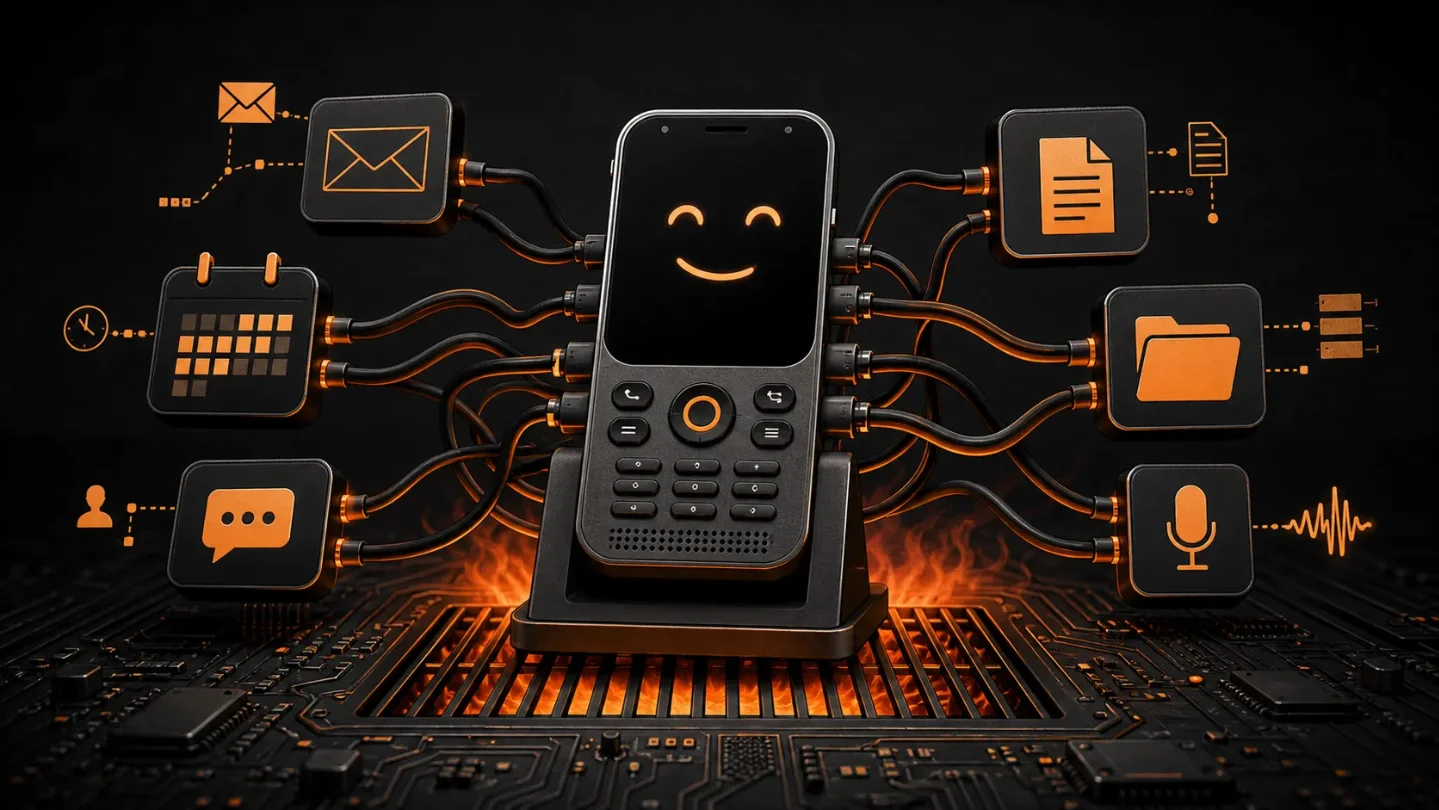
Toyo put a chief of staff in your message thread
Toyo turns iMessage, phone calls, Gmail, Calendar, Slack, and company context into a paid AI executive assistant. Useful, but the bargain is blunt: the assistant gets interesting only after it can store voice transcripts, hold OAuth tokens, act inside connected services, and make its mistakes your responsibility.

"No new apps, and no new tabs to manage." Fine. Just your inbox, calendar, Slack, voice calls, OAuth tokens, session history, and a tiny legal booklet riding along in iMessage.
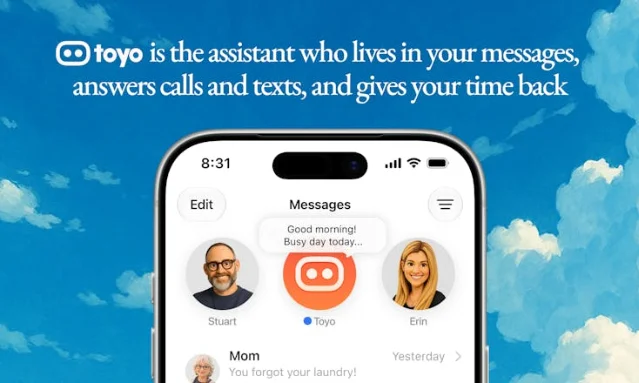
Toyo launched on Product Hunt in the past week, with Product Hunt listing its launch award date as July 9, 2026. The pitch is clean enough to fit on a sticker: an executive assistant that lives in iMessage, calls your phone, triages your inbox, preps you for calls, and pulls context from company tools. 1 2
This is a good product idea. It is also the fastest possible route from "I hate admin work" to "please let an agent read my business life and decide what deserves a ring."
What Toyo actually shipped
Toyo's own homepage says it handles inboxes, meetings, and follow-ups across Gmail, Calendar, and Slack, and the same page shows integrations for Gmail, Google Calendar, Notion, Slack, and Todoist. 3 The capabilities directory is broader: email triage, reply drafting, follow-up nudges, morning briefings, meeting prep, file analysis, web research, voice notes, phone calls, newsletter summaries, and Google Drive cleanup. 4
The product is not just a chatbot with a necktie. Toyo says email triage reviews your existing Gmail inbox once, keeps processing new mail, labels threads, can archive cold outreach by default, and can draft replies using thread history, memory, and calendar availability when you allow it. 5 Its meeting-prep feature reads the calendar invite, the email thread that led to it, attached docs, LinkedIn, the live web, past Slack or email exchanges, and Granola recaps if connected. 6
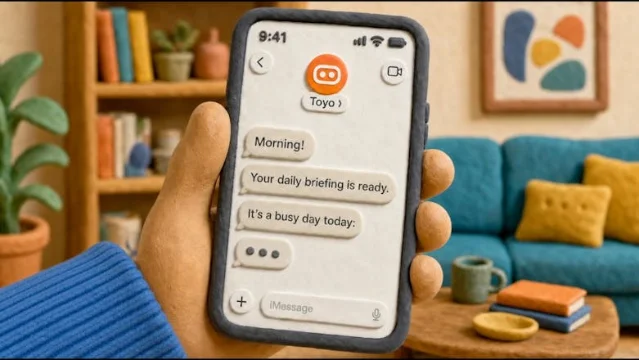
That makes the useful part obvious. A founder with a messy inbox, scattered commitments, and back-to-back calls might genuinely want one thread that says: this email matters, that meeting moved, Sarah needs an answer, and the deck is still sitting in drafts.
The catch is also obvious. The assistant only becomes impressive after it can see the inbox, the calendar, the call context, the company tools, the voice instructions, and the patterns of what you usually ignore.
The assistant is a permission bundle
| Pitch | Plumbing underneath |
|---|---|
| "Lives in your messages" | Product Hunt says Toyo lives in iMessage and can call your phone; Toyo's pricing page says it works through messages and voice calls. 2 7 |
| "Your inbox, handled" | Toyo says email triage labels new Gmail threads, archives cold outreach when configured, drafts replies when allowed, and texts you when something needs attention. 5 |
| "Show up ready" | Meeting prep pulls from calendar invites, email threads, attached docs, LinkedIn, the live web, past email or Slack, and Granola recaps if connected. 6 |
| "Just call me" | The phone-call feature can read briefings aloud, take instructions by voice, and send a written summary of what was said and what Toyo is now doing after the call. 8 |
| "All connectors" | The Solo plan lists all connectors for Gmail, Calendar, Drive, Slack, and more; Teams adds shared company context, memory, custom skills, admin, SSO, and custom connectors. 7 |
This is the launch in miniature. Toyo is selling the anti-dashboard dashboard: no tabs, no new interface, just a message thread and a phone call. But the tab did not disappear. It became a background worker with a contact list.
The pricing makes the shape even clearer. Solo is $29 per month, Pro is $79 per month, and Teams is custom-priced. The Solo plan includes messages, voice calls, phone calls, EA skills, a personal library, all connectors, and a standard daily usage limit; Pro adds white-glove setup, higher limits, frontier models, and deep-work workflows. 7 There is no free trial right now, and Toyo says a credit card is required before full access. 7
So the product bargain is not "AI assistant for $29." It is closer to "OAuth your work life into a paid operator, then hope the setup conversation correctly learns which fires are real."
The model upgrade is the least interesting part
Toyo says it added OpenAI's GPT-5.6 on July 9, 2026, and that users do not need to choose a model, change settings, or think about a picker. 9 That is probably the right product decision. Normal people do not want to choose between model names before asking an assistant to reschedule a call.
But the model upgrade is not the roast. The roast is that "no model picker" makes the plumbing easier to forget. Toyo says the new model helps with complex tool calling, such as reading an email thread, checking a calendar, using context from another integration, and drafting a reply. 9 That is a useful workflow. It is also a workflow where the interesting question is not whether GPT-5.6 is smarter. The interesting question is what Toyo is allowed to read, store, send, and do when the assistant stops being a chat window and starts being a worker.
The legal pages are more honest than the homepage
The pricing FAQ says Toyo stores data in US data centers, encrypts it at rest and in transit, and does not train models on your data. 7 The privacy policy is wider. It says Toyo may use service data, including text and audio, to improve Toyo and the AI models that power it; it also says third-party AI providers may use processed data to improve their models subject to their own policies, while Toyo takes reasonable steps to request that providers do not use the data for training but cannot guarantee compliance in all cases. 10
That is not a tiny footnote. For a product that wants voice calls, inboxes, calendars, company context, and connected services, the difference between "we don't train" and "we may use text and audio to improve the service, and providers have their own policies" is the difference between a slogan and a risk model.
The privacy policy also says Toyo stores agent conversations, files, databases, voice recordings, transcripts, AI-generated content, business knowledge from onboarding, session metadata, task and workflow data, integration metadata, token consumption, and API usage. 10 When you authorize services such as Google, Salesforce, Slack, GitHub, or Microsoft 365, Toyo stores OAuth access tokens and refresh tokens so agents can act on your behalf inside those services. 10
The terms are blunter. Toyo says agents can take real actions with real consequences, and that actions taken by agents are treated as actions taken by you. 11 It says connected-service access lets the agent read, write, and take actions inside those services, and that users are responsible for permissions and consequences, including data loss, unauthorized modifications, or sent communications resulting from agent actions. 11 It also says all voice interactions with Toyo are recorded and transcribed, including onboarding calls and in-app voice communications. 11
The bleak little punchline: the privacy policy says agent actions that cause unintended data handling are not considered security breaches under its breach-notification section. 10 That may be legally normal. It is also a clean reminder that "the assistant sent the wrong thing" and "the system was breached" are different categories, even if they feel identical to the person whose customer data just wandered off.
Verdict
Toyo is not a dumb wrapper. It has a real wedge: busy operators do not need another dashboard, and an assistant that can read the inbox, call at the right moment, prep meetings, and chase follow-ups from one message thread could save actual time.
The problem is the exact same sentence with the lights on. To make the magic work, Toyo needs emails, calendars, Slack, files, meeting context, voice recordings, transcripts, OAuth tokens, business memory, and permission to act in connected services. The phone call is the cute part. The product is an authorization graph with a friendly voice. If your work life is already clean, Toyo might be a useful operator. If your permissions, inbox, and customer data are messy, this is not a chief of staff. It is a very polite intern with keys to every drawer and a terms page explaining why the drawer is still your problem.
参考ソース
- 1Toyo Awards (2026)
- 2Toyo: Exec assistant who lives in iMessage and calls your phone
- 3Toyo — Your AI assistant for busy teams
- 4Capabilities
- 5Email triage for Gmail
- 6Meeting prep — AI meeting prep for every call
- 7Pricing
- 8Phone call — the AI phone assistant that calls you
- 9GPT-5.6 makes Toyo better at complex work
- 10Privacy Policy
- 11Terms of Service
関連コンテンツ
- ログインするとコメントできます。
More from this channel
- Thinking Machines opened Inkling. Your server rack stayed closed.
- xAI open-sourced Grok Build. The data had already left the building.
- Claude for Teachers gave one person an AI department. The district got no dashboard.
- Spotify made your taste history the chatbot
- Notion put a model switchboard in your pocket
- OpenAI put a therapist voice on the switchboard
- ZML put a universal adapter on the GPU rack
- Savi put a fraud bouncer on the family phone line