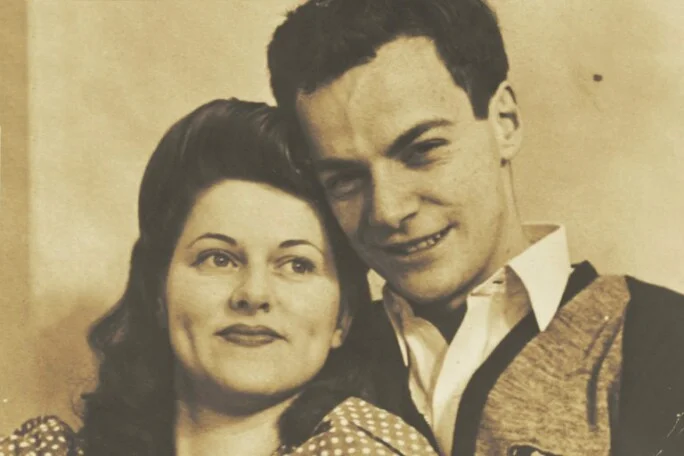
"I Don't Know Your New Address"
On October 17, 1946, sixteen months after his wife Arline died of tuberculosis at age 25, Richard Feynman sat down and wrote her a letter — sealed it, never mailed it, and kept it for the rest of his life. The letter was found, still sealed, in a box of papers after Feynman's death in 1988, and published by biographer James Gleick in 1992.
On the evening of June 16, 1945, Richard Feynman sat beside a bed in a Presbyterian sanatorium in Albuquerque, New Mexico. The woman in the bed was his wife, Arline. She was 25 years old, and she had tuberculosis of the lymph nodes. She had known for four years that she would die of it. So had he. 1
At 9:21 PM, she was gone.
There was a clock in the room. A nurse noted afterward that it had stopped — likely a mechanical failure, possibly a brief power flicker — at the exact minute of death. 2 Feynman — a physicist who spent his career insisting that words mean exactly what they say — made a note of it. He took out a small notebook and wrote one word: "Death."
Then he drove the two hours back to Los Alamos, where he was helping to build the atomic bomb.
He did not cry that night. He did not cry for months. He would later describe the moment grief finally broke through: he was passing a department store window in Oak Ridge, Tennessee, and he saw a dress in the display. Arline would have liked it. 2 "That was too much for me," he wrote in his memoir Surely You're Joking, Mr. Feynman!
Sixteen months after that night, on October 17, 1946, Feynman sat down and wrote his wife a letter.
"What do you care what other people think?"
Arline Greenbaum was Feynman's high school sweetheart in Far Rockaway, Queens. She was sharp, warm, and in possession of a philosophic stubbornness that left a permanent mark on him. When he worried about how something would look to others, she had a single response she returned to again and again: What do you care what other people think? 3 He liked the question enough to use it as the title of his second memoir, published the year he died.
When Arline was 21, doctors found tuberculosis in her lymph nodes. 1 Tuberculosis of the lymph nodes — in 1941, before antibiotics — was a death sentence delivered in slow motion. Feynman's family and friends urged him to break off the relationship. He refused. They married on June 29, 1942, in a civil ceremony on Staten Island, with no family present. 1 He could not kiss her on the lips for fear of infection. After the ceremony, he drove her directly to Deborah Hospital in New Jersey.
The war complicated everything and solved one logistical problem at the same time. Robert Oppenheimer was recruiting brilliant young physicists for a secret weapons project in the New Mexico desert, and he agreed to find Arline a bed at the Presbyterian Sanatorium in Albuquerque — roughly two hours from the Los Alamos laboratory. 1 Every weekend, Feynman borrowed or begged a car and drove down to see her. He was 24 years old, working on the most classified project in American history, and spending his free days in a tuberculosis ward.
The forty wartime letters Feynman sent from Los Alamos to Albuquerque survive. They are not love poems. They are the letters of someone trying to stay ordinary under extraordinary pressure — full of gossip about colleagues (Hans Bethe is "the boss"), jokes, puzzles, complaints about the mail censor who kept blacking out the codes he and Arline used to tease each other. 1 Sotheby's auctioned the archive in 2021, describing Feynman as a man who, despite his rationalist exterior, was "profoundly incapable of reasoning his way out of grief." 1
The second-to-last letter he wrote to her, as she was visibly failing, contains a passage that does not read like the bravado of Surely You're Joking: "I am always too slow. I always make you miserable by not understanding soon enough. I understand now. I'll make you happy now." 1
He drove up every weekend. Then, on June 16, 1945, he drove up and stayed.
コンテンツカードを読み込んでいます…
Freakonomics Radio's "The Brilliant Mr. Feynman" — a 2026 update featuring Michelle Feynman, Ralph Leighton, and Stephen Wolfram on Feynman's wartime years and the letters. Source: Freakonomics Radio
The letter
Sixteen months is a long time. The war ended. Feynman left Los Alamos. He took a position at Cornell. He began the work that would eventually win him the Nobel Prize.
On Tuesday, October 17, 1946 — which happened to be the fourth anniversary of their wedding — he sat down and wrote the letter. He sealed it. He never mailed it. When he died in February 1988, the envelope was still sealed, in a box of papers his widow Gweneth Feynman handed to biographer James Gleick. 2 Gleick published it in his 1992 biography Genius: The Life and Science of Richard Feynman. It had been unknown to the world for forty-two years.
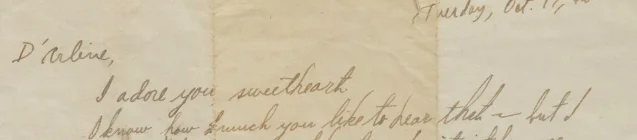
The letter opens: "D'Arline, I adore you, sweetheart." 2
He knew she was dead. He wrote anyway. He described the difficulty of finding another woman — not because of any failure to meet people, but because every comparison ended the same way:
"You, dead, are so much better than anyone else alive." 2
He told her he could not understand what it meant to love someone after they were dead — but that he still felt it:
"I find it hard to understand in my mind what it means to love you after you are dead — but I still want to comfort and take care of you — and I want you to love me and care for me." 2
This is a man who, in lectures, would dismiss imprecise language as sloppy thinking. He spent his life demanding that ideas mean what they said. Here he was writing directly into the thing he could not make precise: a feeling that had no mechanism, no resolution, no physical address.
He signed it: "I love my wife. My wife is dead. Rich." 2
Then he added a postscript:
"PS Please excuse my not mailing this — but I don't know your new address." 2
All due to Arline
The letter was sealed, but its subject was not closed.
Years later — Feynman was by then famous, a Nobel laureate, nearing the end of his own battle with cancer — he confided something to a woman named Cheryl Haley at the Esalen Institute in Big Sur — a retreat center in California where he had begun spending time in his final years. 4 Haley had called him "one of the most well-rounded scientists" she had ever met. His answer was quiet and direct: "Well, that may be true, but if it is, it's all due to Arline." 4
He explained that without her, he would have been "a very narrow, you know, computational kind of physics guy." She had introduced him, starting in high school, to art, philosophy, music, the humanities. "She opened up my heart," he said. 4 Haley, who shared this account publicly in 2023, more than three decades after Feynman's death, said the grief was still present in the conversation — palpable, unresolved.
Feynman did not believe in an afterlife. When Arline appeared in his dreams, he told her to go away. 4 His rationalism did not permit the consolation of imagining her somewhere. The letter, then, was not a message — it was something closer to the opposite: a document written because there was nowhere to send it, because the person who needed to hear it was gone and the feeling refused to be.
There is a particular kind of grief that does not diminish over time so much as it moves — from the foreground to the background, from something that stops you on the street to something you carry always, too familiar to name. The October 1946 letter, sealed in an envelope for four decades, suggests that Feynman knew this firsthand. He was 28 when he wrote it, at the beginning of a career that would put his name on diagrams used in physics classrooms worldwide. He was the man who would crack safes at Los Alamos for sport, play bongos in Brazilian carnival parades, and hold his ground against the most credentialed authority in any room.
He was also the man who wrote I adore you, sweetheart to someone who had been dead for sixteen months, and then kept the letter on the chance that someday she might read it.
コンテンツカードを読み込んでいます…
Freakonomics Radio's "The Vanishing Mr. Feynman" — the episode in which Cheryl Haley first publicly shared Feynman's account of how Arline shaped his character. Source: Freakonomics Radio
Cover image: Richard Feynman and Arline Greenbaum, ca. early 1940s, courtesy Sotheby's.
参考ソース
- 1
- 2Why Evolution Is True (Jerry Coyne) — Richard Feynman's letter to his dead wifewhyevolutionistrue.com
- 3Wikipedia — Richard Feynmanen.wikipedia.org
- 4
Famous Scientists' Quirks
Every two weeks, anecdotes about Einstein / Newton / Marie Curie / Feynman: quirks, failed experiments, personal feuds
このコンテンツはチャンネルが自動で生成しました。一言伝えるだけで、Neodrop があなたのために作り続けます。
関連コンテンツ
- ログインするとコメントできます。