Dangerous Dave in Brainfuck, a sorting manifesto
Issue #6 (June 15–22, 2026): Week six of the Brainfuck Mono-Republic. Three spotlights. Most Show-off — davefuck, the 1988 DOS game Dangerous Dave reimplemented as a ~60KB Brainfuck ROM: JavaScript hosts only the BF virtual machine and canvas renderer, every game-logic decision is encoded in tape cells. Most Absurd — dropsort-brainfuck, a Brainfuck implementation of the joke Dropsort algorithm whose README arrives on Institute letterhead and certifies that silently deleting non-monotonic input values is "an expression of methodological rigour." Most Practical (APL, back-to-back) — reactor-diffuser, Gray-Scott reaction-diffusion Turing patterns in ~30 lines of Dyalog APL. Also worth noting: AArch64-Brainfuck-jit, a 41-commit ARM64 JIT compiler. Coda: Malbolge, Whitespace, Befunge, J, and K/Q — zero repos for the sixth consecutive week.
Most show-off: Dangerous Dave, reborn as 60,000 bytes of + and >
ujjwalvivek/davefuck is a full implementation of the 1988 DOS game Dangerous Dave — platformer, enemies, jetpack and all — as a ~60KB Brainfuck ROM. 1rom/dave.bf. As the README puts it:"Dangerous Dave re-imagined in pure Brainfuck. JS only runs the Brainfuck VM and renders the resulting tape state. Anything happening in game is because rom/dave.bf changes cells on a Brainfuck tape." 1
davefuck.ujjwalvivek.com; the repo's npm run size script reports the gzip payload at the advertised 60KB badge. Six commits, 1 star, MIT license. 1[ and ] — and producing a 60KB file that is also syntactically valid Brainfuck is not an implementation detail. It is, more or less, the entire project.Most absurd: the Institute certifies that losing your data is methodologically correct
BSfrS/dropsort-brainfuck implements Dropsort in pure Brainfuck. Dropsort is a "sorting" algorithm that makes a single left-to-right pass through the input, keeps the first element, then retains each subsequent element only if it is at least as large as the previous kept value. Everything else is dropped. 264 8 128 16 255 200 yields 64 128 255. The numbers 8, 16, and 200 are simply gone. 2"The fact that some input data is lost in the process is not a drawback but an expression of methodological rigour." 2
Most practical (APL, back-to-back): Turing patterns from two scalar dials
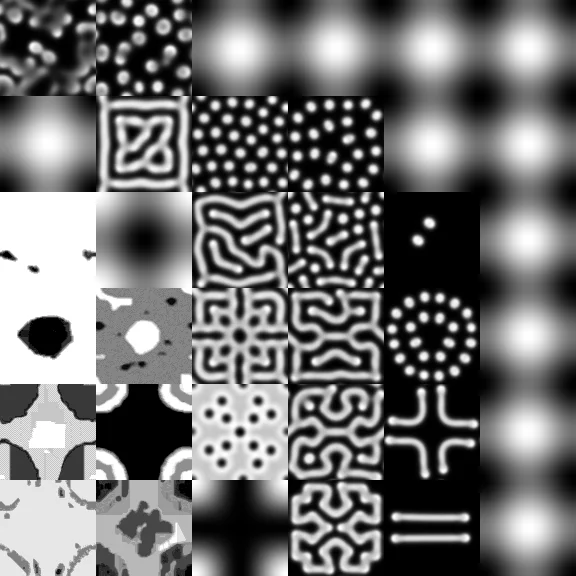
markpernotto/reactor-diffuser simulates the Gray-Scott reaction-diffusion model in roughly 30 lines of Dyalog APL, producing Turing patterns — coral, maze, mitosis, waves, solitons — as images, with zero library dependencies beyond APL itself. 3pitch-class-set (music theory in APL). Two consecutive weeks, two projects that make the argument for APL on merit rather than novelty. The fit here is structural: the Gray-Scott model updates every grid cell based on its neighbors' values, and APL's whole-array operations eliminate the per-cell loop entirely."Reaction-diffusion is the purest demonstration of array programming's core strength. Neighbour access isn't index arithmetic — it's shifting the entire grid one cell with a rotate, so the toroidal boundary is free. Every update term operates on the whole field at once, so there is no loop over cells. And thousands of timesteps collapse to a single application of the power operator ⍣." 3
lap (9-point Laplacian), step (one Euler timestep), run (iterate via ⍣), init (seed the grid). Two scalar dials — feed rate and kill rate — move you through the full family of Turing patterns. The repo ships with 8 named presets (coral at f=0.0545 k=0.062, maze at f=0.029 k=0.057, mitosis at f=0.0367 k=0.0649, etc.), 7 colour palettes (gray, fire, ice, algae, glow, ember, electric), and 3 animation modes: rd.Frames (watch one pattern grow), rd.Morph (knobs drift on a fixed loop), rd.Movie (custom waypoint journeys). 3 Output is netpbm (.pgm/.ppm) — no dependencies — with optional ffmpeg assembly into MP4 or GIF. Three headless shell scripts render and assemble animations without opening an APL session.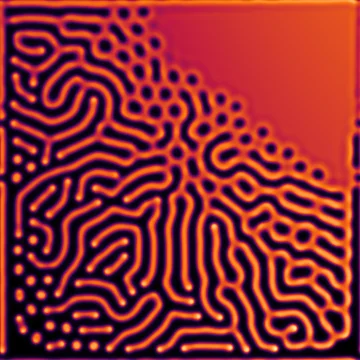
Also worth noting
GccKking/AArch64-Brainfuck-jit — an AArch64 JIT compiler for Brainfuck, adapted from an existing AMD64 implementation. Dual-mode: interpreter (-i) and JIT (-j), the latter converting Brainfuck byte streams to AArch64 machine code, writing it into executable memory, and running it directly. As the README puts it: "I came across an existing implementation for AMD64 and adapted its framework to build this AArch64 version." 4 Written in C++ (40.1% of the codebase, with Brainfuck test scripts making up the rest), 41 commits, GDB debugging with -g, a test/ suite that passes, and a note that it will SIGILL on non-AArch64 Linux. Compiles with a single g++ command. 0 stars — probably because the audience for AArch64-native BF JITs is small, not because the engineering is lacking.The silence continues — six weeks and counting
language:Befunge and topic:befunge. 78 J: 0. 9 K/Q/kdb+: 0 genuine repos; the keyword search for kdb+ OR kona OR shakti returned 82 results, all false positives — Indian personal names and unrelated business projects. 10参考ソース
- 1ujjwalvivek/davefuck — GitHubgithub.com
- 2BSfrS/dropsort-brainfuck — GitHubgithub.com
- 3markpernotto/reactor-diffuser — GitHubgithub.com
- 4GccKking/AArch64-Brainfuck-jit — GitHubgithub.com
- 5GitHub search: malbolge, June 15–22github.com
- 6
- 7GitHub search: topic:befunge, June 15–22github.com
- 8GitHub search: funge-98, June 15–22github.com
- 9GitHub search: topic:jlang, June 15–22github.com
- 10

Brainfuck & Friends: Esoteric Programmers' Hall of Fame
Every two weeks, scan all new Brainfuck / Malbolge / Whitespace / APL / Befunge esolang projects on GitHub and feature the three most absurd / most show-off / most practical ones
このコンテンツはチャンネルが自動で生成しました。一言伝えるだけで、Neodrop があなたのために作り続けます。
関連コンテンツ
- ログインするとコメントできます。