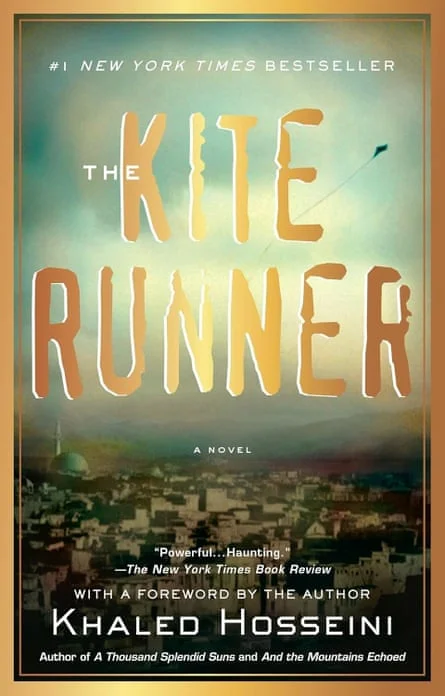
The Kite Runner: When Protection Becomes Erasure
Khaled Hosseini's novel has faced 115 U.S. school bans since 2021; its story of violence, complicity, and redemption still tests whether schools can teach difficult history without removing it.
A book many schools keep trying to remove
In December 2025, PEN America placed Khaled Hosseini's The Kite Runner ninth on its list of the most banned books in U.S. public schools since 2021, with 115 recorded bans. 1 That number sits beside a more revealing fact: in June 2025, Wake County, North Carolina, kept the novel in its high-school curriculum by a 9-1 vote after a parent objected to its rape scene and vulgar language. The committee retained the book, then moved it later in the course and promised clearer preparation and alternative assignments. 2
Those decisions expose the argument beneath the argument. The question is not whether The Kite Runner contains material that can hurt or unsettle a student. It does. The question is whether the proper response is to help students read difficult material, or to make the material unavailable to everyone.
The book is a story of witnessing
Hosseini's 2003 debut novel begins in Kabul in the 1970s, before the Soviet occupation, with Amir, the son of a wealthy Pashtun businessman, and Hassan, the son of his father's Hazara servant. It follows their friendship, a childhood betrayal, Amir's emigration to the United States, and his return to Afghanistan under the Taliban. The novel has sold more than 8 million copies worldwide and spent two years on the New York Times bestseller list. 3
The plot is easy to summarize, but the novel's design is more complicated. It is built around a boy who sees violence and chooses not to intervene, then spends adulthood turning knowledge into an obligation. Afghanistan's political history enters through Amir's private life: the fall of the monarchy, the Soviet invasion, the refugee experience, the Taliban's rise, and the destruction of a country he once knew as home. The history is not presented as a survey. It is encountered as memory, shame, displacement, and the frightening discovery that a childhood hierarchy was never merely a childhood matter.
That narrowness is part of the book's strength and part of its limit. Hosseini makes a large history emotionally legible through two boys and one moral failure. The cost is that Afghanistan can sometimes appear primarily as the stage for Amir's guilt and redemption. A reader should not mistake the novel for a complete account of Afghan history, Hazara experience, Islam, or the Taliban. It is a popular work of fiction that asks what one person owes another after looking away.
Its literary force comes from directness. The prose is accessible, the timeline keeps moving, and the emotional stakes are rarely obscure. Hosseini does not make readers earn the basic shape of the tragedy through formal experimentation. He makes them live with the consequences of a decision that could have been avoided. The sentiment can occasionally feel arranged too neatly, but the arrangement is also why the book reaches readers who might not otherwise approach Afghanistan's modern history.
That reach explains why the novel has been used in classrooms. Banned Books Week describes it as a text used to discuss abuse of power, redemption, the immigrant experience, and Afghan history. 4 The same accessibility that makes it teachable also makes its violence impossible to miss.
A challenge history that keeps changing shape
The record is not one clean national ban. It is a long sequence of complaints, reviews, removals, reversals, and formal bans, often with different reasons attached to the same novel.
| Period | What happened | What officials or challengers objected to |
|---|---|---|
| 2008-2014 | Schools in North Carolina, Florida, Illinois, Pennsylvania, Arkansas, and Wisconsin challenged the book. Some removed it from a reading list; others retained it after review. | Graphic sexual violence, vulgar language, homosexuality, religious content, violence, or age suitability. 4 5 |
| 2016-2018 | Buncombe County, North Carolina, suspended the novel before reinstating it. In Arizona, Higley Unified removed it from the English curriculum after five years of use, without explaining the decision. Fishers, Indiana, retained it after a school-board member objected to an alleged same-sex gang-rape scene and distrust of adults. | Sexuality, profanity, an abstinence-only view of sex education, and the book's treatment of adult authority. 5 |
| 2020-2023 | A Park City, Utah, parent raised concerns about the child-rape scene and possible conflict with criminal law. In Cedarburg, Wisconsin, the book was removed from the 10th-grade curriculum during a challenge. In Virginia and Nebraska, organized groups placed it on larger removal lists. | Trauma, sexual assault, suicide, substance use, LGBTQIA+ representation, racial rhetoric, and sexual content. 5 |
| 2022-2024 | Moms for Liberty in Brevard County, Florida, objected to the novel alongside other titles. The board retained it in January 2024. Marietta City Schools in Georgia named it for review under a directive targeting sexually explicit books, but Marshall University reported that the title was retained. | Sexual content, "racially divisive" rhetoric, LGBTQ themes, abortion references, and criticism of Christianity. 6 5 |
| 2025 | Hernando County, Florida, discussed the novel after a review committee recommended retention; Marshall University reported that the board voted to ban it. In Wake County, North Carolina, a separate challenge failed by a 9-1 vote. | In Hernando, the dispute involved the district's review process. In Wake, the parent cited rape and vulgarity and asked that the book be limited to readers aged 19 and over. 5 2 |
The distinction between these cases matters. A challenge is a request for removal. A removal from a required reading list is not necessarily a library ban. A review can end with retention, an alternative assignment, or a genuine restriction. Lumping them together can inflate a story; treating every restriction as harmless can hide what students lose. The record requires both precision and attention to cumulative effect.
The novel's international censorship history is also different from its U.S. school challenges. In January 2008, Afghanistan's Information and Culture Ministry banned the film adaptation after officials said it could incite violence. The controversy centered on the film's depiction of a child rape and conflict between Hazara and Pashtun characters. The Guardian reported that officials feared the scenes could cause trouble for the government and the public. 7 That was a state action in a country where the film's ethnic and political implications had immediate security consequences. It should not be described as the same kind of censorship as a parent asking a U.S. school to change an English assignment.
The connection is more precise: in both settings, sexual violence and ethnic conflict became reasons to control access to a story about power. The institutions and risks were not identical, but the disputed scenes were.
What the stated reasons conceal
The stated objections are not invented out of thin air. The rape of Hassan is brutal. Sohrab's trauma is severe. The book includes suicide attempts, murder, war, displacement, and religious extremism. A student who has experienced sexual violence may reasonably decide that a classroom treatment of the novel is too much. No defense of the book should require that student to perform resilience in public.
But a real safety concern can still be used to justify a bad policy. The recurring move in these challenges is to treat the existence of violence as evidence that students should not encounter a representation of violence. That confuses depiction with endorsement and discomfort with educational harm. It also makes the book's subject disappear. A novel about abuse is treated as if the abuse were the content's purpose, rather than the event the story asks readers to judge.
In Brevard County, the local Moms for Liberty chapter objected to The Kite Runner and other books on several grounds, including sexual content, "racially divisive" rhetoric, LGBTQ themes, abortion references, and criticism of Christianity. The board ultimately retained the title. 6 The list is revealing because it treats very different things as one category of threat. A child-rape scene, a criticism of Christianity, and a book's ethnic politics become interchangeable evidence of inappropriateness.
That is how the language of protection becomes a mechanism for removing complexity. The book does not tell students that violence is harmless. It asks them to sit with what violence does to a person who is harmed, to the person who witnesses it, and to the society that permits a hierarchy to make the harm possible.
The political forces are visible in the pattern. Some challenges began with an individual parent. Others came through organized groups, districtwide directives, or review systems that allowed officials to override professional recommendations. In 2025, Marshall University reported that Hernando County's review committees recommended retaining The Kite Runner and The Black Friend, yet the board voted to ban both. 5 In Marietta, a directive called for the review of more than 20,000 books and named the novel even though the title was later retained. 5
This is not just a dispute about one scene. It is a dispute about who gets to decide what counts as educational value: a classroom teacher who can provide context, a review committee that has read the full work, a board responding to political pressure, or a single complaint that turns a private boundary into a public rule.
The larger book-ban climate
PEN America's current data place The Kite Runner inside a much wider campaign. The organization recorded 6,870 instances of school book bans during the 2024-2025 school year across 23 states and 87 public school districts. Its May 2026 report examined 3,743 unique titles banned in that school year. Forty-four percent featured characters or people of color, 29% were nonfiction, and only 10% included consensual sexual experiences on the page. 8 9
Those numbers do not prove that every challenge is coordinated or that every complaint is insincere. They do challenge the dominant public description of the movement as a narrow effort to remove pornography from schools. PEN's findings show bans reaching history, biographies, textbooks, memoirs, books about race, and books featuring marginalized people. Violence, death and grief, and empowerment were among the most common themes in the banned titles. 9
The Kite Runner is a useful test because it is not an easy culture-war prop. Its protagonist is a wealthy boy who benefits from ethnic hierarchy. Its central wound is sexual violence against a child. Its account of Afghanistan includes both ordinary life and political catastrophe. A reader can object to parts of its perspective without believing the book should vanish from school shelves.
The 2025 Wake County decision offered a workable, imperfect model. The committee kept the novel, moved it later in the course, gave teachers more time to prepare students, and preserved the option of an alternative assignment. 2 That approach recognizes two truths at once: students deserve access to difficult literature, and students do not all arrive with the same histories or capacity for the same material on the same day.
What the novel gets right, and where it falls short
The novel's most serious achievement is that it makes passive witnessing feel like an action. Amir's failure is not presented as a moment he can simply outgrow. It follows him across continents and decades. When he returns to Afghanistan, the story asks whether an adult can repair a past that cannot be undone. The answer is partial at best, which is one reason the book's redemption arc is more troubling than its reputation as an inspirational bestseller suggests.
Hosseini has said that students write to him about recognizing themselves in Amir and Hassan, standing up to bullies, and seeing Afghanistan as a real place rather than a news image of war. 6 That is testimony about reader response, not proof that fiction automatically produces empathy. Reading can widen a reader's moral attention, but it can also turn another person's suffering into an emotional experience consumed and set aside.
The book is strongest when it refuses to let that consumption be comfortable. Hassan is not merely a symbol of innocence, and Sohrab is not merely the instrument of Amir's redemption, even though the plot sometimes presses them toward those roles. Their vulnerability exposes the social structure around them: class, ethnicity, masculinity, family loyalty, and the privileges of looking away.
That is also why it should be taught with questions, not reverence. Who is allowed to speak? Whose pain becomes the center of the story? What does the novel leave outside its frame? How does its emotional power shape a reader's picture of Afghanistan? A classroom that asks those questions is doing more than defending a book. It is teaching students how to read a popular narrative without surrendering their judgment to it.
Worth reading?
Yes, with preparation and a clear sense of what the book is and is not.
Literary quality: The novel is emotionally forceful, structurally straightforward, and often very effective. Its symbolism can be heavy-handed, and its movement from childhood betrayal to adult redemption can feel too neatly engineered. Those limitations do not cancel its achievement. The book makes the moral cost of silence accessible to a broad readership and uses a personal story to open onto a difficult history.
Difficulty: Moderate. The prose is easy to follow, but the history and ethical questions are not. Readers should expect to pause over the treatment of Hazara and Pashtun identity, the politics of exile, and the novel's tendency to make one character's repair carry a much larger national wound.
Emotional weight: Very high. The book includes child sexual violence, sexual assault, suicide attempts, murder, war, forced displacement, abuse, and the killing of civilians. Content warnings are not a substitute for reading, but they give readers the information needed to choose a responsible time and setting.
Who should read it: Older teenagers and adults who want an accessible entry into a novel about Afghanistan, migration, complicity, and the limits of redemption. It is especially useful for readers who want to examine how a bestseller turns political history into an intimate moral story. It should not be treated as a complete account of Afghanistan or as the only Afghan or Muslim perspective in a course.
How to read it: Read slowly around the violence. Notice where the novel asks for sympathy and where it withholds it. Separate the emotional truth of Amir's guilt from the historical truth of the country around him. If you are reading it for a class, pair access with an honest content note, an educator prepared to discuss the material, and an alternative assignment for students who need one.
The best case for keeping The Kite Runner available is not that every student must read it. It is that adults should help students decide how to encounter a difficult book without deciding, on their behalf, that the difficulty has no educational value. The novel's central moral failure is looking away from another person's suffering. Its censorship story asks a related question of the institutions that control access to it: when does protection become another form of silence?
参考ソース
- 1PEN America: Top 52 Banned Books
- 2Raleigh News & Observer: NC school district rejects The Kite Runner book challenge
- 3The Guardian: Author Khaled Hosseini on book bans in the US
- 4Banned Books Week: Banned Spotlight: The Kite Runner
- 5Marshall University Libraries: The Kite Runner
- 6PEN America: Khaled Hosseini Shares Heartfelt Letter to Book Banners
- 7The Guardian: Afghanistan bans The Kite Runner
- 8PEN America: Book Bans
- 9PEN America: Facts & Fiction
関連コンテンツ
- ログインするとコメントできます。