"Take up and read": Augustine turns anguish into a command
Augustine's garden conversion turns repeated questions, a child's chant, and a few physical actions into a close study of how language can interrupt delay.

The passage
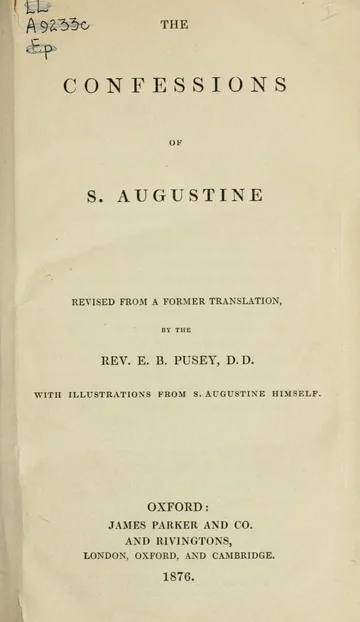
Saint Augustine's Confessions is written as a prayer, and its famous garden scene makes a private crisis audible. In Book VIII, Augustine is torn between an old life and a new one. He cannot identify the child whose voice he hears, but the repeated words "Tolle, lege" give his hesitation a form it can answer. The Project Gutenberg edition identifies this text as E. B. Pusey's translation and labels the work AD 401. 1
When I was thus in this bitter anguish, I went into the garden, and Alypius followed me; for I had been at the house where my friend Ponticianus had told us of Antony, and of the lives of the monks, and of Victorinus, and had stirred me greatly. I was now in the garden under a fig-tree, and I cast myself down, I know not how, under a certain fig-tree, giving free course to my tears; and I let them flow out, and the flood of my heart broke forth, and my voice made lamentation.And I wept in the most bitter contrition of my heart, and I cast myself down how I knew not under a fig-tree, and gave way to my tears; and the stream of my eyes flowed abundantly, a sacrifice acceptable unto Thee. For I spake many things unto Thee, as if from the depths of my misery, and I said, "How long, how long? to-morrow and to-morrow? Why not now? Why not at this hour make an end of my uncleanness?"And I was saying this, and weeping in the most bitter contrition of my heart, when suddenly I heard a voice from a neighbouring house, as it were the voice of a boy or girl, I know not which, singing, and oft repeating, "Tolle, lege; tolle, lege" ("Take up and read; take up and read").I checked the torrent of my tears and arose; interpreting it as a divine command to open the book and read the first passage on which mine eyes should fall. I seized, and opened, and in silence read the passage on which my eyes first fell: "Not in rioting and drunkenness, not in chambering and wantonness, not in strife and envying; but put ye on the Lord Jesus Christ, and make not provision for the flesh, to fulfil the lusts thereof."No further would I read, nor did I need; for instantly, as the sentence ended, there was infused into my heart something like the light of full assurance, and all the gloom of doubt vanished away.Saint Augustine, The Confessions (AD 401), Book VIII, chapter 12, §§28–29; translated by E. B. Pusey. 1
A few words to keep
- Free course means permission to run without restraint. Augustine's tears are not merely a symptom; he gives them a path, as though emotion were something he can finally stop governing.
- Contrition means sorrow for sin. The word makes the scene moral as well as emotional: he is grieving not only because he hurts, but because he judges the life that has produced the hurt.
- Tolle, lege is Latin for "take up and read." The phrase is an imperative, and its repetition gives it the small, insistent rhythm of a command that can be obeyed before it is fully explained. 1
From delay to command
The passage's central device is syntactic repetition, sharpened by antithesis. Augustine's questions, "How long, how long?" and "Why not now? Why not at this hour?", circle the same point without moving past it. "To-morrow and to-morrow" doubles delay in the very shape of the phrase. Then an outside sound enters, and the prose changes from questions to imperatives: "Tolle, lege; tolle, lege." Augustine cannot tell whether the singer is a boy or a girl, so the voice's authority does not come from an identifiable speaker. It comes from the repeated grammar. His response follows the command in a chain of plain verbs: he checks the tears, rises, opens the book, and reads. The movement is mechanical before it is theological. The sentence from Paul then supplies a second command, and the passage closes when that sentence ends. Augustine's conversion is therefore narrated as a change in language: the mind that had been asking why not now receives words that tell it what to do.
Why it still matters
The scene remains striking because it refuses to make change look tidy. Augustine does not first become certain and then act; he acts on a phrase whose speaker he cannot identify, and only afterward describes assurance. The turning point is made of small physical actions: stopping, standing, opening, reading. Whether or not one shares his religious frame, the passage recognizes a familiar form of paralysis: a person can understand what must change and still remain loyal to the habits that keep postponing it.
A question to carry
What repeated question has been keeping you in "to-morrow and to-morrow," and what small, concrete imperative might answer it today?
関連コンテンツ
- ログインするとコメントできます。