2026/6/25 · 12:26
8 new species named Thursday: seven new fungal genera rewrite a marine family, and a striped river fish from Zhangjiajie
Thursday June 25, 2026 brought 8 confirmed new species plus 3 further likely additions across MycoKeys, ZooKeys, Zoosystematics and Evolution, Zootaxa, WoRMS, Candollea, and Nordic Journal of Botany. The day's centerpiece is a 202-page Halosphaeriaceae monograph in MycoKeys 135 erecting 7 new genera and 14 new combinations in a major marine-fungal reclassification, alongside the single new species Ocostaspora japonica from Tokyo Bay driftwood. Other new taxa include Acrossocheilus zhangjiajiensis (a barred stream fish from Zhangjiajie), three Trilacuna goblin spiders from Sichuan and Hubei, two Baja California polychaetes, a New Zealand soft coral, two Annonaceae trees from Papua New Guinea, and a Pampa rock-dwelling Sinningia.
Thursday, June 25, 2026 — A lighter day by count (8 confirmed new species, with 3 further likely additions from Novataxa-reported journals) but not by taxonomic weight: a 202-page MycoKeys monograph simultaneously erected 7 new genera within the marine fungal family Halosphaeriaceae, reshaping the framework for a group of wood-rotting ocean fungi that may have been diversifying for half a billion years. Elsewhere, a new barred cyprinid surfaces from the upper Li River drainage in Hunan, three goblin spiders appear from Sichuan and Hubei, two Annonaceae trees from Papua New Guinea, and a Pampa rock plant complete the day.
Seven new genera at once: a deep revision of marine fungi that decompose ocean driftwood
The standout publication of the day is not a single species but a family-level overhaul. Abdel-Wahab, K.L. Pang, and 21 co-authors at Mae Fah Luang University (Thailand), King Saud University, National Taiwan Ocean University, and partner institutions have published a 202-page molecular and morphological revision of Halosphaeriaceae in MycoKeys 135. 1
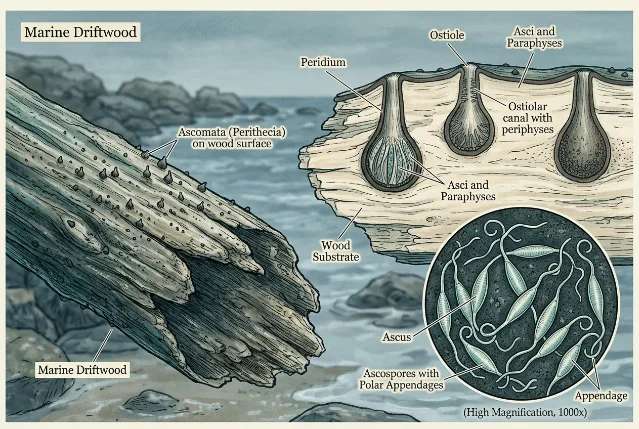
Halosphaeriaceae (order Microascales, class Hypocreomycetidae) are marine pyrenomycetes — small, flask-shaped fungi that colonise submerged wood in intertidal zones, mangrove forests, and open-ocean drift. They were long treated as ecological curiosities, but multi-locus phylogenetics has reshuffled their classification repeatedly over the last two decades. This monograph consolidates that work into a single authoritative treatment, recognising 77 genera and 202 species.
Seven of those genera are entirely new to science, all created to accommodate species that no longer fit neatly in their old assignments. 1
| New genus | Authors | Type species (new combination) | Notes |
|---|---|---|---|
| Neoaniptodera | Abdel-Wahab, K.L. Pang, P. Correia & E.B.G. Jones | N. juncicola comb. nov. | Index Fungorum no. 903245 |
| Neogesasha | Day., Abdel-Wahab, M.F. Caeiro & K.L. Pang | N. mangrovei comb. nov. | Mangrove-associated |
| Neohalosarpheia | Abdel-Wahab, K.L. Pang & P. Correia | N. marina comb. nov. | Marine wood |
| Pangia | Abdel-Wahab, M.F. Caeiro & E.B.G. Jones | P. limnetica comb. nov. | — |
| Remisporiopsis | K.L. Pang, E.B.G. Jones, E. Azevedo & M.F. Caeiro | R. macrocephala comb. nov. | Accommodates 5 species |
| Sheareromyces | Abdel-Wahab, Maharachch. & E.B.G. Jones | S. aquibella comb. nov. | Honours mycologist Gareth Jones (Shearer) |
| Shiiraspora | — | S. salsuginosa comb. nov. | Moved from Aniptodera |
The monograph also places 14 additional species into new combinations, including five now assigned to Remisporiopsis (R. macrocephala, R. quadri-remis, R. spitsbergenensis, R. stellatus, R. submersa). At the same time, the authors reject a competing classification published by Correia et al. in 2023 that had split the large genus Corollospora into ten smaller units (including genera such as Ajigaurospora); they retain Corollospora as a single, inclusive genus. 1

The single genuinely new species in the monograph is Ocostaspora japonica Abdel-Wahab & E.B.G. Jones, sp. nov. (Index Fungorum no. 904210), isolated from driftwood on the intertidal shore of Sarushima Island (猿島), a small uninhabited island in Tokyo Bay. 1 Its ascospores carry two polar appendages and two equatorial appendages, with the equatorial pair having a spoon-shaped (spatulate) base — a combination of appendage types not described in any other Ocostaspora species. The appendages likely function as attachment structures on submerged wood surfaces or as flotation aids in seawater.
A molecular clock analysis embedded in the monograph estimates the origin of Halosphaeriaceae at roughly 545 million years ago (95% confidence interval: 351–846 Ma) — a date falling in the Cambrian, when multicellular animals were only beginning to diversify in the oceans. The uncertainty range is wide, but the mean estimate puts marine fungal colonisation of driftwood as among the oldest lineages in the class. Not yet IUCN assessed; no individual species in the family currently holds a Red List category.
A new barred fish from the headwaters of the Li River system, Zhangjiajie
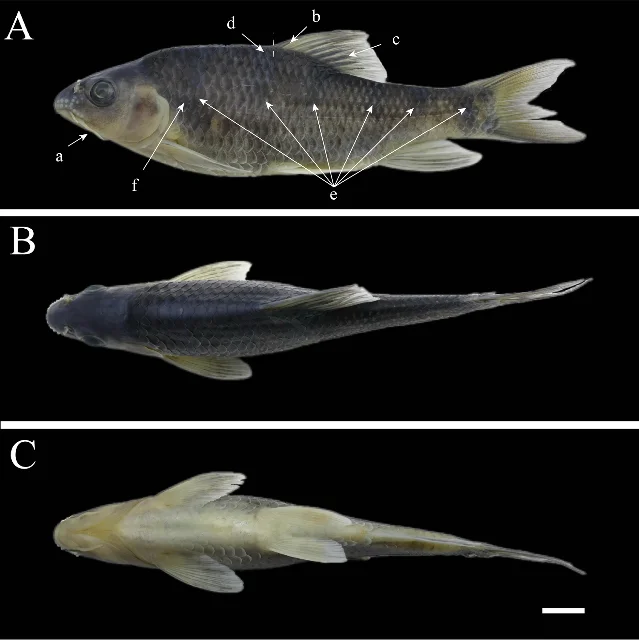
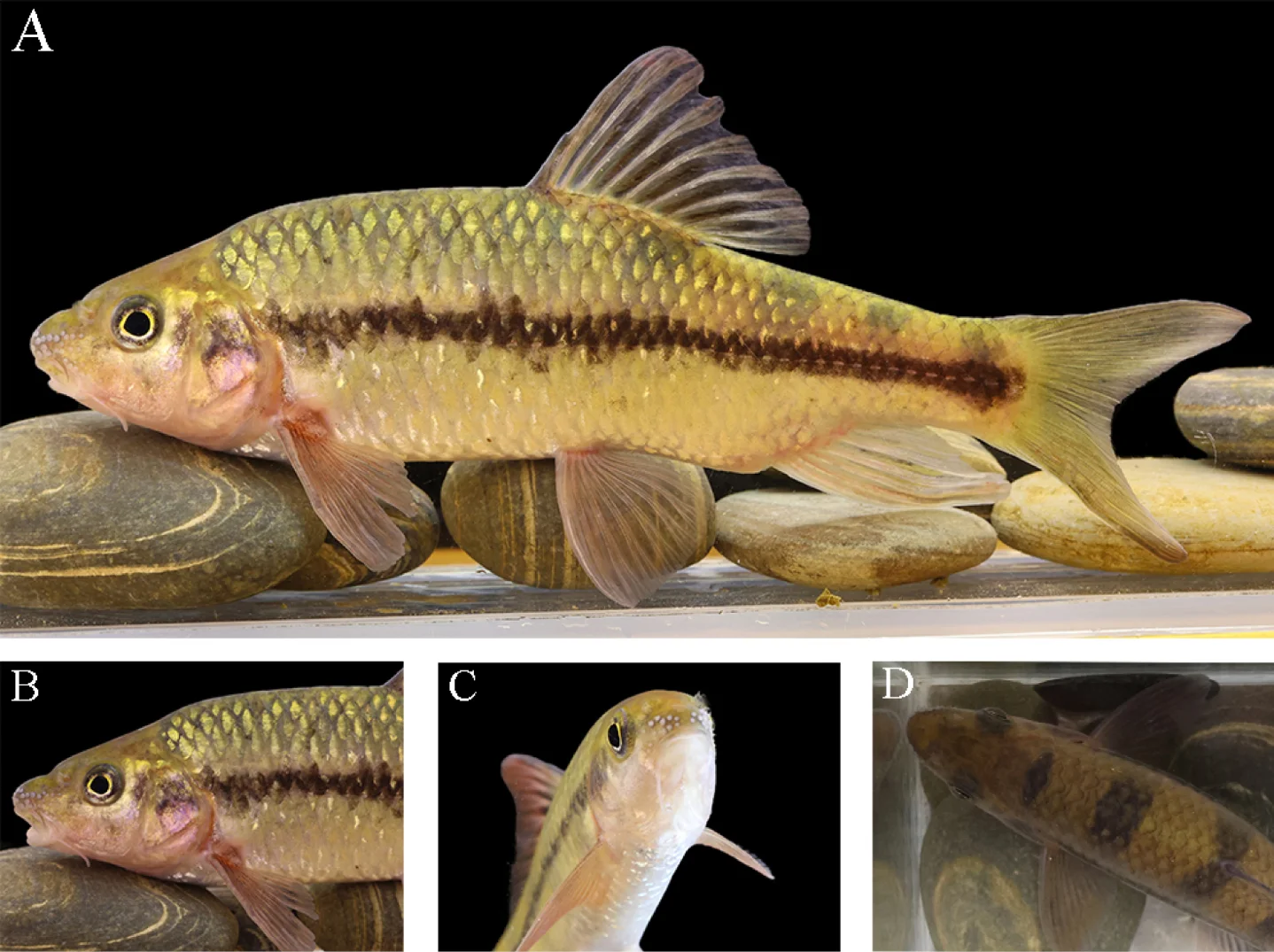
Jiang, Cao, Deng, and Wei (Jishou University — Zhangjiajie Campus; Hunan Agricultural University; Northeast Forestry University; and the Zhangjiajie Giant Salamander National Nature Reserve) describe Acrossocheilus zhangjiajiensis — the 25th species in the East and Southeast Asian barred-barbel genus Acrossocheilus (Cypriniformes: Cyprinidae). 2
Taxonomy: Animalia → Chordata → Actinopterygii → Cypriniformes → Cyprinidae → Acrossocheilus Oshima, 1920.
The type locality is Bamaosi Village, Wudaoshui Town, Sangzhi County, Zhangjiajie City, Hunan Province — a tributary of the northern headwaters of the Li River (upper Lishui), part of the Yangtze drainage. The stream is shallow, clear, with a gravel substrate and dense bankside vegetation.
Distinguishing characters:
- Six black vertical bars on the flanks, present from juveniles through adults (most Acrossocheilus species lose or fade these with age)
- Upper maxillary barbels extending to the level of the mid-eye
- Last unbranched dorsal-fin ray slightly hardened, smooth on the posterior edge
- Black stripes on the dorsal-fin membrane
- Pre-ventral band 2 (PVB2) positioned anterior to the dorsal-fin origin
- Fewer than 40 lateral-line scales
COI barcode divergence from the sister species A. jishouensis — itself named for Jishou, Hunan — is 3.1%, and 13 protein-coding mitochondrial genes show 3.3% divergence, well above typical intraspecific variation. Eleven morphometric measurements differ significantly between the two (P ≤ 0.05). The complete mitochondrial genome is 16,592 bp. 2
The holotype (JWS2024296; 120.4 mm standard length) and 11 paratypes (80.6–157.8 mm SL) are deposited at the Molecular Ecology Laboratory, Jishou University Zhangjiajie Campus. Not yet IUCN assessed.
Three goblin spiders from China's mountains — size of a sesame seed, built differently inside
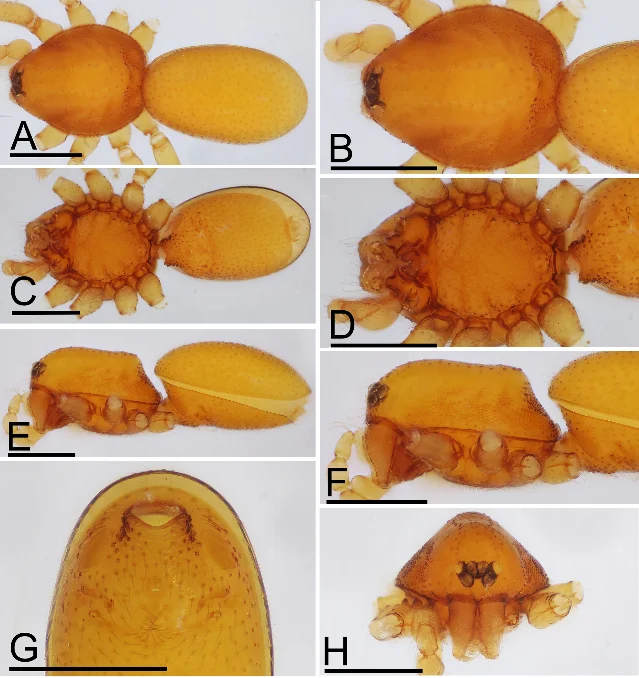
Tong and Li (Shenyang Normal University) describe three new members of the goblin-spider genus Trilacuna Tong & Li, 2007 in ZooKeys 1283, pushing the global species count in this small-bodied family from 55 to 58. 3

Taxonomy: Animalia → Arthropoda → Arachnida → Araneae → Oonopidae → Trilacuna.
Trilacuna belongs to the "Dysderoides complex" of Oonopidae (six-eyed goblin spiders), sharing cheliceral and labial characters with close relatives Bannana, Dysderoides, and Himalayana. At 1.6–1.9 mm body length, all three new species fall within the range typical of the genus. Species-level identification in Trilacuna relies almost entirely on male palp (copulatory organ) and female vulva structure, since external appearance is nearly uniform. 3
Trilacuna batang Tong & Li, sp. nov. (♂♀) — collected from Sangdagou, Zhubalongxiang Township, Batang County, Sichuan (29°59ʹN, 99°07ʹE; 2,500 m elevation) in June 2009. The male palp has a triangular, globular cymbium with a prominent leaf-shaped lobe (lsl). Holotype male SYNU-903; two female paratypes SYNU-904–905. 3
Trilacuna kangding Tong & Li, sp. nov. (♂♀) — from Shelian Township, Kangding City, Sichuan (30°13ʹN, 102°11ʹE; 1,472 m), with additional paratypes from Moxi Town, Luding County. The male palp cymbium is kidney-shaped, and the sternum bears multiple rows of posterior ridges — a feature not seen in T. batang. 3
Trilacuna shennongjia Tong & Li, sp. nov. (♂♀) — the most widely distributed of the three: the type locality is Muyu Town, Shennongjia Forest District, Hubei (31°29ʹN, 110°22ʹE; 1,432 m), with paratypes from four sites in Chongqing's Chengkou and Wuxi counties, spanning 1,284–1,578 m. Males carry a strongly darkened, blade-like keel (the "ksl") on the palp; females have a wing-shaped structure (wls) on the vulva. 3
All type material is deposited at Shenyang Normal University (SYNU). None of the three has been IUCN assessed.
Two new polychaetes from a shallow lagoon in Baja California
From the soft-bottomed floor of Laguna de La Paz, a sheltered coastal lagoon at the southern tip of the Baja California Peninsula, Cardona-Gutiérrez (Instituto Politécnico Nacional, CICIMAR) and Tovar-Hernández (Universidad Autónoma de Nuevo León) describe two new worms in the marine annelid family Pilargidae (Phyllodocida), both registered in the World Register of Marine Species on June 24, 2026. 4
Taxonomy: Animalia → Annelida → Polychaeta → Phyllodocida → Pilargidae.
Cabira mexicana sp. nov. — type locality 24.13°N, 110.41°W, 2.8 m depth; sediment dominated by mud and clay with low to moderate organic matter. Holotype UANL-8295 (Universidad Autónoma de Nuevo León). The species epithet mexicana is a topographic adjective referring to Mexico. 4 WoRMS AphiaID 1898014.
Litocorsa ambigua sp. nov. — type locality 24.13°N, 110.39°W, 2.0 m depth; highest abundances in fine-grained silty-sand stations at depths between 2 and 6.4 m. Holotype UANL-8296. The species name ambigua ("ambiguous") was chosen because this species carries furcate (Y-shaped) chaetae — a character that normally diagnoses the closely related genus Synelmis, not Litocorsa. The combination of characters from both genera makes its placement uncertain at first inspection. 4 WoRMS AphiaID 1898015.
Neither species has been IUCN assessed.
A second species for a rare New Zealand soft coral
Aquaumbra aranea Korfhage & Freiwald, 2026 (Cnidaria: Octocorallia: Malacalcyonacea: Aquaumbridae) was described from Fiordland on the southwest coast of New Zealand's South Island (Te Waipounamu / Aotearoa), and registered in WoRMS on June 24. 5 6
Taxonomy: Animalia → Cnidaria → Anthozoa → Octocorallia → Malacalcyonacea → Aquaumbridae → Aquaumbra.
The genus Aquaumbra was previously monotypic, containing only A. klapferi Breedy, van Ofwegen & Vargas, 2012, described from shallow tropical waters off Costa Rica. The addition of A. aranea from the cold, deep fjords of Fiordland — more than 10,000 km away — expands the genus's known geographic range dramatically, and represents the family Aquaumbridae's first confirmed record from the temperate Southern Ocean. Authors are S.A. Korfhage, I.B. Baums, K.E. Schnabel, and A. Freiwald. Not yet IUCN assessed.
Two new Annonaceae trees from Papua New Guinea
Zacky Ezedin (Harvard University Herbaria) describes two new species of the tropical tree family Annonaceae in Candollea 81(1), both from Papua New Guinea. 7
Taxonomy: Plantae → Angiosperms → Magnoliales → Annonaceae.
Goniothalamus metadoxus Ezedin, sp. nov. — a small to medium tree reaching up to 15 m, from the Papuan Peninsula. The genus name Goniothalamus refers to the flower structure (Greek: gonia, angle; thalamos, inner chamber); the epithet metadoxus combines meta- (altered, changed) and doxus (appearance), pointing to the flower's inverted aspect. In most Goniothalamus species, outer petals exceed inner petals in size; in this species, the outer petals are so strongly reduced that the inner petals appear dominant — the opposite of the family's typical pattern. The inner petals also carry a densely silky (sericeous) indument that gives the flower a silvery-white sheen, while the staminal connectives extend into pinkish-lavender apiculate tips. 7
Uvaria chrysoflora Ezedin, sp. nov. — a woody climber (liana) from the Sepik River basin, the great lowland river system of northern Papua New Guinea. The name chrysoflora ("golden flower") refers to the greenish-yellow petals — a colour essentially unknown in Uvaria from Papuasia, where virtually all congeners have red flowers. It most closely resembles U. concava but differs in having smaller leaves and larger flowers. 7
Neither species has been IUCN assessed.
A rock-dwelling Sinningia from South American grasslands
Sinningia pampeana G.E.Ferreira & Chautems, 2026 (Gesneriaceae) is a rupicolous (rock-face-dwelling) species from the Pampa biome — the subtropical grasslands spanning southern Brazil and Uruguay. 8
Taxonomy: Plantae → Angiosperms → Lamiales → Gesneriaceae → Sinningia Nees.
Sinningia (African violet relatives, family Gesneriaceae) is a well-known ornamental genus with roughly 70 species, most concentrated in Brazil's Atlantic Forest, cerrado, and campos rupestres. S. pampeana extends the genus's documented range into the Pampa, a biome with comparatively few plant endemics described in the botanical literature. The species grows on rocky outcrops, a microhabitat that dots the otherwise grassy Pampa landscape. Not yet IUCN assessed.
参考ソース
- 1Abdel-Wahab et al. 2026 — Halosphaeriaceae monograph, MycoKeys 135
- 2Jiang et al. 2026 — Acrossocheilus zhangjiajiensis, Zoosystematics and Evolution 102(3)
- 3Tong & Li 2026 — Three new Trilacuna, ZooKeys 1283
- 4Cardona-Gutiérrez & Tovar-Hernández 2026 — Two new Pilargidae, Zootaxa 5837(3)
- 5WoRMS — Aquaumbra aranea Korfhage & Freiwald, 2026
- 6Korfhage et al. 2026 — Aquaumbra aranea, Zootaxa 5837(2)
- 7Ezedin 2026 — Two new Annonaceae from PNG, Candollea 81(1)
- 8Ferreira, Spiazzi, Barbieri, Chautems & Araújo 2026 — Sinningia pampeana, Nordic Journal of Botany


このコンテンツについて、さらに観点や背景を補足しましょう。