



When Washington ends the deal: Broadcom's $121 billion hostile bid for Qualcomm
2026/6/17 · 8:38

When Washington ends the deal: Broadcom's $121 billion hostile bid for Qualcomm

In November 2017, Broadcom CEO Hock Tan launched a $103B → $121B unsolicited bid for Qualcomm — the largest hostile takeover attempt in tech history. What followed was 129 days of proxy battles, a Valentine's Day standoff, and a presidential executive order that ended the deal in March 2018. The case turns on four reusable frameworks: the super poison pill, the CFIUS jurisdiction race, the $8.3M vs. $85K lobbying asymmetry, and the engagement theater trap when a target's hidden preference is 'wrong buyer' rather than 'wrong price.'

On November 6, 2017, Broadcom Limited (NASDAQ: AVGO), a Singapore-incorporated semiconductor company led by CEO Hock Tan, sent an unsolicited proposal to Qualcomm's board: $70 per share — $60 in cash and $10 in Broadcom stock — for a deal valued at roughly $130 billion including debt. 1 It was the largest attempted hostile takeover in the history of the technology industry.
By March 12, 2018 — 129 days later — President Trump had signed an executive order permanently blocking the deal on national security grounds, making it only the fifth presidential CFIUS block in the committee's four-decade history. 2 It was also the first such block issued before an acquisition agreement had ever been signed, and the first to target a hostile (rather than negotiated) deal.
What makes the Qualcomm case worth studying is not just the outcome. It is the way two entirely different theories of how the semiconductor industry should work collided — on the proxy ballot, in the boardroom, in congressional hearing rooms, and finally in a Pentagon conference room four hours before the order arrived.
Qualcomm's brand recognition in wireless standards was central to the national security argument CFIUS made against the deal. 3

The parties and their asymmetries

BroadcomQualcomm
Stated objectiveCreate a global comms leader; maximize shareholder returnsPreserve independence to execute 5G R&D strategy and NXP acquisition
Hidden objectiveAcquire Qualcomm's high-margin chip business; restructure its "broken" IP licensing model; cut R&D overheadUse any available lever — including CFIUS — to kill a deal the board believed permanently undervalued the company
BATNAWage a proxy fight to elect 6 of 11 Qualcomm directors; force a negotiated sale at $82/shareComplete the $44B NXP deal, making itself more complex and expensive; file a unilateral CFIUS notice to trigger national security review
LeverageISS partial endorsement of 4 of 6 proxy nominees; growing shareholder frustration with Qualcomm's lagging TSR$8.3M in annual federal lobbying (vs. Broadcom's $85,000); DoD classified prime contracts; first-mover CFIUS filing
Key constraintRedomiciliation from Singapore to Delaware — once complete, CFIUS jurisdiction would expireQualcomm's NXP deal required Chinese MOFCOM approval that never arrived; Apple royalty dispute cut into perceived standalone value
Philosophical positionThe semiconductor growth era is over; mature businesses should cut R&D and maximize marginsChip companies that stop investing in standards lose the next cycle; Qualcomm's licensing model reflects legitimate IP investment

Phase 1: the opening bid and the first rejection (November 2017)

Four days before the bid was public, Hock Tan stood in the Oval Office beside President Trump to announce Broadcom's plan to redomicile from Singapore to the United States — a sequence of events that looked, in hindsight, like a deliberate effort to pre-inoculate the deal against national security objections. 4 Tan had considered approaching Qualcomm since August 2016, when an informal conversation with CEO Steve Mollenkopf had gone nowhere. 1
The formal $70/share proposal landed one week before Qualcomm's board rejected it unanimously. Presiding Director Tom Horton's language was pointed: the offer "dramatically undervalues Qualcomm and comes with significant regulatory uncertainty." 5 Mollenkopf privately called the price "not even in the ballpark." 4 Tan's response to the rejection: "We are well-advised and know what our options are, and we have not eliminated any of those options." 5
The options Tan had in mind were on the proxy ballot.

Phase 2: the proxy campaign (December 2017 – February 2018)

On December 4, 2017, Broadcom formally nominated 11 directors to Qualcomm's 11-member board — the maximum possible slate. Qualcomm rejected all 11 on December 22. 3 Broadcom then raised its bid to $82 per share — $60 cash and $22 in stock — a 50% premium over Qualcomm's unaffected November 2 share price and a total deal value of $121 billion, calling it a "best and final offer." 6 The revised bid included new concessions: a ticking fee if the deal failed to close within 12 months, and a "significant reverse termination fee" if regulators blocked it.
Tan also scaled back his board challenge from 11 nominees to 6, calculating that a majority would be enough to force negotiations. After meeting with proxy advisory firm ISS, he got partial validation: ISS recommended shareholders vote for 4 of the 6 Broadcom nominees, citing Qualcomm's "deterioration of fundamentals" and contrasting Broadcom's 1,173.5% total shareholder return against Qualcomm's 74.2% TSR over the same period. 7
Qualcomm responded to the raised bid by simultaneously raising its offer for Dutch chipmaker NXP Semiconductors from $110 to $127.50 per share — lifting the total NXP deal to approximately $44 billion and making itself a more expensive, structurally complex acquisition target. 3 Broadcom countered the same day by cutting its Qualcomm bid by $3/share to $79, arguing Qualcomm was deliberately overpaying for NXP to complicate the takeover math.

Phase 3: Valentine's Day and the philosophy divide (February 2018)

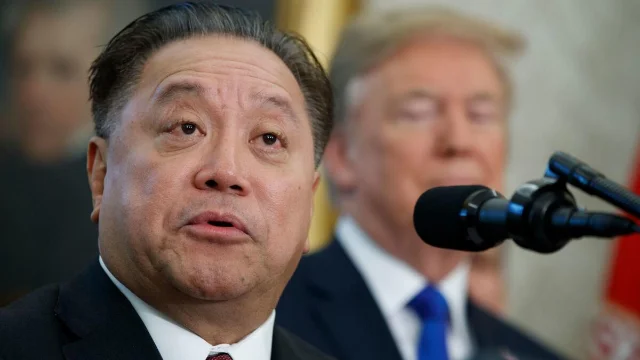
Hock Tan speaks in the Oval Office as President Trump listens, November 2017
Broadcom CEO Hock Tan at the White House on November 2, 2017, announcing redomiciliation plans alongside President Trump — four days before the formal Qualcomm bid. The Oval Office visit would later read as an attempt to establish U.S. credibility before CFIUS nationalized the deal. 4
The only in-person meeting between the two companies' principals took place on February 14, 2018, in New York. Qualcomm sent Chairman Paul Jacobs (son of Qualcomm co-founder Irwin Jacobs), Presiding Director Tom Horton, CEO Steve Mollenkopf, and CFO George Davis. In an unusual move, Tan stepped back and let Broadcom co-founder Henry Samueli — an electrical engineer who had sold his own Broadcom Corp. to Tan's Avago in 2015 for $37 billion — deliver the pitch. Samueli told Mollenkopf and Jacobs to "trust in Hock" and recounted how skeptical he had been before becoming "a convert": "I'm enjoying it a lot and learning a lot from Hock. He's the master." 4 Jacobs and Mollenkopf, both engineers with patents to their names, were unmoved.
The philosophical divide was real and is worth stating plainly. Tan believed the semiconductor industry's high-growth era was finished; the right posture was to acquire strong franchises, eliminate redundant R&D, and return cash to shareholders. He said Qualcomm's IP licensing business was "not sustainable. You can sell products, as Broadcom does, very successfully, and generate a very good return for your shareholders." 8 Qualcomm's board viewed Tan, according to the LA Times, as "an opportunistic financial engineer who lacked appreciation for the kind of long-maturity R&D that the semiconductor industry needs." 4
A second meeting on February 23 made progress on non-price terms but collapsed on valuation. Qualcomm delivered a marked-up merger agreement — including a demand for a 9% enterprise value reverse termination fee and a regulatory efforts provision requiring Broadcom to "do whatever is necessary" — then proposed further engagement in a February 26 letter from Jacobs: "It is the Board's responsibility to critically analyze all of the external and internal information available to us." 9 Broadcom dismissed the letter as "engagement theater." 3
By early March, vote counting showed four of Broadcom's six nominees ahead by comfortable margins. Inside Qualcomm, according to the LA Times, "the mood was bleak." 4

Phase 4: CFIUS moves in (January 29 – March 12, 2018)

The decisive blow had actually been set in motion five weeks earlier, on January 29, when Qualcomm filed a unilateral voluntary notice with the Committee on Foreign Investment in the United States (CFIUS), requesting review of Broadcom's proxy solicitation. 2 No acquisition agreement existed; no formal deal had been announced. Broadcom publicly called the move a "blatant, desperate act." 10 It was, in fact, a carefully constructed legal strategy executed by a Covington & Burling team that included former Senator Jon Kyl.
Qualcomm spent $8.3 million on federal lobbying in 2017 — roughly 100 times Broadcom's $85,000. 4 Many of the Washington contacts Broadcom tried to hire were already working for Qualcomm. Senator John Cornyn (R-TX), co-sponsor of the pending FIRRMA legislation expanding CFIUS's jurisdiction, wrote to Treasury Secretary Mnuchin urging review — arguing Broadcom "would drastically cut Qualcomm's investment in 5G wireless technology research and development, creating a market opening for China's Huawei to move into a dominant position, potentially threatening U.S. national security." 2
On March 4 — two days before the scheduled shareholder vote — CFIUS issued an interim order postponing Qualcomm's annual meeting by 30 days. 11 The next day, CFIUS sent both parties' attorneys a detailed letter identifying three national security concerns: 12
  1. 5G standard-setting risk: Qualcomm had led the development of 2G, 3G, and 4G standards and was "the current leading company in 5G technology development." Broadcom's stated intention to take a "private equity-style direction" — cutting long-term R&D — threatened that position. "A weakening of Qualcomm's position would leave an opening for China to expand its influence on the 5G standard-setting process." CFIUS named Huawei specifically, which at the time held approximately 10% of essential 5G patents.
  2. Debt pressure: The deal required $106 billion in debt financing — described as the largest corporate acquisition loan on record — creating structural pressure to prioritize short-term profitability over investment.
  3. DoD supply disruption: Qualcomm held a facility security clearance and performed on "active sole source classified prime contracts with DOD."
Paul Jacobs, then Qualcomm's executive chairman, led the board's resistance to Broadcom's successive bids
Paul E. Jacobs, Qualcomm's executive chairman and son of the company's co-founder, wrote every rejection letter and led the negotiating team throughout the 129-day siege. 4
Meanwhile, Broadcom was accelerating its redomiciliation from Singapore to Delaware — a direct attempt to extinguish CFIUS's jurisdictional basis before the committee could act. Skadden's post-deal analysis captured the dynamic precisely: CFIUS "likely believed it faced a do-or-die moment: block the transaction at an early stage or potentially lose all ability to influence the outcome." 2 Goodwin Procter described it as "akin to a chess match, with Broadcom seeking to redomicile from Singapore to the United States in an attempt to thwart CFIUS's jurisdiction." 13
On March 9, Tan sent an open letter to Congress pledging a $1.5 billion fund for U.S. RF engineer training, $3 billion in annual R&D, and $6 billion in annual manufacturing after redomiciliation. 14 On the same day, Broadcom filed a definitive proxy statement with the SEC — triggering a CFIUS violation notice for proceeding without the required five business days' advance notice. 15
On the morning of March 12, Tan and his team met with Pentagon officials, delivering a pitch that Broadcom was "a quintessential American success story." The meeting was described as cordial; the team left believing "they had a good shot at salvaging the deal." 4 Within four hours, Trump signed the executive order.

Phase 5: the order and the aftermath (March – August 2018)

The presidential order was blunt: "There is credible evidence that leads me to believe that Broadcom Limited... might take action that threatens to impair the national security of the United States." 16 All 15 individuals on Broadcom's proxy card were disqualified from standing for election as Qualcomm directors; both companies were ordered to "immediately and permanently abandon the proposed takeover." 17
Two days later, Broadcom formally withdrew. Its statement: "Although we are disappointed with this outcome, Broadcom will comply with the Order." 18
The story did not end there — it ricocheted. In July 2018, Qualcomm's $44 billion NXP acquisition collapsed after China's MOFCOM declined to grant approval, withholding the one remaining regulatory sign-off Qualcomm needed. 19 Qualcomm paid NXP a $2 billion breakup fee and simultaneously announced a $30 billion share buyback. Also in July, Broadcom — newly redomiciled to Delaware — announced it would acquire CA Technologies for $18.9 billion, pivoting to enterprise software. 20 Then, in April 2019, Qualcomm settled its global patent dispute with Apple for an estimated $4.5–4.7 billion payment from Apple, plus a six-year license and a chipset supply agreement — a result Qualcomm's stock rewarded with its best single day since 1999, a gain of over 20%. 21
The legislative response was equally concrete. The Foreign Investment Risk Review Modernization Act (FIRRMA), signed on August 13, 2018, expanded CFIUS's jurisdiction to cover minority investments in critical technology companies, certain real estate transactions near military facilities, and joint ventures involving advanced technologies — with the Broadcom-Qualcomm case cited in congressional debate as exhibit A. 22
リンクプレビューを読み込んでいます…

Frameworks you can use

The "super poison pill" — CFIUS as an irreversible anti-takeover defense

Traditional poison pills — shareholder rights plans, staggered boards, supermajority provisions — share one property: the target's board can withdraw them. CFIUS review cannot be withdrawn. Once Qualcomm filed its unilateral notice on January 29, the process belonged to the U.S. government, not Qualcomm's board or its shareholders. Prof. Amy Deen Westbrook of Washburn University School of Law, writing in the Marquette Law Review in 2019, was the first legal scholar to name this formally, arguing that "CFIUS review may be deployed by corporate boards as an antitakeover device" — a "super poison pill" that substitutes public regulatory power for the shareholder rights plan. 22
The practical constraint is symmetrical. Mario Mancuso, a Kirkland & Ellis partner who analyzed the deal's aftermath, put it plainly: "once you fire a CFIUS round, you can't pull it back. In some cases it may very well be a legitimate tool, but I would not recommend that boards use it reflexively." 23 The irreversibility is not just a litigation risk; it means the outcome — even the national security framing — passes out of the board's hands entirely.
For deal-makers on either side of a cross-border hostile bid: if the target has DoD contracts, classified programs, standards-body participation, or critical infrastructure exposure, a CFIUS filing by the target is a credible threat that can permanently end the transaction regardless of shareholder preferences. The proxy vote is not the last line of defense.

The jurisdiction race — using regulatory sequence as leverage

Broadcom's redomiciliation strategy was a calculated attempt to remove CFIUS's legal basis before the committee could act. Once Broadcom became a Delaware corporation, it could no longer be characterized as a "foreign person" under Section 721 of the Defense Production Act, and CFIUS would lose the right to block the deal. Broadcom announced the redomiciliation plan on November 2, 2017 — four days before the bid — and originally expected completion by May 6, 2018. Under pressure, it accelerated to April 3.
CFIUS read the clock and outran it: interim order March 4, detailed letter March 5, presidential block March 12. Skadden's Leiter, Schlager, and Vieira noted that the entire process — from Qualcomm's unilateral filing to presidential prohibition — took 43 days. 2 That pace was, as Skadden wrote, a "degree of policy responsiveness that is largely absent across the rest of the U.S. government."
The general principle: in any cross-border deal where a regulatory clock is running, controlling the sequence of filings matters as much as controlling the terms. A party that understands which regulator has jurisdiction — and when that jurisdiction expires — can use filing timing as a tactical weapon. Broadcom tried to escape the clock; Qualcomm won by resetting it.

The lobbying asymmetry — Washington presence as deal infrastructure

Hock Tan spent $85,000 on federal lobbying in 2017. Qualcomm spent $8.3 million — roughly 100 times as much. 4 Many of the Washington contacts Broadcom tried to engage were already retained by Qualcomm. Senator Cornyn's intervention was not accidental; it reflected years of relationship-building by Qualcomm's government affairs team with members on defense and intelligence committees.
This asymmetry is not unique to Qualcomm. In any deal where national security, critical infrastructure, or emerging technology is plausibly at stake, the acquirer's Washington infrastructure — lobbying relationships, prior CFIUS experience, established DoD/intelligence contacts — is as material to deal probability as the financing package. Broadcom's Oval Office appearance on November 2 was a visible attempt to buy political cover quickly. It failed because the relationship capital needed to survive a CFIUS fight takes years to accumulate, not days.

The hidden preference and the "engagement theater" trap

A recurring failure mode in protracted deal negotiations is the inability to distinguish "not yet" from "never." Qualcomm's February 26 letter proposing a "focused" price meeting — complete with a marked-up merger agreement and a demand for mutual NDA — looked like an opening to negotiation. Broadcom read it as stalling. 9 Both readings were partially right.
Qualcomm's board had a hidden preference that was never fully disclosed in negotiations: Paul Jacobs and Steve Mollenkopf did not believe the semiconductor industry's growth era was over, and no price Broadcom could credibly offer would compensate for what they saw as the permanent destruction of Qualcomm's long-maturity R&D program. That conviction meant Qualcomm's ZOPA (zone of possible agreement) was, from their perspective, empty — not just at $82 but potentially at any price a Hock Tan-controlled acquirer would pay. The February meetings were, for Qualcomm's leadership, a box to check before CFIUS ran out the clock.
The diagnostic for acquirers in similar situations: when the target's rejection language consistently emphasizes strategic rather than valuation concerns — when they say "wrong buyer" rather than "wrong price" — the hidden preference is likely that no deal exists. Persistent engagement treats a philosophical objection as a negotiating tactic and wastes the time during which the target is building its regulatory defense.

What to remember

  • Washington presence is deal infrastructure, not PR. Broadcom's $85,000 lobbying budget against Qualcomm's $8.3 million was not just a number — it represented the difference between having and not having the congressional relationships, CFIUS counsel, and DoD contacts that determine whether a national security argument gets heard. In any cross-border deal touching advanced technology, semiconductors, infrastructure, or defense supply chains, the acquirer's political and regulatory capital is as important to model as the financial structure. Tan arrived in Washington with an Oval Office photo; Qualcomm arrived with a decade of relationships. 4
  • CFIUS irreversibility changes the strategic calculus for targets. A target facing a foreign hostile bid can file a unilateral CFIUS notice and hand the outcome to the U.S. government — but it cannot take that notice back, steer the committee's conclusions, or control the national security framing once it is set in motion. Westbrook's "super poison pill" framing captures the asymmetry: unlike a shareholder rights plan, a CFIUS defense cannot be redeemed for a higher price. Boards considering this tactic need to be confident that the national security argument is substantive, not just convenient — CFIUS will not protect a board that is simply trying to entrench management against a legitimate offer. 22
  • "Wrong price" and "wrong buyer" require different responses. Qualcomm's board rejected Broadcom's $82/share offer not just because the price was inadequate but because Tan's acquisition philosophy — cut R&D, maximize margins, exit risky standards bets — was fundamentally incompatible with what Qualcomm's engineers believed the company was for. When a target's rejections consistently invoke strategic rather than valuation language, the ZOPA may be empty regardless of the bid price. Acquirers who continue to raise bids in that environment are not narrowing a gap; they are paying more for a deal they will not get. 8
  • The proxy vote is not the terminal event in a hostile tech deal. Broadcom was winning the shareholder vote — four of its six nominees were ahead when the CFIUS interim order postponed the meeting. A majority on Qualcomm's board would have given Broadcom the negotiating leverage it needed. But CFIUS intervened before a single vote was counted, and the presidential order disqualified every name on Broadcom's proxy card. In deals involving critical technology, classified government contracts, or emerging standards bodies, a foreign acquirer's ability to clear the proxy hurdle does not mean the deal will close. The regulatory track can overtake the shareholder track entirely. 16

Cover image: Qualcomm silhouette at a product event. Credit: Getty Images.

参考ソース

  1. 1Broadcom press release: "Broadcom Proposes to Acquire Qualcomm"
  2. 2Harvard Law School Forum on Corporate Governance / Skadden: "Broadcom's Blocked Acquisition of Qualcomm"
  3. 3Reuters: "Timeline: Broadcom-Qualcomm saga comes to an abrupt end"
  4. 4LA Times / Bloomberg: "Mr. Tan goes to Washington"
  5. 5CNBC: "Qualcomm rejects Broadcom's $103 billion offer"
  6. 6Broadcom press release: "Broadcom Presents Best and Final Offer for Qualcomm of $82.00 Per Share"
  7. 7Broadcom press release: "Leading Independent Proxy Advisory Firm ISS Recommends..."
  8. 8Reuters: "Broadcom unveils $121 billion 'best and final' offer for Qualcomm"
  9. 9PRNewswire / Qualcomm: "Qualcomm Proposes Further Engagement with Broadcom"
  10. 10National Law Review / Sheppard Mullin: "Chips on Their Shoulders"
  11. 11CFIUS / SEC EDGAR: Interim Order, Exhibit 99.1
  12. 12CFIUS / SEC EDGAR: March 5, 2018 Letter, Exhibit 99.1
  13. 13Goodwin Procter: "President Trump Blocks Broadcom's Bid to Take Over Qualcomm"
  14. 14Broadcom: "In Letter to Congress, Broadcom Pledges to Make the U.S. the Global Leader in 5G"
  15. 15CFIUS / SEC EDGAR: March 11 Violation Notice, Exhibit 99.1
  16. 16Dechert LLP: "Trump Administration Blocks Broadcom's Attempted Takeover of Qualcomm"
  17. 17The White House: Presidential Order Regarding the Proposed Takeover of Qualcomm
  18. 18Broadcom press release: "Broadcom Withdraws Offer to Acquire Qualcomm"
  19. 19BBC: "Qualcomm Axes NXP Deal After Failing to Get Chinese Approval"
  20. 20Broadcom press release: "Broadcom to Acquire CA Technologies for $18.9 Billion in Cash"
  21. 21CNBC: "Apple, Qualcomm Settle Royalty Dispute"
  22. 22Marquette Law Review: "Securing the Nation or Entrenching the Board?"
  23. 23IFLR / Kirkland & Ellis: "The Qualcomm Defence"

関連コンテンツ

このコンテンツについて、さらに観点や背景を補足しましょう。

  • ログインするとコメントできます。