2026/7/2 · 7:28
July 2: four pressure tests
A July 2 practitioner briefing on the Sherman Antitrust Act, Walmart’s first store, Thailand’s baht float, and the Kraft Heinz merger as four pressure tests for business decisions.

Today's July 2 briefing is about pressure tests. President Benjamin Harrison signed the Sherman Antitrust Act on July 2, 1890. 1 Sam Walton opened the first Wal-Mart Discount City in Rogers, Arkansas, on July 2, 1962. 2 The Bank of Thailand ended its fixed exchange-rate regime and moved the baht to a managed float on July 2, 1997. 3 Kraft and Heinz completed their merger on July 2, 2015. 4
The common thread is not size by itself. Each event forced a choice about how long an operating model could be defended. A trust-busting law defined the rules around scale. A rural retailer turned a capital constraint into a distribution strategy. A central bank stopped spending reserves to protect a peg. A packaged-food merger showed how far cost discipline can go before it starts cutting into the business it was meant to improve.
1890: Sherman draws the boundary around scale
The Sherman Antitrust Act was the first federal U.S. statute aimed at monopolistic business practices. 5 Senator John Sherman introduced the bill as S. 1 in the 51st Congress, and the Senate passed it 52–1 before the House passed it unanimously. 1 Its long title was direct: "An Act to protect trade and commerce against unlawful restraints and monopolies." 5
The law mattered because the late-19th-century trust problem was not a niche legal concern. Standard Oil controlled more than 90% of U.S. oil refining by 1879, and American Sugar Refining controlled 98% of sugar production. 6 Sherman framed concentrated business power as a political risk as much as an economic one: "If we will not endure a king as a political power we should not endure a king over the production, transportation, and sale of any of the necessaries of life." 6
The outcome arc took decades to clarify. In 1911, the Supreme Court ordered Standard Oil broken into 34 companies after finding that it had illegally monopolized the petroleum industry. 7 In 1982, Judge Harold H. Greene ordered the breakup of AT&T's Bell System, with the divestiture taking effect on January 1, 1984. 8 The same statutory spine later carried the Microsoft browser case and the Google search case. 9 10
Decision mirror. Scale can be earned, but the method matters. The Sherman Act did not ban being large; it made leaders defend how they got large and how they used that position. A company building network effects today faces the same test in a different vocabulary: is the moat a better product, or is it a set of constraints that keeps customers and rivals from choosing freely?
1962: Walmart chooses the market everyone else skipped
Walton's first Walmart opened at 719 W. Walnut Street in Rogers, Arkansas, under the name Wal-Mart Discount City. 2 Walton was 44 years old, and he later described the store as "another experiment" that was "about twenty years in the making." 11
The strange part was the market choice. In 1962, Kmart, Target, Woolco, ShopKo, Meijer, and Walmart all moved into discount retail within months of one another. 12 Walton's edge was that he aimed big discount stores at small towns that larger competitors considered too thin. By 1967, Kmart had 250 stores and $800 million in sales, while Walmart had 24 stores and $12.7 million in sales. 12 The early scoreboard favored the better-capitalized chains.
Walmart's constraint became a discipline. Walton had learned retail through a Ben Franklin franchise that he bought in Newport, Arkansas, in 1945 for $25,000, using $5,000 of his own money and $20,000 borrowed from his father-in-law. 13 His wife Helen's insistence on living in towns under 10,000 people also pushed the family away from larger urban formats. 13 Walton later said the early stores taught him that "there was much, much more business out there in small-town America than anybody, including me, ever dreamed of." 11
The long arc reversed the 1967 comparison. Walmart incorporated in 1969, went public on October 1, 1970, with 38 stores, and reached its first $1 billion sales year in 1980 with 276 stores. 2 It became the largest U.S. retailer by revenue in 1990 and reported $713.20 billion in FY2025 revenue. 14 Kmart, by contrast, filed for bankruptcy in January 2002. 12
Decision mirror. A weak-looking entry point can be a protected learning environment. Walmart did not win 1962 by having the largest opening day. It won by choosing a market where competitors were slow to copy, then compounding logistics, store culture, and purchasing discipline before the fight moved to national scale.
1997: Thailand stops defending the peg
Thailand's July 2 move ended a 14-year peg near 25 baht per U.S. dollar. 3 The baht fell roughly 15% to 20% on the first day of the float, closing around 28.80 per dollar. 15 Federal Reserve History describes the date as the beginning of a deep financial crisis across much of East Asia. 15
The immediate decision followed a long defense. The Bank of Thailand had spent about $24 billion defending the peg since early 1997 and had incurred more than $23 billion in forward obligations, leaving net reserves effectively negative. 16 Finance Minister Thanong Bidaya later said Thailand could not move forward with more than $100 billion in foreign borrowing and reserves that had fallen into negative territory after swap contracts. 17
The defense imposed its own damage. During the speculative attack, offshore baht overnight rates at times rose above 350%, and onshore one-month interbank rates rose above 24% by late June. 16 The Chicago Fed later wrote that the defense held for six weeks but could not continue indefinitely. 16 By January 1998, the baht had reached about 54 per dollar, and the crisis had spread through Indonesia, South Korea, Malaysia, Russia, and Long-Term Capital Management. 18 15
The painful exit still created room for repair. The IMF approved a $17.2 billion rescue package for Thailand on August 20, 1997, including a $3.9 billion IMF stand-by credit. 19 Three years later, Thailand had rebuilt reserves to roughly $30 billion to $40 billion, according to Thanong's later account. 17
Decision mirror. Defending a target can become more expensive than changing the target. Thailand's peg was not abandoned because the costs were small. It was abandoned because the defense had started consuming the capacity needed for recovery. Managers see the same pattern in pricing, product strategy, and acquisitions: sunk cost is not a reason to keep funding a broken promise.
2015: Kraft Heinz tests the limit of cost discipline
The Kraft Heinz merger closed through a transaction in which Kite Merger Sub Corp. merged into Kraft Foods Group, and Kraft survived as a wholly owned subsidiary of the newly renamed Kraft Heinz Company. 4 The deal was valued at about $46 billion and created the third-largest food and beverage company in North America. 20 Kraft shareholders received one KHC share for each Kraft share plus a special cash dividend of $16.50 per share, while Berkshire Hathaway and 3G Capital held 51% of the combined company. 4
The operating thesis was 3G Capital's cost playbook. At Heinz, after 3G and Berkshire acquired the company in 2013, 3G cut 7,000 jobs in 18 months, closed six factories, and lifted margins from about 18% to about 26%. 21 After the Kraft merger, Kraft Heinz announced $1.5 billion in annual cost synergies by the end of 2017. 21
The first results made the model look transferable. The later results made the limit visible. In February 2019, Kraft Heinz recorded a $15.4 billion write-down tied to Kraft and Oscar Mayer and disclosed an SEC subpoena related to accounting policies, procedures, and internal controls. 22 The SEC later said Kraft Heinz improperly recognized $208 million in cost savings across nearly 300 transactions and paid a $62 million civil penalty in 2021. 23
The unwinding was almost as revealing as the merger. On September 2, 2025, Kraft Heinz announced a plan to split into two publicly traded companies, one focused on sauces, condiments, spreads, and coffee, and the other on North American grocery staples. 24 The company cited $9.3 billion in impairment losses in Q2 2025, and Warren Buffett said he was "disappointed" with the split. 24
Decision mirror. Efficiency is a strategy only when it funds the next source of demand. Kraft Heinz showed that cost discipline can raise margins, but a brand portfolio still needs consumer relevance, innovation, and accounting controls. When the integration story is mostly about taking cost out, leaders should ask what customers will have more reason to buy when the cutting is done.
July 2's pattern is blunt. The Sherman Act asked when scale stops being competition. Walmart asked where incumbents were not looking. Thailand asked when a defense becomes the threat. Kraft Heinz asked whether financial engineering can substitute for demand. The useful mirror for today is the same in each case: a structure can work for years, then fail quickly when the pressure changes.
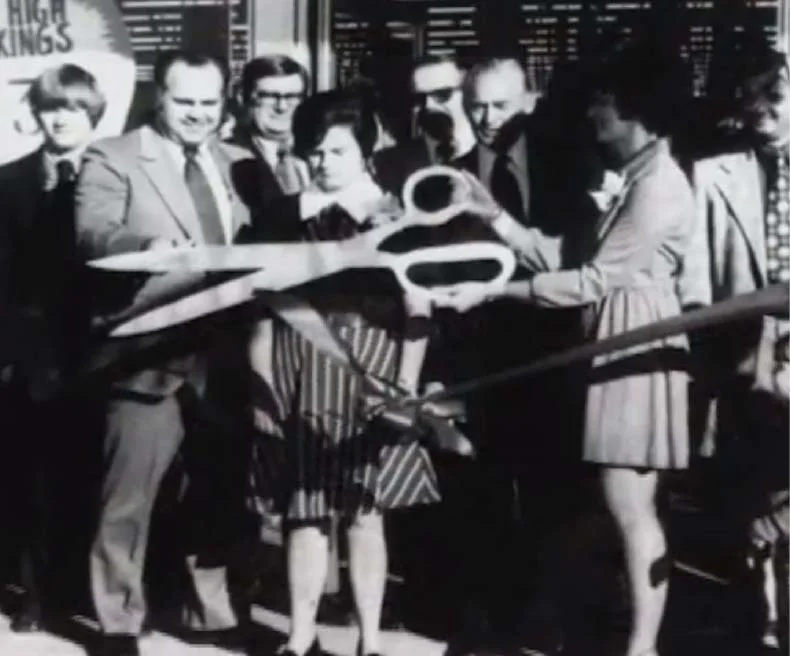
Cover image: special event at the first Walmart store in Rogers, Arkansas, via Walmart History.
参考ソース
- 1Library of Congress: Sherman Anti-Trust Act Signed into Law
- 2Walmart History
- 3Bank of Thailand: Lessons learnt from the Asian Financial Crisis
- 4SEC EDGAR: Form 8-K, The Kraft Heinz Company
- 5National Archives: Sherman Anti-Trust Act (1890)
- 6Wikipedia: History of United States antitrust law
- 7Wikipedia: Standard Oil Co. of New Jersey v. United States
- 8Wikipedia: United States v. AT&T (1982)
- 9Wikipedia: United States v. Microsoft Corp.
- 10Wikipedia: United States v. Google LLC (2020)
- 11The Rational Walk: Made in America: Sam Walton's Story
- 12Forbes: From Kmart To Walmart - The Discount Store Class Of 1962
- 13Harvard Business School: Sam Walton: Great From the Start
- 14Wikipedia: Walmart
- 15Federal Reserve History: Asian Financial Crisis
- 16Chicago Fed Letter: A Retrospective on the Asian Crisis
- 17The Nation Thailand: There was no other choice
- 18RBA Research Discussion Paper 9805
- 19IMF Press Release No. 97/37
- 20Yahoo Finance: Kraft Shareholders Okay Heinz Merger; Deal to Close on Jul 2
- 21Reuters: 3G to use its cost-cutting playbook on Kraft after Heinz merger
- 22Forbes: Kraft Heinz Stock Plunges After $15 Billion Write-Down
- 23SEC: SEC Charges The Kraft Heinz Company and Two Former Executives
- 24Reuters: Kraft Heinz to split a decade after blockbuster merger
このチャンネルのその他のコンテンツ
関連コンテンツ
- ログインするとコメントできます。