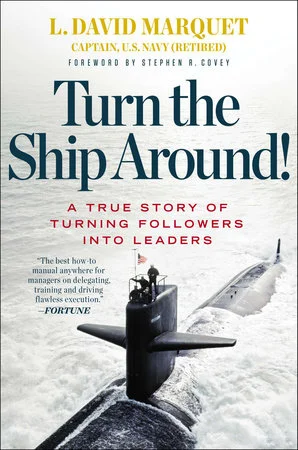
Turn the Ship Around: how to give up control without giving up standards
A practitioner close-read of L. David Marquet's Turn the Ship Around!: how leader-leader, control-competence-clarity, intent language, and certification can move decisions closer to the work, and where the submarine model breaks in ordinary workplaces.

The order was wrong. The culture was worse.
On the USS Santa Fe, a nuclear-powered attack submarine, Captain L. David Marquet gave an order that could not be executed. The helmsman knew it. The officer on deck knew it. The officer repeated it anyway.
When Marquet asked why, the answer was: "Because you told me to." 1
That exchange is the hinge of Turn the Ship Around!: A True Story of Turning Followers into Leaders. The danger was not one bad order. It was a system that trained competent people to suppress what they knew whenever authority spoke. On a submarine, that is a safety problem. In an office, it becomes a slower and quieter version of the same thing: decisions wait for approval, bad news travels upward late, and the manager becomes the most expensive bottleneck in the organization.
Marquet's answer was "leader-leader": move decision-making toward the people who have the information, then build the competence and shared purpose that make that freedom safe. The idea is compelling. It is also easy to copy badly. The book's own evidence comes from a highly selected, intensely trained military crew operating inside unusually clear boundaries. You cannot create autonomy by changing a phrase in a meeting and leaving everything else untouched.
Read the book as a manual for building decision-making capacity, not as a license to stop managing.
The book and the case behind it
The first edition appeared in 2012 from Greenleaf Book Group under the subtitle How to Create Leadership at Every Level. The Portfolio edition most readers encounter was published on May 16, 2013, runs to 272 pages, and carries the subtitle A True Story of Turning Followers into Leaders. 2 1
Marquet graduated first in the U.S. Naval Academy's class of 1981 and spent 28 years in the submarine force. He had prepared for more than a year to command the USS Olympia, a submarine class he knew in detail. Instead, a captain's departure sent him to the USS Santa Fe, a different class of submarine with the worst performance record in the fleet. He knew less about its systems than the crew did. 3
That mismatch made the usual command model dangerous. A captain who pretends to know more than the people closest to the equipment will eventually issue a confident, wrong instruction. Marquet's earlier experiment aboard the USS Will Rogers had already taught him the other half of the lesson: he tried giving broad guidance without first creating the conditions for good decisions, the team made errors, and he returned to the old model. 3
Santa Fe gave him a second chance. He stopped treating the crew as followers and began changing the mechanisms through which they spoke, trained, reviewed work, and made decisions. The Naval Submarine League's review identifies the three foundations as control, competence, and clarity: authority must move down, technical knowledge must move throughout the organization, and people must understand the purpose and operating context of their decisions. 4
The reported result is dramatic: Santa Fe went from "worst to first" on retention and operational standings, and continued winning awards and promoting people after Marquet left. That is the author's central case for designing a system that survives the leader's departure. 3 The claim is meaningful, but it remains a single transformation story, not a controlled comparison of organizations.
The core argument: stop being the decision-making bottleneck
The leader-follower model concentrates authority at the top and asks everyone else to execute. It can produce quick compliance when the work is simple and the boss has the best information. It performs badly when the work is cognitive, local knowledge matters, and conditions change faster than instructions can travel.
Leader-leader distributes ownership. The leader still sets direction, standards, and boundaries. The difference is where the decision is made. Marquet's phrase is "give control, not take control." 3
This is not a softer version of command. It is a more demanding one. A follower can say, "I did what I was told." A leader has to explain what they intend, why it is technically sound, how it serves the mission, and what they will do if the situation changes. The manager gives up the comfort of being the answer while taking on the harder work of creating people who can answer well.
Marquet's book is strongest when it treats empowerment as an operating system. Speeches about initiative do little if approval rules, meeting rituals, training systems, and performance measures still reward passivity. The author says it bluntly: "Don't preach and hope for ownership; implement mechanisms that actually give ownership." 5
The frameworks that survive close reading
1. Leader-leader is a system, not a mood
The first framework is the contrast itself. In a leader-follower organization, the leader owns the thinking and the follower owns the execution. In a leader-leader organization, people at every level are expected to think, decide, and contribute to the mission.
Marquet does not argue that every person makes every decision. He argues that the decision should be made as close as practical to the information, with the authority, competence, and context required to make it. The manager's job shifts from solving every problem to designing a decision-making factory.
The operational test is simple: listen to what people bring you. If your direct reports routinely arrive with "What should I do?" and leave with your answer, you are training dependence. Ask instead: "What do you see? What do you recommend? What do you intend to do? What information would change your mind?"
The point is not to force employees to perform confidence. It is to make their reasoning visible before action and to build the habit of owning an outcome.
2. Control, competence, and clarity must rise together
Control is the authority to make a decision. Competence is the technical knowledge to make it responsibly. Clarity is an understanding of the organization's purpose, priorities, and decision boundaries.
Remove control and people wait. Give control without competence and mistakes multiply. Give competence without clarity and people optimize their own corner while missing the larger goal. The book's compact warning is: "Control without competence is chaos." 5
A manager applying this framework should ask three questions before delegating a recurring decision:
- Does this person have the information and authority needed to act?
- What training, practice, or exposure would make the decision safer?
- What purpose, metric, or guiding principle should shape the tradeoff?
Marquet's submarine had unusually strong competence systems. Sailors trained, qualified, and certified for specific roles. That fact matters more than many business summaries admit. In the Santa Fe case, distributed control was supported by a serious effort to make the crew technically capable and to explain the ship's purpose down to daily operations. 4
3. "I intend to" converts permission into ownership
The most memorable mechanism is a small change in language. Instead of "Request permission to..." or "What should I do about...?" people say, "I intend to..." Marquet describes it as a three-part conversation: the person states the action, explains why it is technically correct, and connects it to the mission.
For example:
"I intend to move the launch date by one week. The integration test is still failing in two critical paths, and we have not completed the rollback plan. The change protects the customer commitment we made for a reliable release."
The manager can approve, challenge, or stop the action. But the default relationship has changed. The employee is proposing a decision rather than requesting a command.
Marquet's book lists the active phrases as "I intend to . . .", "I plan on . . .", "I will . . .", and "We will . . ." 5 The words matter because they expose whether the person has thought through the action. They are not magic words. If the manager still makes every meaningful decision, the phrase becomes theater.
The book also contains the more important, less quotable instruction: the leader must resist the urge to give an order. In an interview carried by the American Forces Radio Network, Marquet described empowerment as giving people the ability to make decisions and said the manager sometimes has to "bite your bottom lip" rather than take the problem back. 6
4. Replace briefings with certification
A briefing is often one person speaking while everyone else receives instructions. Marquet replaced that ritual with certification: the people doing the work explain their roles, the decisions they may need to make, and the conditions that would make them stop or ask for help.
This changes the evidence of readiness. A briefing proves that information was delivered. A certification tests whether the team can explain and execute the work.
A product or operations manager can adapt the mechanism without copying naval language. Before a high-risk launch, ask each owner to state:
- the decision they own;
- the failure modes they are watching;
- the signal that would make them pause or escalate;
- the next action they intend to take.
If the answers are vague, the team is not ready. The manager has found a training or clarity gap before the event, which is the useful part of the exercise.
5. Seek dissent before the room converges
Marquet repeatedly tries to prevent hierarchy from narrowing what people say. One practical technique is to ask for individual views before opening discussion. On a decision such as whether to launch, a manager might ask everyone to rate their confidence privately, then hear first from the strongest dissenters and the strongest supporters.
This is not consensus theater. The purpose is to surface information that would otherwise be edited out because the boss spoke first or the group wants to look aligned. The book's phrase is memorable: "Cherish the dissension. If everyone thinks like you, you don't need them." 7
The boundary is equally important. Dissent belongs before the decision. Once the decision is made, people can disagree with the choice while still carrying out the agreed plan, unless the decision violates a safety, legal, or ethical boundary.
6. Pursue excellence instead of organizing around error avoidance
Santa Fe's crew had learned that mistakes were dangerous to their careers. That created a perverse incentive: the safest action was to make no decision and do nothing that could be criticized.
Marquet's correction was to make excellence the aim and error reduction a consequence of understanding the work. The distinction is practical. If your team defines success as "zero mistakes," people will hide uncertainty and avoid experiments. If success means reliable outcomes, sound judgment, and learning from weak signals, people can report problems before they become incidents.
This does not mean lowering standards. A nuclear submarine cannot treat every error as harmless. It means separating the investigation of an error from the identity of the person who made it, then improving the system that allowed the error to pass.
A manager can test the difference by asking: "What are we doing this week to make the work better?" If the only answer is another approval step or another checklist, the team may be protecting itself rather than improving the operation.
The passages worth carrying around
These are short lines from the book, with their surrounding idea. They are useful because each one points to a mechanism rather than a general virtue.
"A vast untapped human potential is lost as a result of treating people as followers." (early discussion of the long-term cost of leader-follower, p. 15) 5
"I intend to . . ." (the language mechanism for moving from permission to ownership, pp. 82-83) 5
"Don't preach and hope for ownership; implement mechanisms that actually give ownership." (control mechanisms, p. 98) 5
"Control without competence is chaos." (learning and technical competence, p. 128) 5
"Leadership is not some mystical quality that some possess and others do not." (the argument for leadership at every level) 7
"No, Captain, you're wrong." (the moment a junior sailor challenges Marquet in the control room) 8
"Instead of more 'leadership' resulting in more 'followership,' I practiced less leadership, resulting in more leadership at every level of the command." (late reflection on the transformation, p. 204) 5
What practitioners kept, and what they had to change
The contemporary application evidence is more useful when it is modest. It shows what people borrow, not that the whole model works everywhere.
One executive coach, Stephen Lynch, describes using the "What would you recommend?" version of Marquet's approach with a client who had become a decision-making bottleneck. He agrees with moving authority toward the information, but warns that civilian organizations often lack the military's baseline of role competence and certification. His adaptation is to explore options with an employee before pushing the decision back, rather than treating "I intend to" as a substitute for coaching. 9
A 2017 open-access letter applied the model to graduate medical education. The authors mapped intent-based leadership onto patient care, trainee learning, surgical time-outs, and morning huddles. They also stated that their search had found no measured outcomes for intent-based leadership in medical education at that time, and warned that autonomy must not compromise supervision or patient safety. 10 That is a good example of adaptation with a visible boundary: distribute voice and responsibility, but keep safety oversight explicit.
Marquet's current organization now teaches the model through masterclasses, coaching, and implementation programs rather than only through the book's story. That is evidence of an ongoing practice, not evidence that those programs produce a consistent effect. 11 The distinction matters for readers who are tempted to treat a popular management book as an intervention study.
The practical pattern across these applications is clear: keep the decision-rights question, keep the demand for competence and context, and translate the submarine rituals into the language of the work. Do not transplant the hierarchy, the jargon, or the assumption that every role can be made autonomous at the same speed.
Where the book breaks
The Santa Fe story is a single, unusually favorable case
The book is a memoir and operating manual built around one command. Its evidence is rich in scenes and mechanisms but thin on comparison. We do not get a matched set of submarines, a clear baseline for every outcome, or an independent evaluation of which intervention caused which improvement.
That does not make the story false. It changes the claim a reader can responsibly make. The book shows that this kind of transformation happened under Marquet's command. It does not show that repeating the same steps will produce the same result in a software company, hospital, or public agency.
Military competence is not a footnote
The approach worked in an environment where roles were specialized, training was formal, mission clarity was unusually high, and safety rules were non-negotiable. Stephen Lynch's criticism is the right corrective: business leaders often copy the language of intent while skipping the work of building competence and strategic clarity. 9
A new manager with incomplete information may need more coaching, not less. A junior employee may be able to recommend a decision without yet being ready to own it. The responsible move is to narrow the decision, provide a temporary boundary, and build capability through practice. "Empowerment" should not be used to push risk downward while the manager keeps the authority to blame.
Leader-leader can hide a power problem
Marquet says the leader should give control, but the leader still designs the rules, decides the boundaries, controls access to opportunities, and evaluates performance. That creates a tension the book sometimes moves past too quickly: people can be invited to speak and still face consequences for disagreeing with the person who controls their promotion.
The solution is not to abandon distributed decision-making. It is to specify where a person has genuine authority, what cannot be delegated, how dissent is protected, and how mistakes will be reviewed. Otherwise "state your intent" can become a more polished way of asking people to guess what the boss wants.
The rhetoric is easier to copy than the mechanisms
"Give control" sounds inspiring. It is also vague. What decision? At what level? With what training? Against which metric? With what escalation rule? The Naval Submarine League review emphasizes that the transition is rocky and that mistakes are part of learning. 4
The book is most valuable when it forces those questions into the open. It is least useful when readers reduce it to a slogan about flat organizations. The goal is not fewer managers. The goal is fewer decisions that need to travel through the manager who happens to sit highest in the hierarchy.
Five Monday moves
1. Find one approval bottleneck
Look at the last ten decisions that came to you. Pick one recurring category where the person closest to the work already has enough information to recommend an action. Write down the boundary, the metric, and the conditions that require escalation. Tell the owner: "For the next two weeks, you own this decision. Bring me your intent and reasoning; do not wait for permission unless one of these conditions appears."
2. Replace one status briefing with certification
Before the next launch, client meeting, or operational change, have each owner explain what they will do, what they are watching, and what would make them stop. If they cannot explain the work without reading the slide deck, postpone the event long enough to close the knowledge gap.
3. Ask for recommendations before giving answers
When a direct report asks, "What should I do?" do not reflexively answer. Ask, "What do you recommend, and what information are you using?" If the decision is beyond their current competence, coach them through the options and name what they need to learn before owning it. The objective is not to make the manager silent. It is to make the reasoning visible.
4. Hear the outliers first
At the next decision meeting, collect individual views before discussion. Ask for the strongest reasons to proceed and the strongest reasons to wait. Invite the person with the least popular view to speak first. Then make the decision and state what evidence would cause you to revisit it.
5. Turn a repeated correction into a training mechanism
Choose one mistake you have corrected more than once. Do not send another private reminder. Create a short practice: a checklist the owner helped write, a worked example, a review question, or a certification step. Measure whether the error pattern changes over the next few cycles. If it does not, improve the mechanism rather than blaming the person again.
Should you read it?
Yes, if you manage people and want a vivid argument against making yourself the center of every decision. Read the Santa Fe story for the scenes, then read the mechanisms for control, competence, clarity, intent language, certification, and dissent. Those chapters are more useful than the broad promise that every organization can become flat.
Read it with a safety rail. The book's success depends on conditions many workplaces do not share: formal training, clear roles, a strong common mission, and a leader willing to absorb the short-term cost of developing judgment in others. If your team lacks those conditions, begin there.
The best question to carry into Monday is not "How do I empower my team?" It is more specific: "Which decision am I still holding that belongs closer to the work, and what competence and clarity would make it safe to let go?"
参考ソース
- 1Turn the Ship Around! — Penguin Random House
- 2Turn the Ship Around! editions — Goodreads
- 3My story — David Marquet
- 4Book review — Naval Submarine League
- 5Turn the Ship Around — Thrive Street Advisors
- 6The Leadership List transcript — DVIDS
- 7Book summary — Readingraphics
- 8Turn the Ship Around! quotes — Goodreads
- 9Turn The Ship Around — Stephen Lynch
- 10From nuclear submarines to graduate medical education — PMC
- 11Intent-Based Leadership
関連コンテンツ
- ログインするとコメントできます。