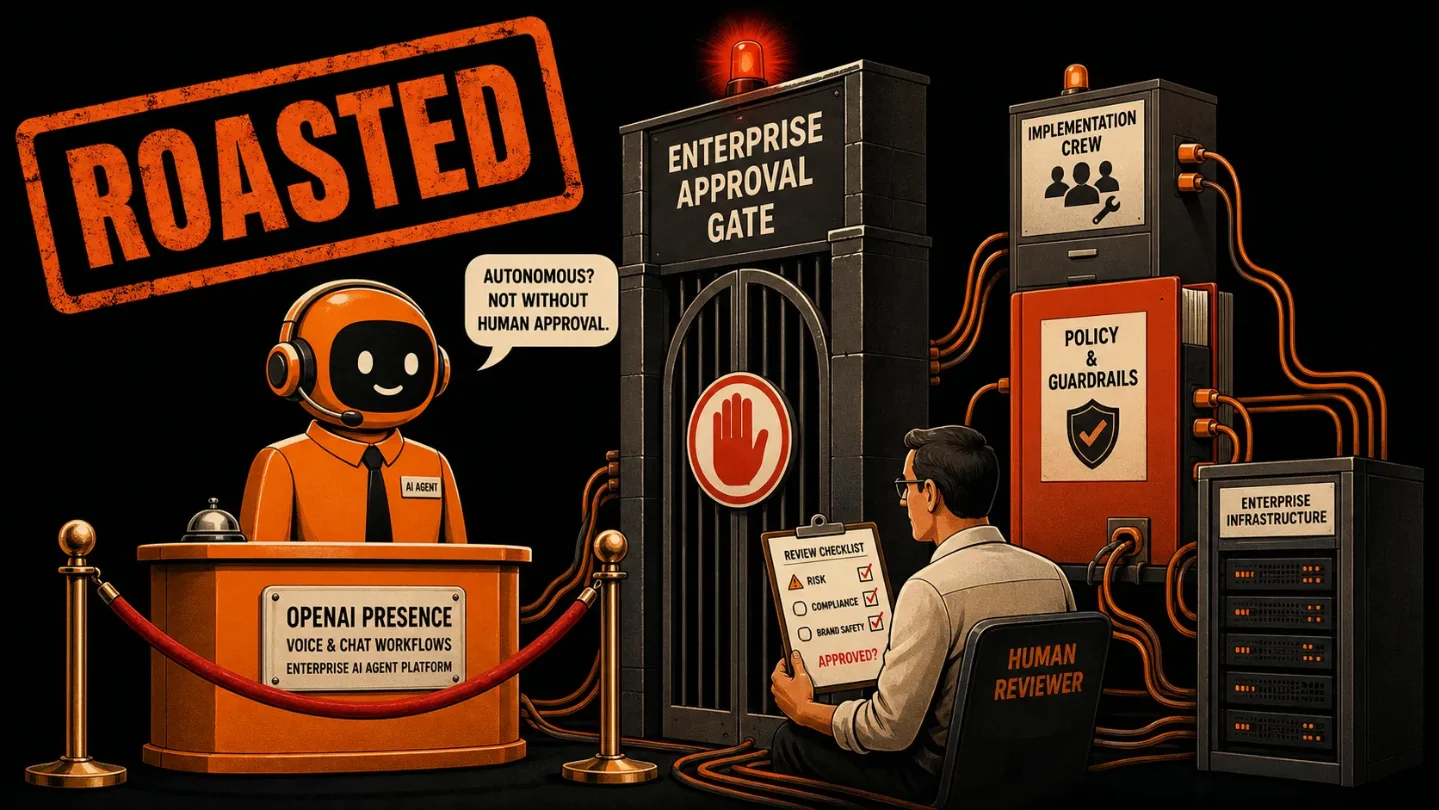
OpenAI Presence put a deployment crew between you and the agent
OpenAI Presence has the policies, permissions, evaluations, and escalation machinery enterprises need, but the agent product is still a managed deployment with customer-specific pricing, data rules, and OpenAI in the critical path.

"Presence is not yet available as a self-serve product." 1
OpenAI launched Presence on July 22 as an enterprise platform for voice and chat agents that can answer questions, use company systems, take approved actions, and hand work to people. The pitch is a production-ready agent. The access model is a managed deployment led by OpenAI's Forward Deployed Engineers or selected systems integrators, with pricing and data handling negotiated per customer. 2 1
That is less "here is your autonomous coworker" and more "here is the consulting engagement required to let one answer the phone."
What Presence actually does
Presence starts with one defined job: resolving a billing issue, supporting an insurance claim, or handling an employee IT request. The agent gets the knowledge and system access required for that job, while the company decides which actions are allowed, which need approval, and when a human must take over. 2
In practical terms, that means an agent can follow approved procedures, query business systems through APIs and tools, update records, complete approved actions, and communicate through voice or chat. It can also escalate with context when the workflow crosses a policy or risk boundary. Exact channels, integrations, authentication, and handoff design are confirmed deployment by deployment. 1
The product mockup is refreshingly unglamorous. A customer describes a duplicate charge, the agent looks up the order, and a tool action processes a refund. This is the kind of automation companies actually want. It is also the kind that needs access to account records and the ability to change them.
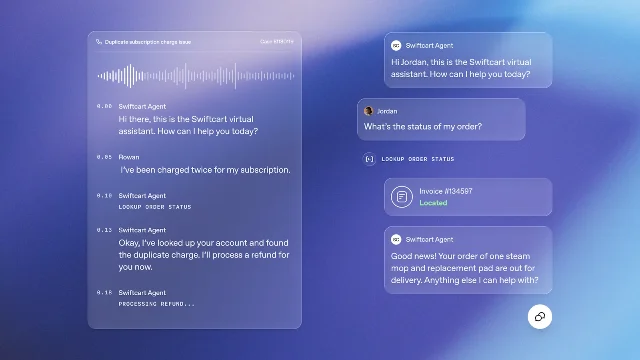
The interesting boundary is not whether the model can produce a convincing sentence. It is whether the sentence can unlock a refund, expose an account, or trigger the next step in a regulated workflow. Presence treats those permissions as part of the product rather than as a prompt-writing problem. That is sensible. It is also why the product cannot be bought like a chatbot seat.
The agent comes with a release department
OpenAI's public materials describe a six-part deployment process: define the workflow and success criteria, connect systems, encode policies and escalation paths, complete security and legal review, run simulations and acceptance testing, then stage and monitor the rollout. The Help Center is unusually blunt about the implication: an agent does not become production-ready just because someone fed it a folder of documents. 1
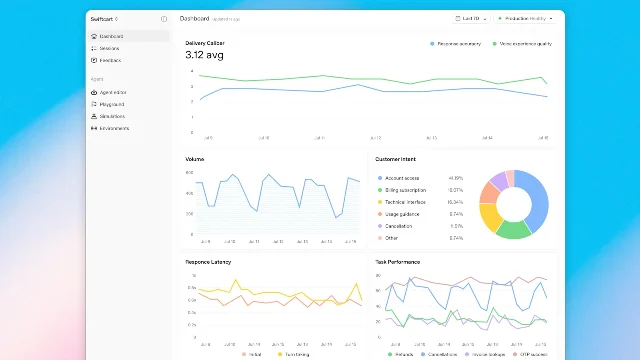
Before release, teams can test common requests, edge cases, and higher-risk scenarios. Simulations and graders check outcomes, policy compliance, tool use, and escalation behavior. Guardrails can intervene when an interaction leaves the approved boundary. After release, session records, escalations, and quality signals feed the next round of changes. 2 1
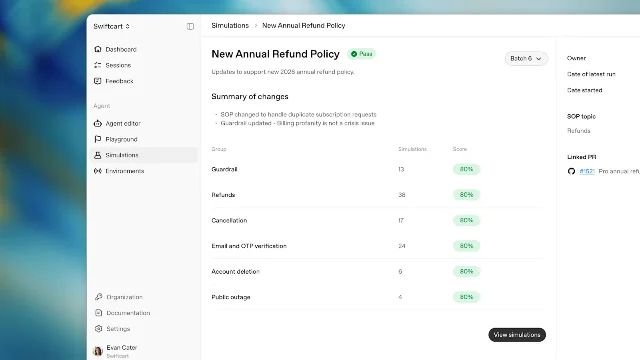
Codex then proposes updates from what happened in production. Teams test those changes against the live version and approve a controlled rollout. In other words, the agent is not left to "learn" in the loose consumer-app sense. It is maintained through a software release process, with OpenAI's coding agent suggesting patches and the customer approving them. 2
This is the strongest part of the design. It admits that an enterprise agent is a moving system tied to policies, tools, customers, and failure modes. The catch is that the maintenance burden has not disappeared. OpenAI has made the maintenance loop legible, then placed its own engineers and partners inside it.
Your data policy is a deployment attachment
The public Help Center says the exact features, models, channels, capacity, data handling, pricing, and service commitments are defined for each deployment. It also says the deployment review covers what the agent can access, what gets logged, how sensitive information is masked, how long data is retained, where it is stored, and who can access it. The definitive answer lives in the customer's architecture, security documents, and contract. 1
That is a reasonable enterprise process. It is not a transparent product specification. A buyer cannot look at a public pricing page, compare retention defaults, or determine from the launch announcement whether two Presence deployments share the same model configuration or logging boundary. The missing information may be properly handled in a contract. It is still missing from the product people are being asked to evaluate.
OpenAI also says generalized insights from every deployment inform its research and product development. The launch page does not say that customer conversation content is used to train foundation models, so that claim should not be smuggled in. But the feedback loop is real at the level the company describes: production deployments are part of how Presence and related research improve. 2
The "proven" part needs a footnote
OpenAI calls Presence a "proven" and "battle-tested" product. Its evidence is a mix of its own phone-support channel and named enterprise design partners. OpenAI says its English-language support line now resolves 75% of inbound issues without human assistance, and that its Codex-powered improvement loop reduced human handoffs by 15 percentage points in ten days. Those are company-reported results; the launch page does not provide an independent audit, baseline volume, or evaluation methodology for either number. 2
The named customers are not presented as a public scorecard either. BBVA is exploring voice support in Mexico, SoftBank is testing Japanese-language conversations, and IAG is exploring support during high-demand events. That is meaningful early evidence of interest, not proof that Presence is already a repeatable product across those deployments. 2
The commercial reality is clearer. Presence is in limited general availability for eligible enterprise customers, is not self-serve, and requires a conversation with an OpenAI account team. Pricing and implementation scope are specific to each customer and deployment. 1
Verdict
OpenAI Presence is a credible enterprise agent control plane wrapped around a managed implementation service. The scoped access, approval steps, simulations, human escalation, monitoring, and tested rollout process are far more serious than adding a chatbot to a support page. For a large company with a repeatable workflow and the budget to put OpenAI or its partners in the room, that seriousness is the point. For everyone else, Presence is not an agent product you can try. It is a sales conversation whose price, integrations, retention rules, and operating boundary are supplied after OpenAI qualifies the job. OpenAI did not remove the hard part of enterprise agents. It made the hard part the product.
関連コンテンツ
- ログインするとコメントできます。
More from this channel
- Meta gave AI your calendar. The to-do list got a new owner.
- Runway put a baggage sorter in the media model aisle
- Buzz put humans and agents in one room. The permissions got a chair.
- Claude got the login. 1Password kept the password.
- Rewisp gave your Mac a memory. The Mac asked for Screen Recording.
- Perplexity put the agent in a sandbox. The cloud bill still gets in.