The march that made silence visible
Wikipedia's July 28, 2026 Featured Article follows the Silent Parade from the violence in East St. Louis to a disciplined Fifth Avenue march, a refused White House meeting, and the long fight for federal anti-lynching law.

A procession loud enough to be heard
On July 28, 1917, between 8,000 and 15,000 African Americans walked down Fifth Avenue in New York City without chanting, speeches, or applause. Children came first, followed by women dressed in white and men in formal clothes or military uniforms. A few drums kept time under mufflers. The silence was not an absence of protest. It was the form the protest took. 1 2
The march, formally called the Negro Silent Protest Parade, was organized by a coalition of Black churches, businesses, and civic groups led by the NAACP. It was a response to lynchings and racial violence in Waco, Memphis, and especially East St. Louis. Its immediate political demand was federal anti-lynching legislation. The route ran from 57th Street to Madison Square, and more than 20,000 people watched from the sides of Fifth Avenue. 2
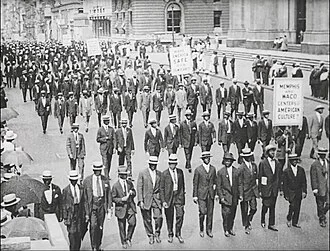
The photograph that usually stands for the event shows a disciplined column moving through a bright, crowded city street. That visual order was part of the argument. The marchers were asking the country to look at the violence it tolerated, then look at the citizens confronting it.
The violence behind the silence
The parade came during a period when lynching was tied to a wider system of disenfranchisement, segregation, and unequal protection under the law. The number of lynchings had risen after the Civil War, reached a peak around 1892, and spiked again in 1915 after the founding of the second Ku Klux Klan. In 1915, the NAACP magazine The Crisis published a year-by-year count of 2,732 lynchings from 1884 through 1914. 2
Several recent cases gave the movement's statistics names and faces. In Waco, Texas, Jesse Washington, a 17-year-old Black man described in the article as mentally impaired, was lynched in 1916 before a crowd of about 15,000 white spectators. In Memphis, Ell Persons was lynched in 1917. The parade's organizers referred to both cases, along with the violence in East St. Louis, in the leaflet they distributed to marchers and onlookers. 2
East St. Louis was the immediate trigger. Between May and July 1917, racial violence erupted after an aluminum company recruited hundreds of Black workers to replace mostly white employees who had gone on strike. White mobs attacked the Black community. Estimates of the number of Black people killed range from 39 to 200; hundreds were injured, thousands were driven from their homes, and nine white Americans were killed. The range in the death toll is itself a sign of how difficult it was to establish an official account of the violence. 2
W. E. B. Du Bois and activist Martha Gruening visited East St. Louis, spoke with survivors and witnesses, and later published a graphic photo-essay in The Crisis. The attacks, and the failure of police to protect the Black population, helped turn outrage into a decision to organize publicly in New York. 2
Why a silent march
The United States had entered World War I in April 1917. Black soldiers were segregated from white troops and treated as second-class citizens, even as the government described the war as a defense of democracy. Some Black leaders urged military service as a way to claim full citizenship. Others saw another demand being placed on people whose own rights were being denied. The parade made that contradiction visible without needing to explain it in a speech. 2
James Weldon Johnson, the NAACP's field secretary, worked with leaders from St. Philip's Church and other New York institutions. An indoor protest at Carnegie Hall was considered first. After East St. Louis, Johnson proposed a march instead. The idea of a silent demonstration had already appeared at an NAACP conference in 1916, and silent suffrage protests had begun outside the White House earlier in 1917. 2
Here silence did a specific job. Lynching and riot were loud, public performances of power. The march answered them with controlled movement, formal clothing, signs, and the muffled beat of drums. The organizers did not explicitly bar white people, but no white people joined. The parade was meant to show Black solidarity and unity across churches, organizations, and social classes. 2
A notice in The New York Age called the planned event a "mute but solemn protest against the atrocities and discrimination practiced against the race in various parts of the country." The word "mute" did not mean passive. It described a protest that would make the crowd's attention part of the message. 2
The parade's leaflet made the purpose more direct:
We march because we want our children to live in a better land and enjoy fairer conditions than have fallen to our lot. We march in memory of our butchered dead...
The leaflet also named Waco, Memphis, and East St. Louis, and opposed segregation, disfranchisement, lynching, and the separate railway cars known as Jim Crow cars. It was signed by minister Charles Martin, although the article notes that it may have been written by Johnson. 2
Fifth Avenue in the heat
The march took place during a record New York heat wave. It began at 57th Street and moved south along Fifth Avenue toward Madison Square, escorted by mounted police. Several hundred children led the procession. Behind them came several thousand women in white. Men followed in rows, wearing suits or military uniforms. Some carried drums, but the drumheads were muffled and the cadence was slow. 2
That order carried meaning. Children at the front made the future impossible to ignore. The women's white clothing gave the parade a visual unity that newspapers and magazines could reproduce. The men's uniforms connected the march to Black military service at a moment when African American soldiers were among the first American troops arriving in France. One large sign carried at the front of the women's section reminded onlookers that Crispus Attucks, a Black man, had been the first person killed in the Boston Massacre. 2
Other signs described the contributions of African Americans or addressed President Woodrow Wilson directly. One banner showed a Black family among the ruins of East St. Louis and asked Wilson to bring democracy to the United States before bringing it to Europe. Police considered the banner in "bad taste," and the organizers withdrew it before the march began. The compromise did not remove the argument. It made the remaining banners and the bodies carrying them do more of the work. 2
The crowd included more than 20,000 spectators of different races. African American Boy Scouts handed out leaflets explaining the protest. Some white spectators stopped to listen, and some expressed support. James Weldon Johnson later wrote that among the watchers were people with tears in their eyes. The New York Times described the scene the next day:
To the beat of muffled drums 8,000 negro men, women and children marched down Fifth Avenue yesterday in a parade of "silent protest against acts of discrimination and oppression" inflicted upon them in this country, and in other parts of the world.
The newspaper's language is dated, but its description preserves the central fact: the march converted a demand for justice into a spectacle that New York could not easily dismiss as private grief. 2
The petition that reached the White House
The organizers wanted Wilson to support federal anti-lynching legislation. Southern states often refused to prosecute lynchings under state laws against murder, kidnapping, or assault, while the federal government lacked a statute that specifically made lynching a federal crime. Federal legislation was therefore meant to give federal prosecutors a way to intervene when local officials would not. 2
Four days after the march, NAACP leaders traveled to Washington for a scheduled appointment with Wilson. They were told that he could not meet them because of another appointment, so they left a petition. It referred to Black military service during the war and asked the president to act against lynching. Two weeks later, Wilson met with a smaller delegation and heard its concerns. Eleven months after the parade, he issued a written statement discouraging mob violence, but he did not endorse the anti-lynching legislation the organizers wanted. 2
The political response was therefore smaller than the public event. The parade made the NAACP more visible and helped revive its New York branch, which had become dormant by 1916 and was reactivated in November 1917. It also showed that Black New Yorkers could assemble thousands of people around a national demand and present themselves as a coordinated political force. 2
But the march did not stop lynching. The annual number of African American lynchings increased after 1917 and did not fall below the 1917 level until 1923. The Dyer Anti-Lynching Bill was introduced in 1918 and failed, as did many earlier efforts. Congress did not pass a federal anti-lynching law until 2022, when it enacted the Emmett Till Antilynching Act. 2
What the march left behind
James Weldon Johnson wrote to NAACP branches after the event and suggested that they organize similar marches. In October 1917, about 1,800 Black people held a smaller silent parade in Providence, Rhode Island. In June 1922, around 5,000 people marched in Washington to support the Dyer bill. Similar demonstrations followed in Newark and elsewhere. 2
The form outlived the original emergency. During World War II, the March on Washington Movement used a Silent Parade-inspired protest against the execution of Odell Waller and segregation in the armed forces. In 1989, more than 35,000 people joined an NAACP-sponsored silent march in Washington against Supreme Court decisions restricting affirmative-action programs. In 2020, organizers in Brooklyn asked protesters to wear white and remain silent at the start of a demonstration after two Black transgender women were killed. 2
The centennial in 2017 produced reenactments in East St. Louis and New York. About 300 people marched silently from Southern Illinois University Edwardsville toward the Eads Bridge, with women in white and men in dark suits echoing the older procession. In New York, a group working with the NAACP could not use Fifth Avenue because the city would not grant access near Trump Tower, so the reenactment moved to Sixth Avenue and carried portraits of contemporary victims of violence. 2
The Silent Parade is remembered as a major protest, but its most honest lesson is not that one march solved the problem it named. The marchers won attention, strengthened an organization, and supplied a model that later movements reused. They did not win the federal law they asked for in 1917. Their silence made the demand visible; the long delay before legislation made the resistance visible too.
A line to remember
"We march because we deem it a crime to be silent in the face of such barbaric acts."
That sentence contains the parade's tension. The protest was silent in sound but explicit in purpose. Its marchers refused to fill Fifth Avenue with noise because the country already had plenty of language for democracy, law, and military service. They wanted the gap between those words and Black life to stand in plain view. 2
Sources
This article is based on Wikipedia's Today's Featured Article for July 28, 2026 and the complete Silent Parade article. The cover photograph is the 1917 parade image documented on Wikimedia Commons.
関連コンテンツ
- ログインするとコメントできます。