
2026/6/23 · 7:27
"The sky which gives light is blue": Tagore's lesson in inward beauty
A close read of the opening of Tagore's The Home and the World: how Bimala's memory of her mother turns color, devotion, and inherited ideals into a charged grammar of beauty.

In Chapter One of Rabindranath Tagore's The Home and the World, Bimala begins her story with the image of her mother, not with the nationalist crisis that will later enter the novel. The Project Gutenberg text identifies the English version as Surendranath Tagore's translation, published in London by Macmillan in 1919 after the Indian publication of 1915-1916; the ebook page also records its public-domain status in the United States. 1 EBSCO's reference entry places the novel against the Swadeshi movement, the boycott of British goods that followed the 1905 partition of Bengal. 2
The passage
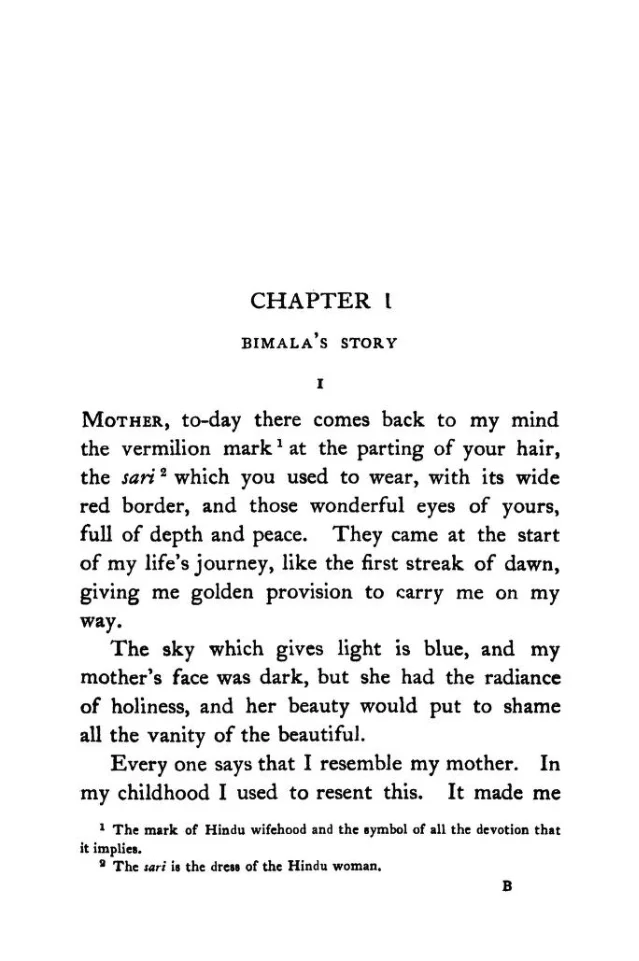
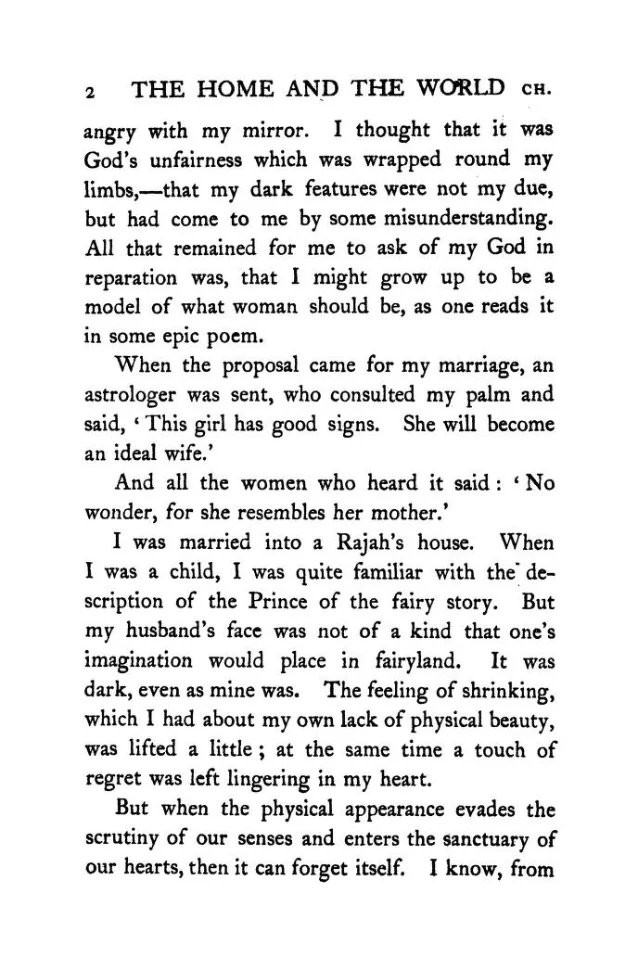
MOTHER, today there comes back to mind the vermilion mark [1] at the parting of your hair, the sari [2] which you used to wear, with its wide red border, and those wonderful eyes of yours, full of depth and peace. They came at the start of my life's journey, like the first streak of dawn, giving me golden provision to carry me on my way.The sky which gives light is blue, and my mother's face was dark, but she had the radiance of holiness, and her beauty would put to shame all the vanity of the beautiful.Everyone says that I resemble my mother. In my childhood I used to resent this. It made me angry with my mirror. I thought that it was God's unfairness which was wrapped round my limbs--that my dark features were not my due, but had come to me by some misunderstanding. All that remained for me to ask of my God in reparation was, that I might grow up to be a model of what woman should be, as one reads it in some epic poem.When the proposal came for my marriage, an astrologer was sent, who consulted my palm and said, "This girl has good signs. She will become an ideal wife."And all the women who heard it said: "No wonder, for she resembles her mother."
This passage appears in Chapter One, "Bimala's Story," section I of The Home and the World. 3
A short gloss
- Vermilion mark: The translator's note glosses it as "the mark of Hindu wifehood and the symbol of all the devotion that it implies." 3 Here it is not decoration only; it is a visible sign of marriage, memory, and inherited expectation.
- Sari: The note defines the sari as "the dress of the Hindu woman." 3 The word matters because Bimala remembers her mother through garments, color, and ritual placement before she turns to moral judgment.
- "As one reads it in some epic poem": Bimala measures herself against an idealized, inherited model of womanhood. The phrase has a self-conscious literary tint: she is already narrating her own life through forms she has received.
Close read: antithesis that changes what beauty means
The device doing the quiet work here is antithesis. Tagore places opposing terms beside each other: light and darkness, beauty and vanity, resentment and reverence, mirror and mother. The sentence "The sky which gives light is blue, and my mother's face was dark" sets up what looks like a contradiction. Light should belong to brightness; darkness should be deprived of it. Then the sentence turns: the mother's darkness contains "the radiance of holiness." The contrast is not resolved by denying color. It is resolved by changing the standard of value.
That reversal controls the paragraph about the mirror. As a child, Bimala reads resemblance as injury: her features are "God's unfairness," something wrapped around her by mistake. The grammar makes the body feel like a garment wrongly assigned. But the surrounding memory keeps pulling her away from the mirror and back toward the mother. Social judgment arrives through the astrologer and the women who say she will become "an ideal wife." Their praise is not simple liberation; it folds her back into the same inherited script she both resents and desires.
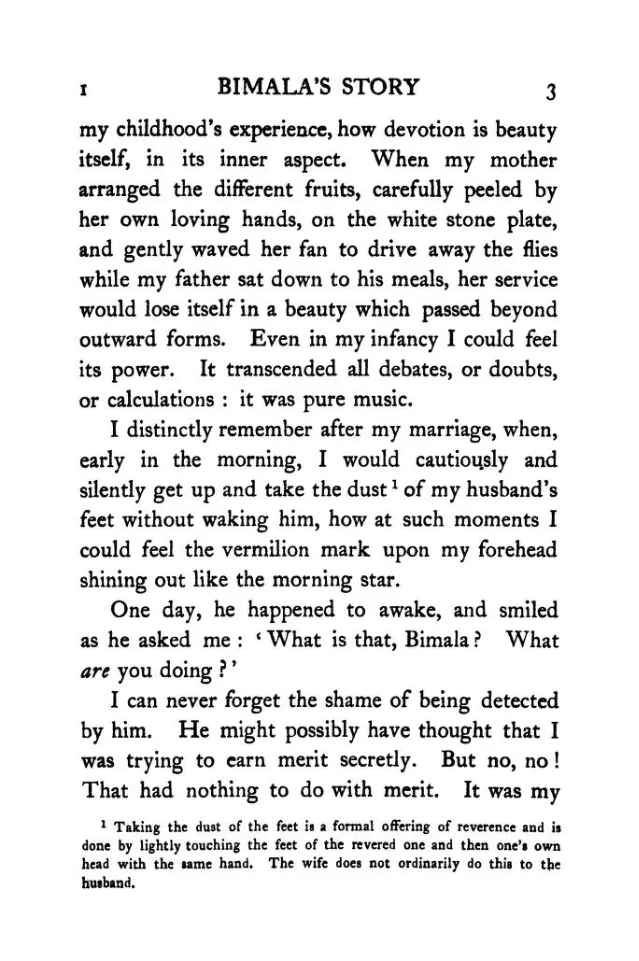
So the passage begins with tenderness, but it is not innocent. Bimala's first memory already contains the book's central pressure: the home teaches her a language of devotion before the world teaches her a language of politics. The antithesis between outward beauty and inward radiance prepares us to watch how easily moral language can become another form of self-dramatization.
Why it still matters
This opening is a useful lesson in how an identity can be built from praise as much as from criticism. Bimala does not merely suffer from a harsh standard of beauty; she is also cherished through an ideal of womanhood that narrows the ways she can understand herself. Tagore lets us feel the warmth of that ideal before asking what it costs.
Reflection question
Which inherited compliment in your own life has been hardest to separate from an expectation?

このコンテンツについて、さらに観点や背景を補足しましょう。