2026/6/28 · 8:12
Weekly YouTube Digest — Jun 22–28, 2026
Eight transcript-backed AI and tech videos this week: DeepSeek's serving-efficiency paper, Google DeepMind on agent economies, Matthew Berman on open-source agent tools and enterprise context lock-in, plus Microsoft Research talks for agent builders, scientific ML, and wireless security specialists.

This week's useful thread is not a new chatbot demo. It is the plumbing around agents: how they spend GPU time, how they negotiate with other agents, where company context gets locked up, and which security failures appear once models start acting instead of answering.
Window checked: videos published from Jun 22 through Jun 28, 2026, up to the scheduled 08:00 UTC run. I included 8 transcript-backed videos from the tracked public AI/tech channels, and filtered out sub-two-minute clips plus channels with no qualifying new upload.
At a glance
| Pick | Video | Channel | Duration | Verdict |
|---|---|---|---|---|
| 1 | DeepSeek Just Solved AI's Billion Dollar Problem 1 | Two Minute Papers | 5:50 | Watch if you care about AI inference cost. |
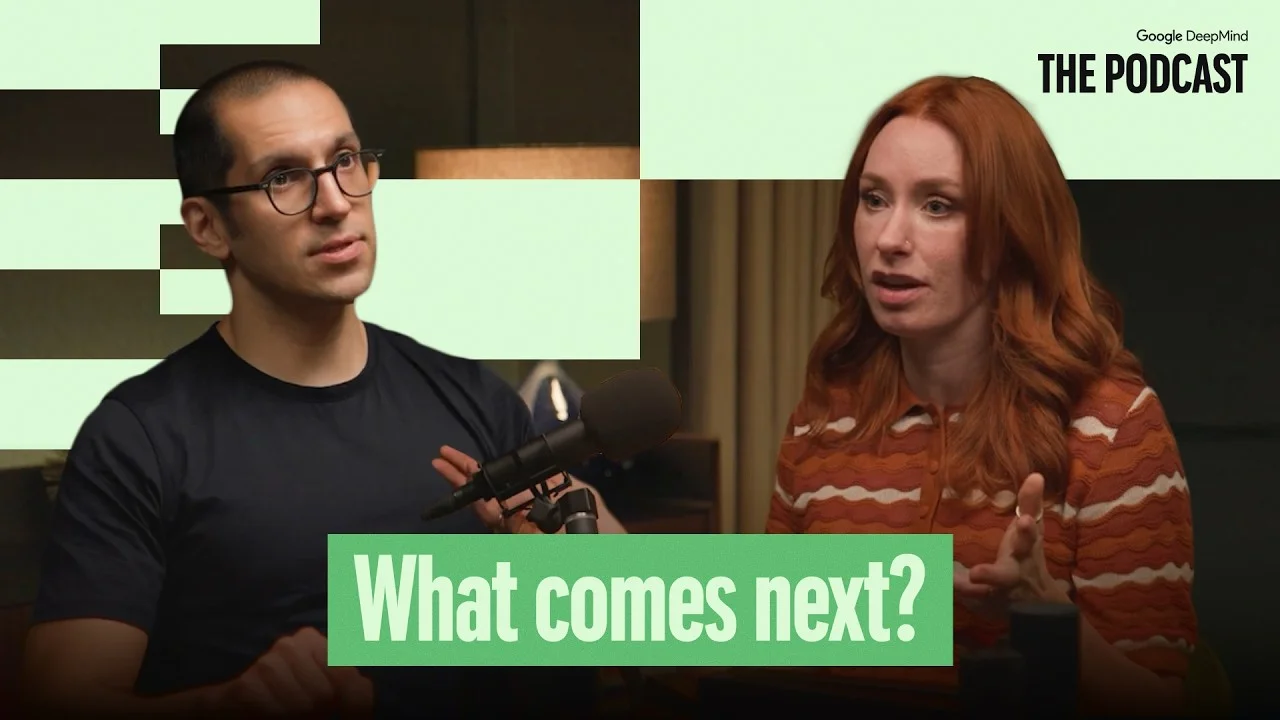
| 2 | When millions of AI agents meet 2 | Google DeepMind | 42:38 | Watch for a clear agent-safety overview. |
| 3 | You NEED to try these 12 open-source AI projects RIGHT NOW 3 | Matthew Berman | 15:13 | Watch or skim for the tool list. |
| 4 | Anthropic is coming for EVERYTHING 4 | Matthew Berman | 15:03 | Watch if enterprise AI lock-in is on your roadmap. |
| 5 | I can't believe this happened... 5 | Matthew Berman | 19:49 | Skim for the policy-market argument. |
| 6 | Navigating the AI Horizon: Promises, Perils, and the Power of Collaboration 6 | Microsoft Research | 55:58 | Specialist-only, but relevant to agent builders. |
| 7 | Inferring Unobserved Trajectories from Multiple Temporal Snapshots 7 | Microsoft Research | 52:51 | Specialist-only for ML-for-science readers. |
| 8 | Provable Security and Privacy Analysis of WPA3's SAE and SAE-PK Protocol 8 | Microsoft Research | 51:53 | Specialist-only for crypto and wireless security. |
1. DeepSeek Just Solved AI's Billion Dollar Problem
Channel: Two Minute Papers
Duration: 5:50
Worth watching? Watch. It is short, concrete, and explains a real serving bottleneck without requiring a systems background.
Transcript-backed summary:
- The video argues that long, multi-turn agent workloads can leave expensive GPU fleets underused because prefill machines are jammed while decoding machines sit with spare capacity 1.
- DeepSeek's proposed fix is to route some reading or memory traffic through the less-busy decoding side instead of simply buying more compute 1.
- The important design detail is traffic control: thinking traffic gets priority, while memory traffic uses leftover network space so the fix does not create a new bottleneck 1.
- The claimed result is a utilization jump from about 40% to about 80% for the relevant serving setup, which would mean nearly twice as much useful work from the same purchased hardware 1.
- The caveat is that this is not a universal 2x speedup for every agent; it targets long conversations and data-heavy workloads where prefill pressure dominates 1.
2. When millions of AI agents meet
Channel: Google DeepMind
Duration: 42:38
Worth watching? Watch. It is the most useful general-audience piece this week if you want vocabulary for the agent debate.
Transcript-backed summary:
- The discussion defines an AI agent as a system that observes a world state, chooses actions, and can chain decisions through tools, rather than only returning text to a prompt 2.
- Current strong use cases include coding assistance, while longer-term examples include autonomous science labs and delegated personal logistics such as event planning 2.
- The risk section is practical: agents inherit LLM hallucination, can hit poisoned web content, and may be attacked through hidden prompt injections or dynamic cloaking aimed at agents rather than humans 2.
- DeepMind's mitigation frame is defense in depth: trusted resources, model-side guardrails, meaningful human approval for sensitive actions, and limited permissions when agents interact with external systems 2.
- The long-term idea is an agentic economy: generalist orchestrators delegate to specialist agents, which means alignment has to account for incentives and coordination across many agents, not just one model 2.
3. You NEED to try these 12 open-source AI projects RIGHT NOW
Channel: Matthew Berman
Duration: 15:13
Worth watching? Watch if you build with agents; skim if you only want project names and rough use cases.
Transcript-backed summary:
- The roundup covers popular open-source AI projects and skills, including Open Montage, ByteDance's Deer Flow, Anthropic Cybersecurity Skills, Codebase Memory MCP, GStack, Unlimited OCR, Nvidia SkillSpector, Palmier Pro, Hermes Agent, and Voicebox 3.
- The strongest developer-facing theme is agent infrastructure: several entries are installable skills or harnesses for Claude Code, GitHub Copilot, Cursor, and related coding-agent tools 3.
- Open Montage is presented as a way to turn coding assistants into a production team for video generation from text prompts, while Palmier Pro is framed as an AI-native open-source video editor 3.
- Codebase Memory MCP gets the most concrete systems claim in the transcript: indexing the Linux kernel and answering structural queries quickly enough to be useful inside development workflows 3.
- The main caveat is platform coverage and maturity: for example, Palmier Pro is described as macOS-only at the time of the video, and several entries sound like fast-moving developer experiments rather than stable products 3.
4. Anthropic is coming for EVERYTHING
Channel: Matthew Berman
Duration: 15:03
Worth watching? Watch if your company is deciding where internal knowledge and agent workflows should live.
Transcript-backed summary:
- The video centers on Claude Tag, described as a Slack-integrated feature that can draw on company conversations, documents, and team structure so Claude behaves more like an embedded team member 4.
- Berman frames this as a third LLM interface pattern after standalone web chat and local model apps: persistent AI inside the company's daily communication layer 4.
- The core strategic worry is context lock-in. If the AI vendor builds the richest map of a company's work, switching providers becomes harder than swapping a model endpoint 4.
- The transcript also raises a SaaS risk: agents with direct workflow access could make some existing app interfaces less important if users increasingly ask the agent to do the work across systems 4.
- The proposed counterweights are competition among AI providers and open-source models that let companies keep more of their business context under their own control 4.
5. I can't believe this happened...
Channel: Matthew Berman
Duration: 19:49
Worth watching? Skim. The topic matters, but the video is highly opinionated, so treat it as one creator's read on AI policy and market structure.
Transcript-backed summary:
- Berman argues that frontier AI companies are moving toward limited, government-influenced releases of powerful models, using GPT-5.6 and Anthropic's Mythos/Fable discussion as the main examples in the transcript 5.
- His market-structure claim is that pre-release review and trusted-company previews favor incumbents because large firms can get early access while startups and individual builders wait 5.
- He links the issue to regulatory capture, arguing that safety-driven policy pressure can become a moat for companies that already have frontier models and government relationships 5.
- The transcript cites criticism from Bill Gurley about Anthropic's lobbying posture and the company's handling of alleged distillation concerns 5.
- The creator's practical recommendation is to support open-source AI and oppose permanent government pre-release review if it blocks broad access to frontier tools 5.
6. Navigating the AI Horizon: Promises, Perils, and the Power of Collaboration
Channel: Microsoft Research
Duration: 55:58
Worth watching? Specialist-only. Agent builders and researchers should skim the sections on small agentic models, on-device agents, and multi-agent evaluation.
Transcript-backed summary:
- The talk covers Microsoft Research work on small language models and small agentic models, including Faro 1.5, a 7B-parameter model described as strong on computer-use tasks 6.
- The research hypothesis is that agentic models may scale differently from chat models because they can rely on tool use and delegation instead of storing all capability in parameters 6.
- Magentic Light is presented as an open-source, on-device agent experience with an orchestrator, safety isolation, and a user-facing interface for completing real tasks 6.
- The risk section is concrete: agents can take harmful unexpected actions such as changing passwords, sending unwanted emails, or running unsafe code if capability and guardrails are not developed together 6.
- The multi-agent findings are the most research-heavy part: current models struggle when many tools or agents are available, collaborate worse across model families, and do not reliably optimize user value in agent marketplaces 6.
7. Inferring Unobserved Trajectories from Multiple Temporal Snapshots
Channel: Microsoft Research
Duration: 52:51
Worth watching? Specialist-only. This is for people working on stochastic processes, trajectory inference, and scientific ML.
Transcript-backed summary:
- The problem is inferring unobserved population trajectories from snapshot observations, where each cell, particle, animal, or object may be observed only once 7.
- The proposed method, SPEAR, extends Schrödinger bridges by allowing scientists to specify a family of reference SDEs with unknown parameters rather than one fully specified reference dynamic 7.
- The transcript describes an iterative coordinate-descent projection algorithm that minimizes KL divergence between the solution satisfying snapshot constraints and the reference family 7.
- Reported examples include Gulf of Mexico vortex debris data and immune-cell activation data, where SPEAR recovered more plausible curved or branching trajectories than baseline Schrödinger-bridge approaches 7.
- The limitations are clear: no out-of-time forecasting, no unobserved dimensions, and fixed diffusion constants under the current KL-divergence setup 7.
8. Provable Security and Privacy Analysis of WPA3's SAE and SAE-PK Protocol
Channel: Microsoft Research
Duration: 51:53
Worth watching? Specialist-only. It is useful if you care about formal protocol analysis or Wi-Fi security, not if you want general AI news.
Transcript-backed summary:
- The talk analyzes WPA3 Personal's SAE and SAE-PK protocols, which were introduced to improve Wi-Fi authentication beyond WPA and WPA2 8.
- SAE-PK is intended to reduce evil-twin attacks by tying the network password to a router public key through a fingerprint-like construction 8.
- The authors formalize a cryptographic primitive called a fingerprinting scheme, with properties such as second-preimage resistance and indistinguishability 8.
- The transcript reports two vulnerabilities in the standard protocol: a role-confusion issue and an offline dictionary attack connected to how the secret random modifier appears in signed material 8.
- The talk proposes protocol fixes and custom security models that account for Wi-Fi's shared-password structure, where the password belongs to the router rather than the client 8.
What I would actually open first
If you only have 30 minutes, watch the Two Minute Papers DeepSeek serving piece, then the first half of Google DeepMind's agent discussion. If you build with AI tools, add Berman's open-source roundup. If your work touches enterprise AI procurement, the Claude Tag video is the one to send around internally, with the caveat that it is an opinionated read rather than a neutral product briefing.
参考ソース
- 1DeepSeek Just Solved AI's Billion Dollar Problem
- 2When millions of AI agents meet
- 3You NEED to try these 12 open-source AI projects RIGHT NOW
- 4Anthropic is coming for EVERYTHING
- 5I can't believe this happened...
- 6Navigating the AI Horizon: Promises, Perils, and the Power of Collaboration
- 7Inferring Unobserved Trajectories from Multiple Temporal Snapshots
- 8Provable Security and Privacy Analysis of WPA3's SAE and SAE-PK Protocol
このコンテンツについて、さらに観点や背景を補足しましょう。