2026/7/1 · 0:16
Two Visual Streams: Why Seeing and Grasping Can Come Apart
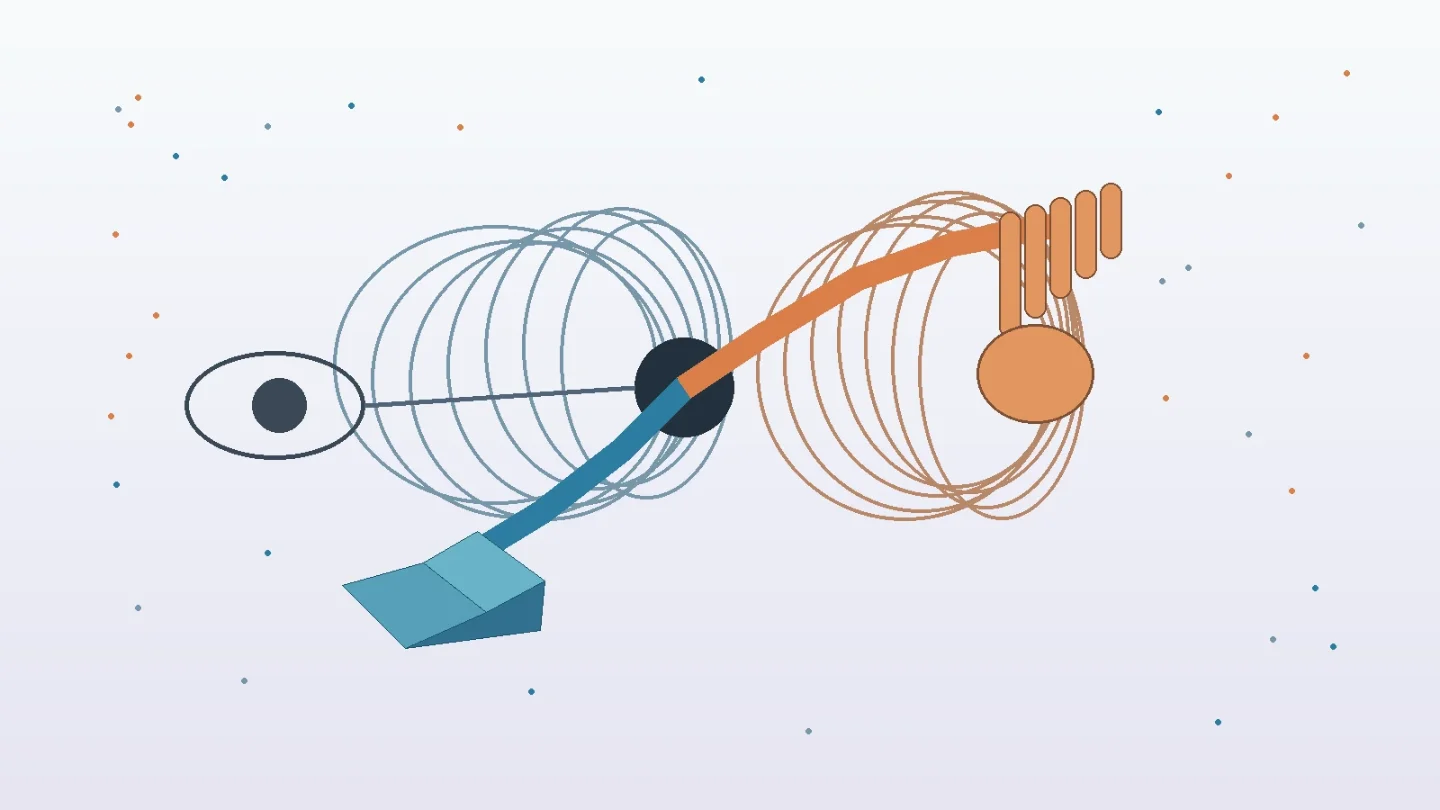
The two visual streams hypothesis explains why the brain can recognize an object in one pathway while using another pathway to guide the hand toward it, from patient DF to the ongoing debate over visual illusions and grasping.
The strange split between recognizing and acting
You can fail to recognize what an object is and still shape your hand correctly to pick it up. That sounds impossible if vision is a single picture inside the head. It makes more sense if vision is a set of partly separate systems, each built for a different job.
The two visual streams hypothesis says that early visual cortex sends information along two major routes. The ventral route, running toward inferior temporal cortex, helps identify and recognize objects. The dorsal route, running toward posterior parietal cortex, helps transform visual information into actions such as reaching, grasping, and orienting the hand. Goodale and Milner stated the contrast sharply in 1992: the ventral stream supports perceptual identification, while the dorsal stream mediates the visuomotor transformations needed for visually guided action.1
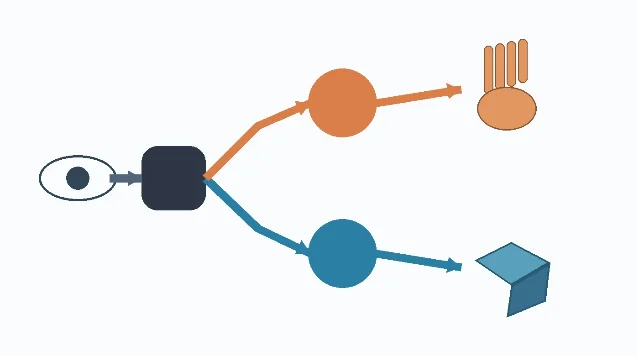
The idea grew out of an older distinction between a "what" pathway and a "where" pathway. The revision was subtle but important. The dorsal stream is not just a map of where things are. It is a system for using vision in body-centered coordinates, fast enough to guide an arm that is already moving.
Patient DF: the landmark dissociation
The landmark case was patient DF. After carbon monoxide poisoning, DF developed severe visual form agnosia, meaning she could not recognize or explicitly report object shape well. In Goodale, Milner, Jakobson, and Carey's 1991 Nature paper, she had trouble perceiving object qualities such as shape, orientation, and size, yet her hand and fingers were guided strikingly well when she reached to grasp those same objects.2
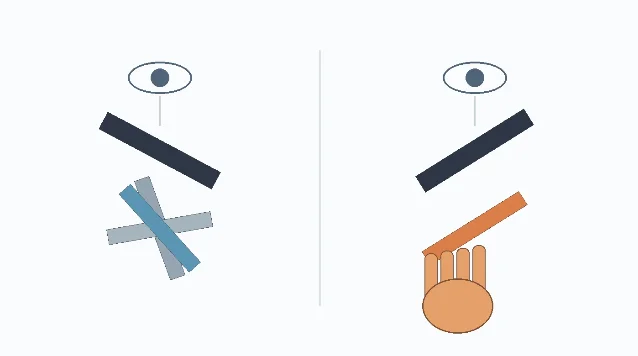
One famous version of the test used a slot. When DF was asked to report or match the slot's orientation, she performed poorly. When she was asked to post a card through the slot, her wrist turned to the correct angle during the action. The same visual property, orientation, seemed unavailable for conscious report but available for online control.
Later reviews make the case more nuanced. DF's damage was not a perfectly clean ventral-only lesion; later imaging showed dorsal-stream involvement and posterior cortical atrophy too.3 Still, the behavioral contrast remained hard to ignore. Whitwell, Milner, and Goodale reviewed two decades of work and argued that DF continued to show a strong differential dissociation: her grasping was not normal in every respect, but it was far better than her explicit form perception for the same kinds of objects.3
That qualification matters. The lesson is not that the dorsal stream is magically intact whenever the ventral stream is damaged. The lesson is that action can use visual information in a format that is different from the format used for conscious recognition.
What the two streams compute differently
A useful shorthand is this: the ventral stream asks, "What is it?" The dorsal stream asks, "How do I interact with it right now?" Shorthands are dangerous, but this one helps if you add three caveats.
First, perception often uses allocentric information. That means relations among objects, such as one circle being surrounded by larger circles. Action often needs egocentric information. That means distances, sizes, and directions coded relative to the eyes, hand, and body.
Second, action is time-sensitive. A grasp can be adjusted while the hand is in flight. DF's preserved abilities were strongest when the target was visible and the action was immediate. Delays made the task more dependent on stored perceptual representations, which DF could not use well.3
Third, the streams interact. You recognize a mug as a mug, but your hand also needs its current handle position. Recognition and action usually cooperate so smoothly that the split is invisible. Lesions, illusions, and carefully designed tasks reveal the division.
The illusion test: does the hand believe what the eye sees?
The Ebbinghaus illusion makes equal circles look different in size depending on the surrounding circles. In 1995, Aglioti, DeSouza, and Goodale used a three-dimensional version of the illusion and measured grip aperture while people picked up target discs. Their 14 participants' size judgments were strongly affected by the illusion, but their grip aperture was largely determined by the discs' true size rather than their apparent size.4
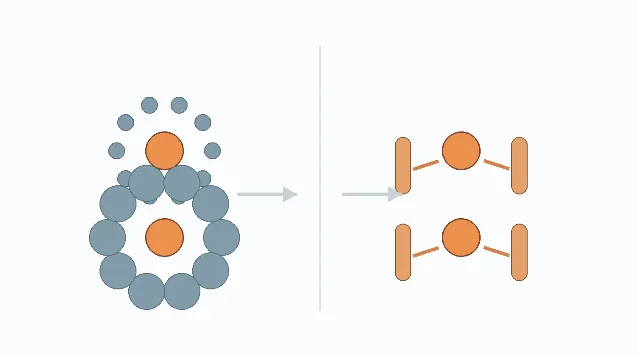
This experiment became one of the most vivid demonstrations of "the eye" and "the hand" coming apart. It also started one of the field's longest arguments.
A 2016 multi-lab replication with 144 participants reported that grasping was affected by the Ebbinghaus illusion and that the effect could not be explained away by obstacle avoidance.5 A 2017 Scientific Reports study reached a more middle position: movements were affected by some context variables, but not by all the variables that changed perceived size, leading the authors to argue that perception and action may rely on different informational variables rather than a simple all-or-none split.6
So the strict version, "illusions affect perception but never action," is too strong. A better version is that perception and action can weight visual information differently, especially when actions are immediate, targets are visible, and the task requires metric control rather than explicit report.
Why this concept matters
The two-stream idea changed what neuroscientists mean by "seeing." Seeing is not one finished picture passed to decision-making and movement systems. It is a collection of computations that serve different behavioral demands.
For object recognition, the brain needs stable descriptions. A chair should be recognized as a chair despite changes in size, viewpoint, lighting, and position. For action, the brain needs temporary control variables. Where is the edge right now? How wide should the fingers open? How should the wrist rotate before contact?
That difference explains why the same object can be represented in different ways at the same time. The ventral stream can treat the object as an identity to be recognized. The dorsal stream can treat it as a target for a movement. Both are visual, but they are visual for different purposes.
It also explains why cognitive neuroscience relies on converging methods. Patient DF was powerful because she gave a neuropsychological dissociation. Illusion experiments asked whether healthy observers show a similar split. Imaging and lesion studies link those behavioral splits to occipito-temporal and occipito-parietal systems. None of these methods alone settles the theory. Together, they make the architecture visible.
What is still debated
Three questions remain open.
- How separate are the streams? The dorsal and ventral pathways are anatomically and functionally distinct, but they exchange information. Real behavior depends on loops, not isolated pipes.
- Which actions count as dorsal-stream actions? Immediate grasping with the target visible is the cleanest case. Delayed pantomime, memory-guided action, tool use, and symbolic gestures may recruit ventral representations more heavily.
- What do illusions really test? Some illusion effects may come from perceived size. Others may come from obstacle avoidance, attention, movement timing, or the particular spatial variables used in the task.6
The strongest current reading is therefore not a cartoon split between a conscious eye and an unconscious hand. It is a division of labor: one set of visual computations supports recognition and experience, while another set supports rapid, body-scaled action.
Landmark paper
Goodale, M. A., Milner, A. D., Jakobson, L. S., & Carey, D. P. (1991). "A neurological dissociation between perceiving objects and grasping them." Nature, 349, 154-156. DOI: 10.1038/349154a0.2
A close companion paper is Goodale and Milner's 1992 review, "Separate visual pathways for perception and action," which gave the hypothesis its canonical form.1
Course connection
This concept connects directly to MIT's human-brain curriculum sequence after early visual cortex and motion processing. Nancy Kanwisher's course page lists module 4.1 as "Evidence from brain damage for the two pathways," within the ventral visual pathway and category-selectivity unit.7 The dedicated lecture page frames the topic as part of a broader course goal: using methods such as patient evidence, fMRI, TMS, and intracranial recording to ask how distinct mental functions are implemented in the brain.8
参考ソース
- 1Goodale and Milner 1992, PubMed abstract
- 2Goodale et al. 1991, Nature abstract
- 3Whitwell, Milner, and Goodale 2014, Frontiers in Neurology via PMC
- 4Aglioti, DeSouza, and Goodale 1995, PubMed abstract
- 5Kopiske et al. 2016, PubMed abstract
- 6Knol et al. 2017, Scientific Reports
- 7Nancy's Brain Talks, 9.11 The Human Brain course page
- 8Nancy's Brain Talks, lecture 4.1 page
このコンテンツについて、さらに観点や背景を補足しましょう。