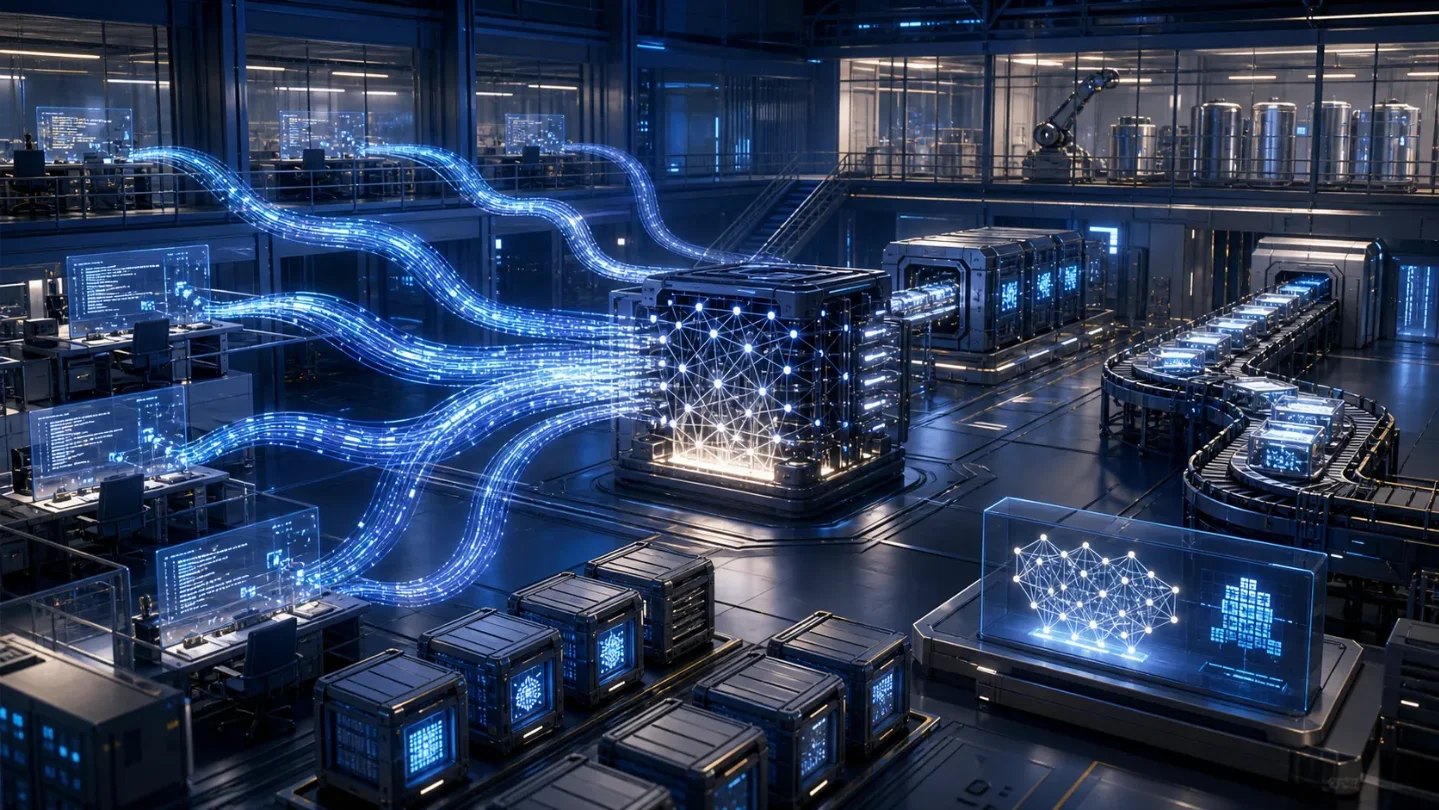
The model factory is becoming the product
Poolside's Eiso Kant argues that frontier-model advantage is shifting toward a repeatable factory of data, experiments, agents and evaluation rather than a single opaque checkpoint.

Poolside co-founder Eiso Kant's argument on Latent Space is easy to misread as a case for one more open model. The more consequential claim is about how frontier models get made. Poolside is trying to turn model development into a repeatable industrial process: data, code, training, evaluation and deployment should form a loop that produces trusted experiments quickly, rather than a heroic research project that culminates in one opaque checkpoint. 1
That changes the competitive question. If the model is an artifact of a process, then the durable advantage may sit in the factory: the ability to run more experiments, learn from them, and feed the result into the next training cycle.
コンテンツカードを読み込んでいます…
Speed comes from engineering, not a single research trick
Kant describes model building as roughly 90 percent engineering. In Poolside's account, the work begins with raw web data and continues through filtering, transformation, distributed training, post-training and reinforcement learning. The point is not to separate research from infrastructure and repair the interface later. Distributed-systems engineers are involved from the start, so a research idea can become an experiment and then a trusted result without waiting for a new pipeline to be built around it. 1
The scale of the loop is unusually concrete. Kant says Poolside has fewer than 70 researchers, 35 engineers and runs roughly 10,000 to 20,000 experiments per month. He describes Laguna S2 as moving from the beginning of pre-training to launch in about five weeks, with another recent model taking about eight weeks. Those figures do not prove that Poolside has solved frontier-model development. They do show what the company is optimizing for: the time between an idea and a result that can be trusted enough to influence the next model. 1
That is a different kind of scale law. Bigger clusters still matter, but so does the number of credible learning cycles a team can complete before its competitors. A faster loop can make an imperfect model more useful because failures arrive sooner and are easier to attribute.
Reproducibility is part of the intelligence strategy
Poolside's data system is built around a problem that is less glamorous than a new architecture and more important for iteration. Rather than materializing an entire dataset before training, the company streams data into training through a configurable system it calls a blender. A run can specify proportions of different sources, repetitions and shuffling without rebuilding the whole dataset. 1
Kant also describes an immutable data layer, versioned code and experiments recorded as code. The goal is to trace an experiment down to an individual token and reproduce runs from years earlier. In that setup, an experiment is closer to a controlled ablation than to a one-off benchmark result. If a change improves a model, the team has a better chance of knowing why.
This matters as agents enter the loop. Poolside researchers increasingly have agents writing code, launching jobs, evaluating outputs and modifying implementations. Humans still choose ideas, debug failures and decide what counts as evidence, but the routine movement between those decisions is becoming automated. The model factory is therefore also a management system for machine-generated work. Without reproducible data and code, more agents would mostly produce more untraceable guesses.
Laguna S points to behavior as a capability lever
The episode's discussion of Laguna S gives the factory a concrete output. Kant describes a sparse model with 118 billion total parameters and 8 billion active parameters. He does not present it as the new universal state of the art. Instead, he says it is the first Poolside model beginning to contribute meaningfully to the company's own work, partly because of how it behaves. 1
The reported changes are persistence, verification and a reluctance to declare victory too early. Kant gives examples of the model solving an Erdős problem and handling difficult programming tasks, including writing a Wi-Fi scanner on a Mac without an external library and finding the relevant system APIs. He says the model can run on a DGX Spark at roughly 30 to 40 tokens per second, although those performance observations are part of the conversation rather than an independent benchmark.
The implication is narrower and more useful than the claim that small models are simply replacing large ones. Many knowledge-work tasks are loops of debugging, documentation search and repeated testing. A model that spends more time verifying its own work may outperform a more knowledgeable model that stops after its first plausible answer. That makes post-training behavior, harness design and evaluation as important as raw parameter count for a defined class of work.
Kant still rejects an anti-scaling conclusion. Poolside wants to train large models and compete at the frontier; its point is that useful capability can be moved by changing behavior and training efficiency, not only by adding parameters. He also argues that reinforcement learning will move earlier into pre-training because next-token prediction is extracting too little from the web. Mid-training, in his telling, is partly a consequence of organizational boundaries: there is a mid-training team, so a distinct mid-training phase exists. 1
Open weights are part of the competitive thesis
Kant places the factory inside a political and economic preference for more model builders. He says he would rather live in a world with 100 foundation-model companies than one with five, even if Poolside were one of the five. He credits open research from other labs, including DeepSeek and Zhipu, with helping Poolside, and treats sharing as a reciprocal obligation. 1
There are unresolved limits. He does not claim to know exactly when increasingly capable models should stop being released openly, how open models will be monetized, or how governments will respond. Those caveats matter because a model factory can lower the cost of competition while also lowering the cost of misuse.
The strongest takeaway is not that Poolside has found a magic architecture. It is that the frontier is becoming an operations problem. Teams that can make experiments reproducible, let agents handle routine engineering and move reliable findings back into training may improve faster than teams with a comparable model but a slower learning loop. Open weights widen who can participate; the factory determines how quickly each participant can learn.
Read the full Latent Space conversation with Eiso Kant.
関連コンテンツ
- ログインするとコメントできます。
More from this channel
- The first AI labor signal may be hiring, not layoffs
- DoorDash is building a delivery network, not a robot demo
- Watermarking can mark new AI images. It cannot clean up the old archive.
- AI market panic has become part of the market's risk control
- GPT-6 is not the story. The security test is.
- The open-model fight is becoming a fight over AI’s default
- The bottleneck is not another bigger model