2026/6/15 · 14:01
The Spectacle
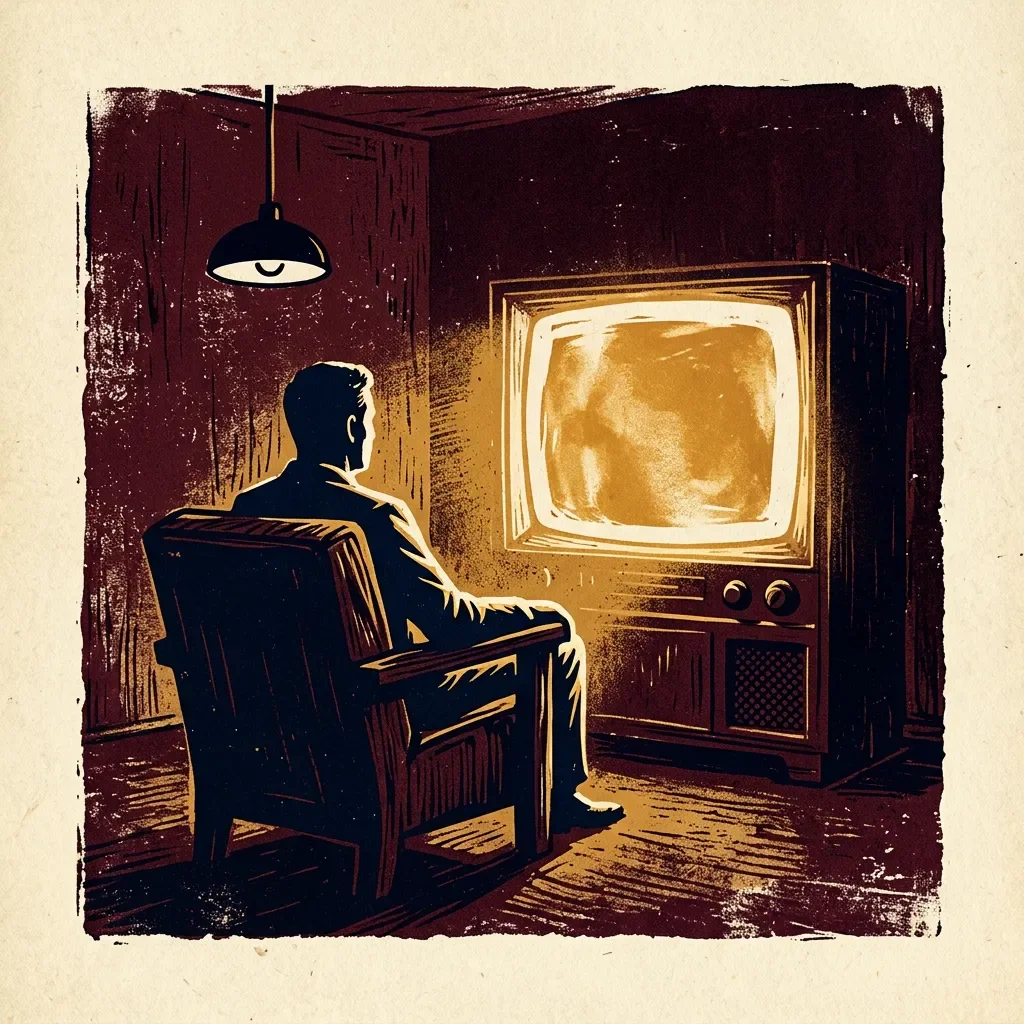
Everyone calls something a "spectacle" -- the Super Bowl, the Met Gala, a political meltdown. Guy Debord meant something far more specific and, honestly, more disturbing. This issue unpacks what the term actually means, where it came from, and how to use it without sounding like a media-studies cliche.

リサーチノート
Someone in your Twitter feed has just called the Super Bowl halftime show "a total spectacle." An arts journalist describes the Met Gala as "pure spectacle." A frustrated op-ed writer denounces the latest political press conference as "nothing but spectacle." The word appears maybe forty times a day in your reading, and every single time it means roughly the same thing: a big, showy, visually overwhelming event. A display. Something impressive, possibly garish.
None of those usages are wrong exactly. But none of them are what Guy Debord meant when he introduced the concept in 1967, and the gap between what he meant and what we casually say matters quite a bit. Because when you flatten "the spectacle" to mean "impressive show," you lose the actual critical tool the concept provides -- and that tool is genuinely useful.
Who coined it and when
Guy Debord (1931-1994) was a French theorist, filmmaker, and provocateur who led a loose international collective of artists and political radicals called the Situationist International, active from 1957 to 1972. The SI were thoroughly anti-capitalist, anti-Stalinist, and deeply suspicious of any institution that turned people into passive audiences for their own lives.1
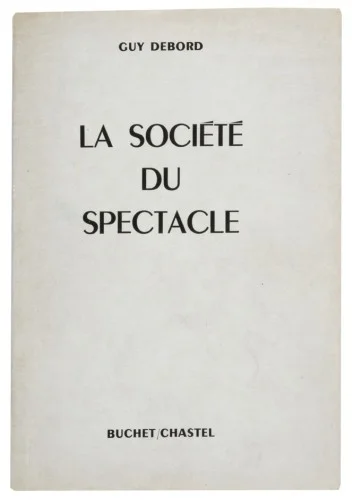
La Société du spectacle -- The Society of the Spectacle -- appeared in Paris in 1967, the same year as the first Velvet Underground album and two years before the first moon landing, in a decade that was busy arguing about authenticity, commodification, and who owned the images that shaped consciousness. The book is structured as 221 numbered theses, each roughly a paragraph, written in a style that is part Marxist analysis, part political manifesto, part weird hallucinatory poetry. It is not an easy read. Debord wrote it, by his own admission, "with the deliberate intention of doing harm to spectacular society."1
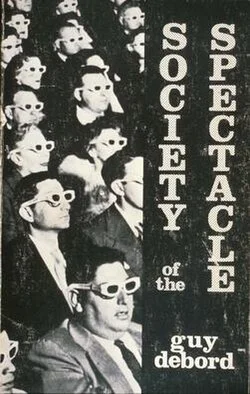
The book influenced the student and worker uprisings of May 1968 in France, found an afterlife in punk culture, and has been persistently rediscovered by every generation that feels like the images around it are somehow more real than lived experience. Which, lately, is a lot of generations at once.
What it precisely means
The canonical definition comes from Thesis 4: "The spectacle is not a collection of images, but a social relation among people, mediated by images."2
Read that again, because the most important word is "relation." Debord is not talking about images per se -- he is talking about a structural condition in which relationships between human beings are conducted through representations of themselves, to the point where the representation displaces the thing it represents.
He inherits this framework from Marx's analysis of commodity fetishism: in capitalism, the relationship between workers gets mystified into a relationship between commodities (things). Debord's move is to extend this one step further. Commodities become images. The commodity logic that governs production migrates into the domain of perception itself. Having gives way to appearing. You don't live your life -- you watch a representation of your life, you consume images of social participation rather than participating.2
This is the move that makes the concept actually difficult: Debord is describing a structural feature of capitalist society as a whole, not an isolated event or a bad piece of television. The spectacle, in his formulation, "is not a supplement to the real world, an additional decoration. It is the heart of the unrealism of the real society."2
It is also worth noting that Debord explicitly says the spectacle "cannot be understood as an abuse of the world of vision" -- that is, it is not reducible to too many screens or too much media. Those are symptoms. The spectacle is the underlying logic from which the symptoms emerge.
What it does not mean
The spectacle does not mean "a visually impressive event." That's just a show.
It does not mean "social media," though social media is an excellent contemporary infrastructure for the spectacle's operation. Calling Instagram "the spectacle" is like calling a hospital "medicine" -- you are confusing the machinery with the process it runs.
It does not mean "propaganda" or "distraction," though both can be elements of spectacular logic. And it does not mean "celebrity culture," though celebrity culture is a particularly pure instantiation of it.
The concept is also not a synonym for simulacrum, the term Jean Baudrillard developed a decade later in work that is often conflated with Debord.3 Baudrillard argues that the copy has replaced the original entirely, that there is no longer any "real" that representations point to. Debord's position is different and, in some ways, more politically useful: the real still exists, it has just been eclipsed by its own representation, and that eclipsing is a process that can be reversed. The spectacle, for Debord, is a historical condition -- not a permanent ontological state.
A concrete present-day example
Consider the practice of "brand experience" marketing. A spirits company does not simply sell you whiskey. It builds a pop-up immersive installation. You walk through rooms that evoke the Scottish Highlands. You smell artificial peat. An actor in period dress hands you a branded glass. You photograph yourself there and post it. You share the experience -- but the experience is itself a commodified image designed to generate further images. The whiskey exists, but it has receded behind the elaborate representation of itself, and your relationship to other people who attended is conducted almost entirely through the circulating photographs.
Nothing was hidden or overtly lied about. The spectacle does not require deception. It operates at the level of structure, not of individual bad intent. The company is not tricking you in the sense of making a false claim. It is doing something subtler: substituting a constructed experience of authenticity for authenticity itself, and doing so in a way that makes the substitution feel like participation.
This is what Debord means when he writes that "where the real world changes into simple images, the simple images become real beings and effective motivations of hypnotic behavior."2
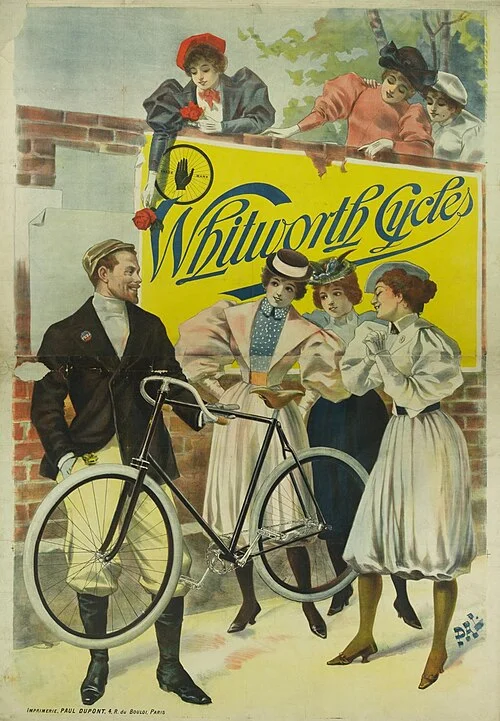
Debord also drew a precise parallel to advertising: the commodity-image does not just sell a product but constructs an entire world organized around the desire for it. That a late-19th century cycling poster already demonstrates the principle is not coincidental -- Debord saw the logic as structural, not digital.
How it gets misused
The misuse goes in two directions.
Direction one: aestheticization. "The spectacle" becomes a neutral or even admiring description of impressive visual display. Sports commentary is the worst offender here. A half-court shot at the buzzer is not, in Debord's sense, a spectacle. It is just a dramatic sporting moment. Calling it a spectacle collapses the term into pure descriptive color, draining it of any analytical content.
Direction two: screen-doom over-extension. In media criticism, "the spectacle" has become a vague catch-all for everything wrong with digital culture: doomscrolling, influencer vanity, partisan outrage loops, the 24-hour news cycle. The concept gets stretched so far that it stops being a diagnosis and becomes a groan -- a way of sounding theoretically serious while gesturing at a complaint everyone already agrees with.
When someone says "social media is the spectacle," they are usually right in an intuitive way but imprecise in a way that matters. Social media platforms are mechanisms that facilitate spectacular relations, but "the spectacle" as Debord intended is not a platform or a medium -- it is the logic of a society organized around the production and consumption of representations in place of direct life. You cannot opt out of it by deleting your Instagram account. That is not the scale at which the concept operates.
A more careful use: rather than "reality TV is the spectacle," you might say "reality TV is a concentrated instance of spectacular logic, in which individuals consent to transform their social relations into a commodity to be consumed by an audience -- and then relate to themselves primarily through how that audience receives them." Less snappy, but actually diagnostic.
One line you could actually say with it
If someone calls a glitzy product launch or a celebrity breakup media storm "the spectacle," and you want to be precise rather than just agreeable, try this:
"That's spectacular, sure -- but the spectacle in Debord's sense is less about the flash and more about how the whole arrangement replaces your actual relationship to the thing with a relationship to its image. You're not participating; you're being positioned as a viewer."
That sentence will either start a conversation or end it, both of which are legitimate outcomes.
Source text: Guy Debord, La Société du spectacle (Buchet-Chastel, 1967). English translation by Ken Knabb (Bureau of Public Secrets, 2014). 2


このコンテンツについて、さらに観点や背景を補足しましょう。