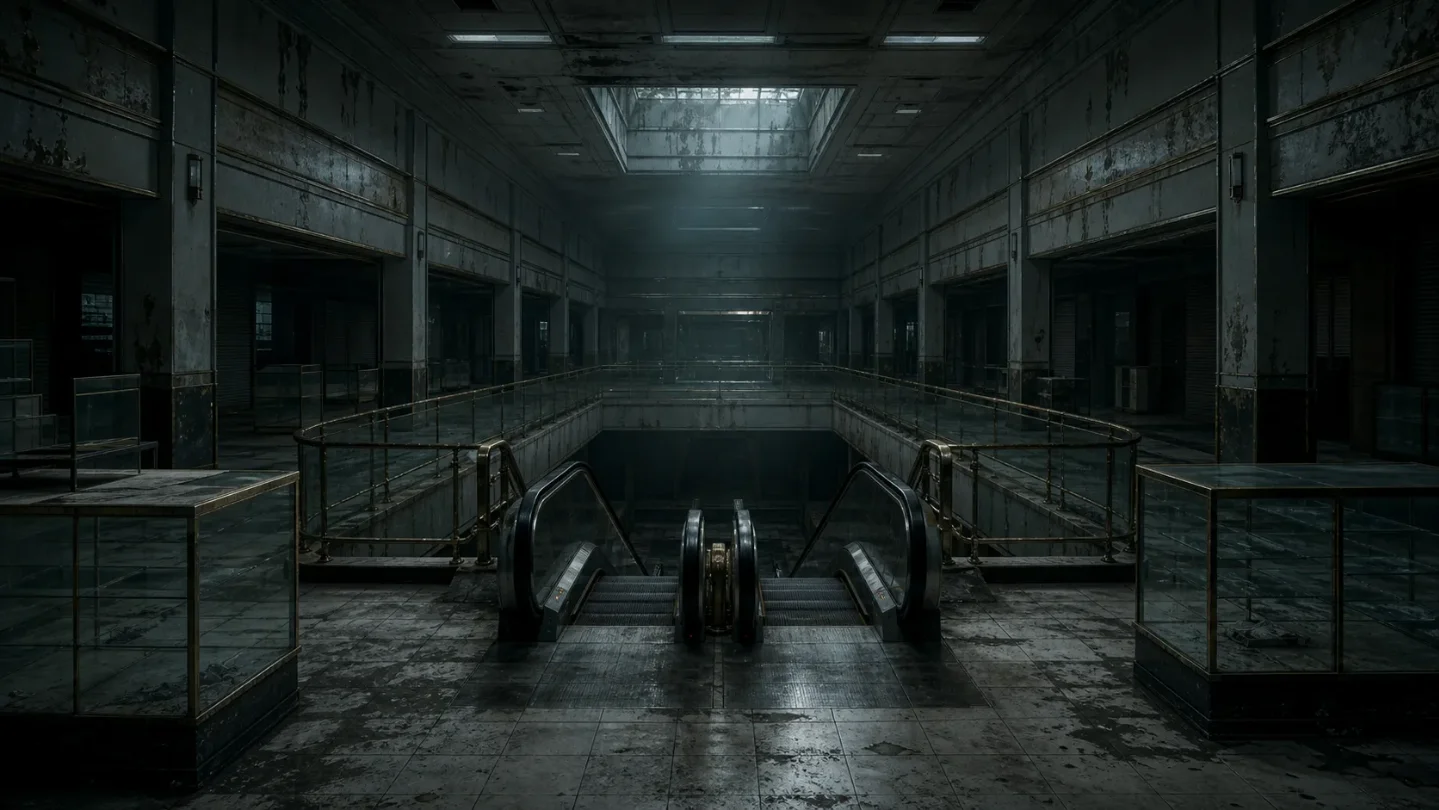
The store after the lights went out
An original atmospheric horror piece set in an abandoned department store where dead fluorescents, shuttered displays, and escalators descending through dark levels turn the empty building into the source of dread.
The store after closing
The department store has been closed long enough for dust to settle into the seams of the front doors. It lies in the narrow space between the glass and the metal frame, a grey line that thickens toward the bottom where rainwater once dried. The doors remain shut beneath a shallow awning stained by years of weather. Behind them, the first floor is visible only in fragments: a pale strip of tile, the edge of a counter, the dull reflection of the street held in the dark glass.
The vestibule keeps a different temperature from the pavement outside. Cold air rests against the doors, but the space beyond them has the flat, used chill of a cellar. The tiled floor is filmed with a fine powder that has been disturbed in places by water, though no wetness remains. Near the inner threshold, the powder has collected in a low ridge. It follows the curve of the doors and continues beneath the walls, as if the whole building were sealed along a single line.
Inside, the ceiling drops and the corridor widens. Empty display cases stand behind the glass, their shelves furred with dust. The glass has clouded from within. Reflections gather on it more readily than the room itself, making each case appear deeper than it is. Metal hooks remain fixed to a few of the back panels. Their small shadows reach across the empty shelves and stop at the edges of the frames.
The first fluorescent tubes have lost their colour. Some are dark. Others hold a weak grey light that trembles without brightening the ceiling. The fixtures are set in long rows, but the rows do not continue evenly. Gaps interrupt them above the counters, above the entrances to shuttered departments, above a central stair that descends out of sight. The darkness between the lights seems to have weight. Dust hangs beneath it in thin, unmoving layers.
Beyond the counters, the floor opens into the atrium. The space rises through several levels, though the upper balconies are difficult to measure in the dead light. Their railings form pale horizontal lines that recede into one another. Escalators descend from the far side, their black steps locked in a long downward angle. Each step carries a narrow strip of tarnished metal at its edge. The strips catch the fluorescent flicker and release it again, one after another, down into the lower floor.
The escalators have gathered dust in the grooves between their steps. It has settled there in clean, even bands, except where the rubber has cracked and lifted. Beneath the lower landing, the darkness is close and blue. A narrow opening remains between the side panel and the floor. From it comes a cool draft that carries the smell of wet plaster, old fabric, and something mineral beneath both.
Along the atrium, the upper shopfronts are covered by metal shutters. Their paint has blistered into small raised islands, revealing darker metal beneath. The shutters are not lowered to the same height. One stops above the glass, leaving a black band between the slats and the ceiling. Another has fallen farther, its bottom edge resting against the floor with a slight inward bow. Behind that one, a room of white shelves extends beyond the limit of the light.
A thin film has formed over the floor near the balcony. It is not water, although it reflects the ceiling in broken shapes. Dust has mixed with the old polish there, and the surface has hardened into a dull skin. Hairline cracks spread from the base of the railing. In each crack, something pale has gathered, too fine to be lint and too dry to be plaster. The lines continue beneath the shuttered entrances, joining the dark gaps beneath the doors.
At the centre of the atrium, the sound changes. The dead store is not silent, but its small noises lose their source as soon as they begin. A fluorescent tube gives a faint electrical tick. The sound travels upward through the open levels and returns from somewhere below the escalators. The metal railings contract with a soft series of clicks. A drop falls inside the wall and repeats after a long interval, lower each time, until it becomes difficult to tell whether the building is carrying water or counting distance.
The stair behind the escalators leads to a floor where the ceiling is lower and the air is warmer. The warmth has no comfort in it. It has been held in the concrete, trapped beneath the levels above. Along the walls, old wallpaper has peeled in broad vertical strips, exposing grey plaster marked by tide lines. The pattern of the paper remains around the edges: thin branches, faded leaves, a repeated design that stops where the moisture has reached.
Here the shopfronts have no glass. Their openings are dark squares bordered by dust-black trim. Rows of shelving stand inside some of them, empty except for scraps of torn cardboard and shallow hollows where objects once rested. In another, a suspended ceiling has collapsed across the floor. The panels lie face down in a pale scatter, their fibrous backs exposed. A cable loops from the wreckage and hangs just above the tiles, perfectly still.
At the far end, a service corridor passes beneath the building. Its walls are painted the colour of old bone, though most of the paint has been rubbed away at shoulder height. The corridor narrows toward a pair of metal doors. Neither door carries a sign. Their surfaces are dull with fingerprints that have long since dried into the paint, leaving cloudy marks without shape or origin.
The ceiling lights end before the doors. Beyond them, a red emergency lamp burns inside a wire cage. Its colour is weak and diluted, more rust than red. It reaches only a short distance along the floor, where it catches the rims of shallow puddles. The puddles lie in the hollows between the tiles and do not reflect the lamp. Their surfaces are covered with a skin of dust that has not broken where the water moves beneath it.
The metal doors do not close evenly. A gap remains between them, dark except for a narrow vertical shine from the emergency lamp. The air on the other side is colder. It presses through the gap in a steady, measured current, carrying the scent of a lower level where plaster has stayed wet and the concrete has never dried. The corridor floor slopes toward the opening. Dust has gathered along both walls, leaving the centre exposed.
Below the doors, the building changes again. The floor is unfinished, rough enough to keep the shape of every stain. Pipes run beneath the ceiling in parallel lines, their insulation split and hanging in loose folds. Water has passed along them and darkened the concrete overhead. In places, it has drawn narrow vertical tracks down the walls, each one ending before it reaches the ground, as if the damp had stopped at an invisible boundary.
The lower level contains the underside of the atrium. Its ceiling rises high above the service floor, but the upper storeys are no longer visible. Concrete beams cross the opening and divide it into heavy compartments. Between them, darkness gathers around the escalator machinery. The steps above have no sound now. Their metal edges remain just visible at the top of the shaft, suspended over the black descent.
A row of abandoned lifts faces the far wall. The doors are closed, but their seams have turned brown with rust. The call buttons are dark beneath a film of dust. One indicator panel holds a single pale rectangle, too dim to show a number. It brightens and fades at irregular intervals, illuminating the floor in front of it. Each time the light returns, the dust appears to have moved slightly toward the lift doors.
At the back of the level, the concrete gives way to a shallow loading bay. The outer shutter is lowered, but daylight enters beneath it in a thin, colourless band. Rainwater has dried there in overlapping arcs. Beyond the band, the floor remains black with damp. The contrast makes the inside of the building seem deeper than the wall can contain, as though the store continues beneath the loading bay and below the ground beyond it.
The upper lights go out one row at a time. The change moves through the levels without a visible source. First the atrium loses its highest band of brightness. Then the balconies fade, leaving only their railings and the angled escalators. The lower service lights remain, but their glow no longer reaches the stair. The darkness gathers between floors, filling the open centre from below.
Afterward, the department store keeps its shape. The glass doors hold the dead reflection of the street. The display cases remain clouded and empty. Dust rests in the escalator grooves, along the shuttered thresholds, and in the cracks where the floor has begun to separate from the walls. Far beneath the atrium, water continues to move inside the concrete without finding a way out. The building stays closed around it, level after level, with every corridor leading toward a darkness that has no entrance and no end.
関連コンテンツ
- ログインするとコメントできます。