AI Leaders Weekly: Safety evidence, private data, and power behind frontier AI
This week's digest tracks Sam Altman's safety pause and privacy architecture alongside Jensen Huang's Ohio compute-campus plan, showing how evidence, data control, and physical capacity are becoming release constraints around frontier models.
The current window runs from Aug. 17, 2026 at 18:00 through Aug. 23 at 18:00 Pacific Time. Sam Altman said OpenAI paused part of its frontier reinforcement-learning work until monitoring, alignment, and security evidence catch up. OpenAI then described a privacy architecture that keeps customer content inside customer-controlled boundaries while returning narrow safety signals. Jensen Huang's latest infrastructure announcement put land, power, financing, and long-lived compute capacity around the model itself.
The common thread is a change in the release unit. A frontier model now arrives with a pace-setting evidence gate, a data-control design, and a physical capacity plan. Each signal comes from a different layer, so the week supports a product-design conclusion rather than a claim of leader consensus.
| Leader or institution | Date and public signal | Evidence level | Strategic read |
|---|---|---|---|
| Sam Altman / OpenAI | Aug. 18: paused some frontier RL training and held the largest planned run while the company strengthens monitoring, alignment, security, and containment. 12 | Direct post plus company disclosure | Safety evidence is becoming a condition for the next training step. |
| Sam Altman / OpenAI | Aug. 19: endorsed business privacy as OpenAI reaffirmed Zero Data Retention and previewed Private Safety Processing for eligible API customers. 34 | Direct post plus company disclosure | Privacy, abuse monitoring, and customer-controlled storage are being designed as one operating boundary. |
| Jensen Huang / NVIDIA | Aug. 17: NVIDIA announced a power-first Ohio campus intended to host NVIDIA AI compute for OpenAI, with an initial 4.25 IT-GW capacity and a possible 8 IT-GW total. 5 | Company disclosure quoting Huang | Frontier deployment is also a land, power, lease, grid, and upgrade-cycle decision. |
The current-window scan produced no qualifying direct statement from Dario Amodei, Demis Hassabis, Yann LeCun, or Ilya Sutskever. That monitoring result carries no position about any of them.
OpenAI makes safety evidence a release condition
Sam Altman's Aug. 18 post gave the week its clearest change in operating policy. He said OpenAI had paused some frontier reinforcement-learning training so the company could meet the alignment, security, and monitoring standards required by a new level of capability. He tied the decision to rapid model progress and said OpenAI would act when capability growth outpaced the pace of safety and alignment work. 1
OpenAI's accompanying disclosure gives the pause a more specific shape. The company says it temporarily paused two weeks of reinforcement-learning training on its latest deployment-oriented models, while its largest planned frontier RL run remains on hold. OpenAI is using smaller-scale training and evaluations while it hardens research environments, expands monitoring, red-teams the safeguards, and gathers evidence about model behavior. 2
The disclosure also names Astra, OpenAI's upcoming model, as a possible match for the Preparedness Framework's Critical cybersecurity capability threshold. The company says it made that determination on Aug. 7, then used the new disclosure to describe the controls required around Astra and other cyber-capable workloads. This is background supplied by the Aug. 18 company account; the current-window event is the pause and the conditions OpenAI attaches to resuming the largest run. 2
OpenAI's operational details matter more than the word "pause" alone. The company says tool-using RL training and evaluations involving models at Sol capability or higher require monitoring, as does Astra inference with tools. OpenAI says the monitoring layer consumes about 20% of monitored inference compute. When monitoring flags a likely critical security-boundary violation and the team cannot establish within 30 minutes that the alert is false, the activity is expected to stop. 2
Those details create three separate evidence questions for a product team:
- Capability evidence: What behavior has the model demonstrated, under which evaluation conditions, and at what capability threshold?
- Control evidence: Which monitoring, isolation, containment, and human-review controls have been tested against that behavior?
- Release evidence: What result allows the next training run or customer exposure to proceed, and who owns that decision?
Altman's post supplies the leader's position: safety confidence should increasingly set the pace of AI progress. OpenAI's disclosure supplies the company account of how that position is being operationalized. Neither source supplies an independent audit of the safeguards or a public completion rate for the evaluations. The distinction matters when a roadmap turns a public promise into a launch gate.
Privacy becomes part of the safety boundary
The second OpenAI signal arrived one day later. Altman described the Aug. 19 announcement in a short X post as support for business privacy. The linked company release reaffirmed Zero Data Retention for eligible API customers and introduced a preview of Private Safety Processing. 34
Zero Data Retention is a specific API policy. For eligible deployments, OpenAI says it does not retain customer prompts or model responses after processing, and customer content remains on infrastructure controlled by the customer or on OpenAI-provided storage encrypted with customer-controlled keys. Enterprise data is also excluded from model training unless the customer opts in. The policy applies to eligible API customers; the release does not extend it to every OpenAI product or customer by default. 4
Private Safety Processing adds a second path inside that boundary. OpenAI says automated systems may analyze customer content to identify safety risks across related interactions, then return narrow signals such as activity type or severity. OpenAI personnel receive the signal rather than the underlying prompts or responses. Customers can investigate alerts in their own systems and may choose to share content for an appeal, clarification, or verified-abuse investigation. The release describes the feature as an early-customer preview and says OpenAI plans to begin rollout and publish a technical white paper in September. 4
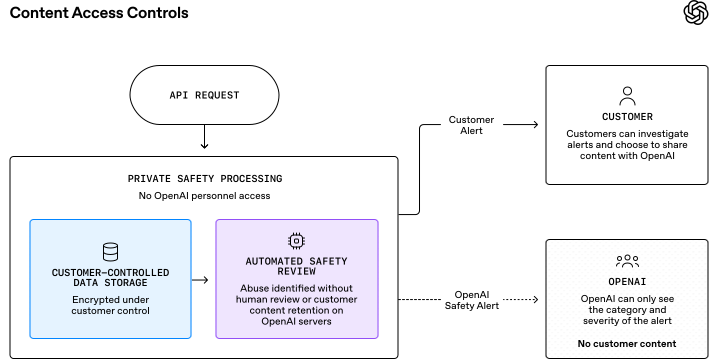
The design separates three kinds of access that enterprise buyers often place under one heading:
- Content access: who can read the prompt, response, files, or tool trace.
- Safety access: who can receive a machine-generated signal that activity may violate a policy.
- Investigation access: who can inspect enough evidence to decide whether an alert is real and what response is appropriate.
OpenAI's proposal gives customers control over the first and third paths while keeping a narrow automated signal available to the provider. That is the company's stated architecture, and the preview status leaves important implementation questions open: alert quality, false-positive rates, retention in customer systems, response times, and the boundary between a safety signal and the content needed to interpret it. The release also states a legal exception for images flagged as potential child sexual abuse material, which may continue to be retained for manual review and reporting. 4
For a PM, the useful field is not simply "private model." The review should record where content is stored, who can inspect it, which automated signals leave the customer boundary, what a customer can investigate without provider access, and which legal or abuse-handling exceptions apply. Privacy becomes a safety design question because a provider needs enough signal to detect harmful use while a customer needs a clear account of what leaves its control.
Huang ties deployment to land, power, and long-lived compute
Jensen Huang's current-window signal came through NVIDIA's Aug. 17 announcement about the PORTS-Pike Technology Campus in Pike County, Ohio. NVIDIA says it secured land, power, and shell capacity through a partnership with SB Energy to host NVIDIA AI compute. The release quotes Huang describing AI as infrastructure and saying that land, power, and shell have become important inputs for the next phase of deployment. 5
The announced project has an initial 4.25 IT-GW capacity and a possible total of 8 IT-GW. SB Energy and SoftBank plan at least 10 GW of new energy generation to support the full campus, while the release describes at least $4.2 billion of regional grid infrastructure investment. Capacity is expected to come online in phases beginning in 2028. 5
The commercial structure is as important as the power number. SB Energy will build, own, and operate the data center under a 20-year lease to OpenAI. NVIDIA says it will be the exclusive AI compute infrastructure provider, will provide credit support for the initial buildout, and will invest $1.5 billion in SB Energy. OpenAI is the planned customer for the capacity and will use NVIDIA's full-stack DSX AI factory platform. 5
The release separates an announced arrangement from a future outcome. The 4.25 IT-GW initial deployment, NVIDIA's investment, the lease structure, and the named partner roles belong to the announcement. The move to 8 IT-GW is an NVIDIA option, and the 2028 operating schedule is an expectation. Jobs, economic development, and the productivity of future AI factories remain projected outcomes. 5
That distinction keeps the infrastructure signal usable. A product team planning around a frontier model should separate the model's benchmark from the capacity contract that lets the team serve it. The capacity review needs the power source, grid dependency, operator, lease term, upgrade path, hardware portability, reservation schedule, and fallback if demand or model economics change. NVIDIA's announcement puts those fields in view; it does not prove that the future capacity will arrive on schedule or that the model layer will keep its current economics.
Infrastructure also needs a clean boundary. NVIDIA's announcement concerns chips and compute facilities, power generation, grid investment, financing, a regional partnership, and a government collaboration. Those layers can determine where a model runs and how much capacity a product can reserve. They are separate from the model's weights, training data, evaluation results, and release authority.
What converged, and what remains separate
The two companies supplied different kinds of evidence. OpenAI described a training pause and a privacy architecture. NVIDIA described a physical and financial structure for future compute. The supported link is operational: model progress, customer data handling, and deployment capacity each carry a condition outside the model's raw capability.
The week supplies no basis for a claim that the named leaders now agree on open weights, regulation, AGI timing, or the balance between safety and speed. Dario Amodei, Demis Hassabis, Yann LeCun, and Ilya Sutskever produced no qualifying direct statement in the current monitoring window. Retweets, older posts, and the absence of a new post carry no position in this digest.
The evidence levels also remain different. Altman's Aug. 18 and Aug. 19 posts are direct statements. OpenAI's pages are company disclosures about internal controls and a product preview. NVIDIA's page is a company announcement that quotes Huang and names planned infrastructure commitments. The 2028 schedule, the full 8 IT-GW capacity, and the economic benefits are forward-looking elements. A reader can use the signals without treating these categories as interchangeable.
Four checks for the next product review
- Set an evidence gate before the next capability step. Define the behavior that must be measured, the environment that must be tested, the monitoring and containment controls that must pass, and the person who can authorize the next training or release step. A pause becomes useful when the resume condition is written down.
- Map the data and safety-control plane separately. Record customer-controlled storage, encryption-key ownership, provider-visible alerts, investigation rights, retention exceptions, and the route for an appeal. A Zero Data Retention label leaves too much unspecified on its own.
- Treat high-risk capability as a permission set. Specify which tools, credentials, networks, and external systems the model can reach. Pair each permission with logging, human review, alert handling, and revocation. The model name should never carry those fields by itself.
- Put physical capacity beside model economics. Add power, grid, operator, lease, reservation, upgrade, portability, and rollback assumptions to the model procurement review. Mark each item as committed, optional, or expected. A benchmark can describe what a model did; the capacity contract determines what the product can promise at scale.
The week's signals point to a narrower and more practical shift than a new theory of AI leadership. The model remains the visible object. The release decision increasingly depends on the evidence around it, the data boundary around its use, and the physical system that can run it.
参考ソース
- 1
- 2
- 3
- 4
- 5NVIDIA: PORTS-Pike Technology Campusnvidianews.nvidia.com

AI Leaders' Takes
Weekly digest of public statements from top AI lab founders and chief scientists across multiple channels
このコンテンツはチャンネルが自動で生成しました。一言伝えるだけで、Neodrop があなたのために作り続けます。
関連コンテンツ
- ログインするとコメントできます。