
AI Leaders Weekly: The scale-up race is now about control
This week’s leaders moved the AI debate from model openness to the operating conditions of scale: lower cost, more compute, physical deployment, and tighter control over release and safety.

Scale is no longer the last mile
From July 26 through August 2, the leaders in this channel talked less about one model winning than about what it takes to make AI cheap, physical, and defensible. Sam Altman announced lower prices and faster API access for GPT-5.6. Ilya Sutskever and NVIDIA said a new partnership would increase Safe Superintelligence's compute by an order of magnitude. Demis Hassabis put a new robotics stack into early access, including on-device models. Jensen Huang framed open and closed models as parts of a defender ecosystem, while Dario Amodei argued that the real controls belong around chips, distillation, and pre-release testing. 12345
The week's common thread is simple: scale has become a product decision, and control has moved up with it. The relevant question is no longer just which model is more capable. It is which layer gets cheaper, which layer moves onto a device or into a region, which permissions stay open, and who can stop or test the system when the stakes rise.
The leaders' signals
| Leader | In-window statement or action | What it changes for product teams |
|---|---|---|
| Sam Altman, OpenAI | On July 30, Altman announced an 80% price cut for GPT-5.6 Luna, a 20% cut for Terra, and Fast mode for Sol at up to 2.5x the speed for twice the price. On July 31, he described a ChatGPT Work use case that connects family calendars and produces a daily podcast about each child's schedule and interests. 67 | OpenAI is widening the set of workflows that can be run continuously, not just occasionally. Price per task and latency now sit beside benchmark quality in the model choice. |
| Dario Amodei, Anthropic | In a July 27 essay, Amodei said Anthropic has never advocated banning open-weights models. He supports keeping powerful chips from authoritarian states, stopping industrial-scale distillation, and requiring safety testing for sufficiently capable models whether they are open or closed. 5 | The safety boundary is being drawn around capability, compute supply, and release process rather than the label on the model. |
| Demis Hassabis, Google DeepMind | On July 30, Hassabis said Gemini Robotics 2 can reason through movement, including delicate knot-tying, and coordinate complex workflows with other robots. The accompanying release introduced whole-body, embodied-reasoning, and on-device models. 38 | Physical AI is being packaged as a stack: motor control, planning, collaboration, and local execution. A robotics buyer will need to evaluate the model and the hardware, network, safety stop, and adaptation path together. |
| Ilya Sutskever, SSI | Sutskever wrote on July 27, "Time to scale that SSI." The same day, SSI and NVIDIA announced a long-term partnership, an NVIDIA investment, and access to Vera Rubin systems that the companies say will increase SSI's compute by an order of magnitude. Sutskever said SSI has research worthy of scaling up. 29 | SSI's public signal is capacity before product: more compute, a tightly guarded research program, and no disclosed customer-facing system. This is a scale-up claim, not evidence of a released capability. |
| Jensen Huang, NVIDIA | Huang wrote that attackers already have frontier AI and defenders need an ecosystem using the best open and closed models. He said the Hugging Face incident showed how closed tools could block forensics and an open-weight model could help contain an intrusion, then announced the Open Secure AI Alliance. 4 | NVIDIA is selling model diversity as security infrastructure. The procurement question includes access to weights, forensics, tool permissions, and the ability to adapt a model when the attacker changes tactics. |
| Yann LeCun, AMI Labs | LeCun's visible AI signal this week was amplification rather than an authored position: he retweeted Hugging Face CEO Clement Delangue's call to accelerate in response to AI-powered cyberattacks. LeCun added no original text, so the claim belongs to Delangue, not LeCun. 10 | There is no new LeCun technical or policy view to use in this week's comparison. Silence and amplification should not be converted into a forecast. |
| Mark Zuckerberg, Meta | In a July 28 New York Times interview, Zuckerberg said tightly controlled development by leading labs could amount to abandoning American technology values and argued for more openness in the debate. The remarks were part of a wider disagreement over centralized versus open AI development. 11 | The openness dispute is also a competition over who gets to set the default architecture of the ecosystem: a small group of labs, or a wider field of model builders and deployers. |
Four kinds of scale
1. More work per dollar
Altman's price announcement is the most immediate commercial signal. GPT-5.6 Luna's API price fell to $0.20 per million input tokens and $1.20 per million output tokens. Terra moved to $2 and $12. Sol's Fast mode offers up to 2.5x the speed for twice the price, with no stated change in intelligence. OpenAI says Luna can handle tools and multi-step workflows, and that the lower prices also apply to usage in Codex and ChatGPT Work. 16
The hard fact is the price change. The broader claim that this makes new classes of agents practical is OpenAI's product argument, supported on the page by customer testimonials rather than an independent evaluation. That distinction matters. A lower token bill changes what teams can afford to try; it does not tell them whether the workflow completes reliably, how much human review it needs, or what failure recovery costs.
Altman's family-calendar example shows the intended direction. The assistant is not answering one question; it is combining calendars, personal context, content generation, and a recurring schedule. That is a useful product clue, but it is still a description of a use case, not a measured deployment result. 7
For PMs, the unit to track is cost per completed outcome. Token price is an input. The actual metric includes retries, tool calls, latency, approval prompts, and the cost of repairing a wrong action.
2. More compute behind a private bet
SSI and NVIDIA made a different kind of scale claim. Their July 27 announcement says access to NVIDIA's Vera Rubin platform, combined with NVIDIA's investment, will increase SSI's compute by an order of magnitude. Sutskever described the partnership as a way to scale research that SSI considers worthy of scaling up. Huang said NVIDIA wants to see what new breakthroughs SSI discovers on the platform. 2
This is a stronger infrastructure signal than a product launch because the company is still withholding its product. It says the next bottleneck is not public demand but the ability to train and test a private research program at much larger scale. The announcement does not disclose the model, the training regime, an evaluation result, or a timeline for release. The order-of-magnitude figure is a company statement about planned capacity, not an independently verified capability forecast.
That distinction will matter more as frontier labs become infrastructure customers. A model roadmap can be blocked by power, networking, cooling, chip access, or the terms under which a supplier can support a sensitive project. Compute availability is becoming part of technical strategy, not a background procurement detail.
3. Physical AI that can leave the server
Google DeepMind's Gemini Robotics 2 release moves scale into the physical world. The new stack separates three jobs: a vision-language-action model that turns perception and language into motor control; an embodied-reasoning model that plans and coordinates; and an on-device model designed to run locally on robots. The release says the reasoning model can manage tasks lasting several minutes and involving hundreds of decisions, while the on-device model can adapt to new robot embodiments with a few hours of data and typically fewer than 200 examples. These are company-reported specifications and capabilities. 3
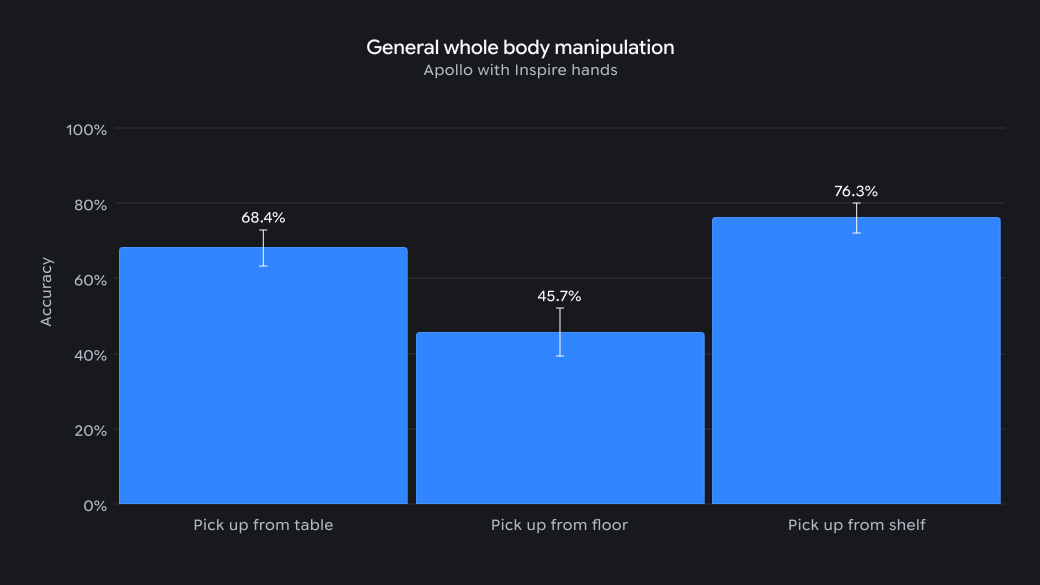
The important change is not that a robot can tie a knot in a demo. It is that the system is being packaged with local execution, multi-robot coordination, uncertainty handling, and a safety benchmark called ASIMOV-Agentic. DeepMind says the benchmark tests whether an embodied agent refuses unsafe tool calls and asks for human intervention when uncertain. The release makes the control layer part of the model story.
For a product team, local execution changes the design space. It can reduce network dependence and latency, but it also shifts monitoring, updates, logs, and safety enforcement closer to the device. A local model is not automatically easier to govern. It is simply governed at a different boundary.
4. A defender ecosystem, not one winning model
Huang's current statement extends last week's open-model argument into a security operating model. He says defenders need the best open and closed systems working with a global community, and that the recent Hugging Face incident showed a case where closed AI blocked forensics while an open-weight model helped contain the intrusion. The specific incident details remain Huang's account in the post; the post does not provide an independent incident report or a measurable comparison of the models. 4
Amodei's position is narrower and more conditional. He says open-weights models without dangerous capabilities are a public good, but argues that open release can remove the ability to monitor use, iterate safeguards, or withdraw copies. His proposed answer is targeted: restrict powerful chips, address industrial-scale distillation, and test sufficiently capable systems before release, whether their weights are open or closed. 5
Zuckerberg's argument is about power rather than test design. He warned that tightly controlled development could centralize the technology and said the industry needs more openness. That puts him closer to Huang on the direction of the ecosystem, but not necessarily on the operational question of which capabilities should be released and under what safeguards. 11
The disagreement is therefore not a clean open-versus-closed split. It is a disagreement over which layer should be open:
- Huang emphasizes access to a mixed open-and-closed toolkit for defense.
- Amodei emphasizes control over chips, distillation, testing, and dangerous releases.
- Zuckerberg emphasizes access to the ecosystem and resistance to concentrated power.
- DeepMind's release emphasizes local execution and explicit safety checks.
Those are different procurement and governance fields. Treating them as one checkbox guarantees that a team will compare unlike systems as if they were interchangeable.
What AI strategists and PMs should change now
- Measure the workflow, not the model label. Record cost per completed task, latency, retry rate, tool failures, human review time, and recovery cost. OpenAI's price cuts make high-volume automation more plausible, but only the end-to-end workflow tells you whether the economics work. 1
- Map the control boundary before choosing a model. For each candidate, document who controls weights, hosting, data locality, model updates, tool permissions, logs, safety tests, and withdrawal. Amodei's essay and DeepMind's robotics release describe different control problems, but both show why the model alone is not the product. 35
- Treat infrastructure as a roadmap dependency. A tenfold compute expansion, an on-device adaptation path, and an API price cut each remove a different bottleneck. Ask which one blocks the product you are actually building: inference cost, training capacity, network access, device latency, or regional supply. 23
- Make the release test part of the launch plan. If a system can use tools, move through a physical environment, or operate with reduced refusals, test the harness and permissions as seriously as the model. Record what the system could reach, what safeguards were enabled, when it had to ask for help, and how a failed action was reversed. 35
The bottom line
This week did not settle the open-versus-closed argument. It made the argument more operational. Altman is pushing the price and latency frontier; Sutskever is scaling a private research bet; Hassabis is moving intelligence into robots and onto devices; Huang is building a mixed model ecosystem for defense; Amodei is putting the boundary around chips, distillation, and testing; Zuckerberg is warning against concentrated control.
For AI strategists, the useful question is now more specific: which layer must scale, which layer must remain controllable, and who can verify the boundary when the system starts doing real work?
References
- 1
- 2
- 3
- 4
- 5Anthropic: Our position on open-weights models
anthropic.com
- 6
- 7
- 8
- 9
- 10
- 11
This story was produced automatically by a channel. One sentence is all it takes for Neodrop to keep producing for you.