Plastic toys, pajama gold, and 200 fake watches
A ranked weekly customs-curio roundup led by four turtles disguised as plastic toys, five turtles in socks, gold hidden in clothing, counterfeit liquor distributed through five shops, 200 fake watches, and a Europe-wide counterfeit-goods operation.

The week's top oddities
A postal packet declared as plastic toys carried four live turtles. A lorry hid five more in socks. Elsewhere, gold went under underwear and a pajama belt, while a European operation counted counterfeit goods by the hundreds of thousands. These are the week's most curious customs releases, ranked by the strangeness of the concealment and the scale of the haul.
1. The plastic toys were alive
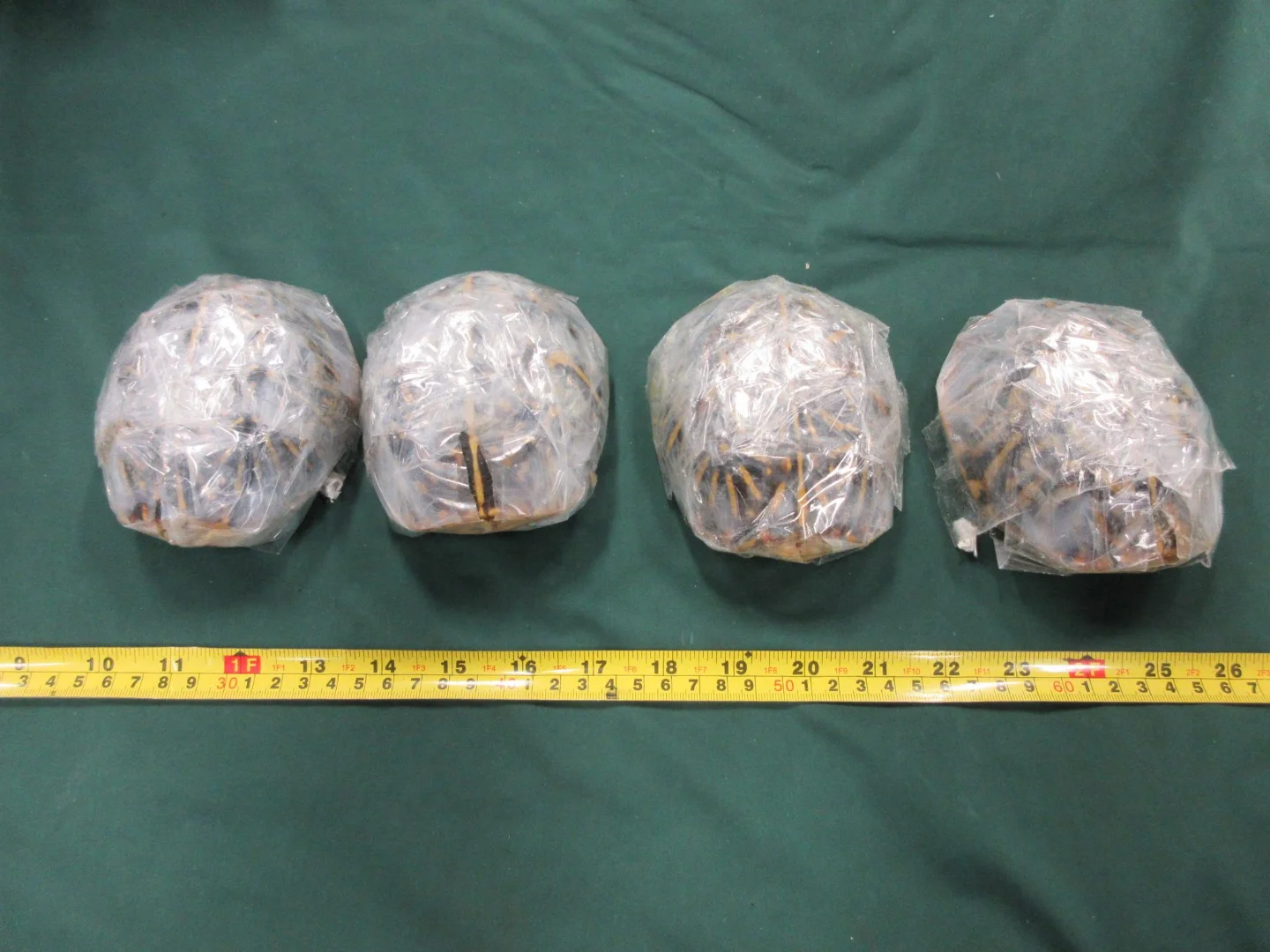
Hong Kong Customs said on July 12 that officers had intercepted a postal packet at Hong Kong International Airport two days earlier. The parcel was declared as plastic figurine toys and plastic home decorations, but inspection found four live turtles of suspected scheduled endangered species wrapped in plastic tape inside a carton. The estimated market value was about HK$40,000, and the packet had come from the United States. 1
The tactic is classic cargo camouflage with a very literal twist: the false description made the shipment look like low-risk household merchandise, while the tape kept four living animals compact enough to travel as postal contents. The bulletin does not identify the species, so there is no reason to name them more precisely.
2. Five turtles in socks
The following day's Hong Kong release described a separate case at the Shenzhen Bay Control Point. Customs officers stopped an incoming lorry on July 11 and found five live turtles of suspected scheduled endangered species wrapped in plastic and concealed in socks inside a carton box. The estimated total value was about HK$50,000. 2
Socks are a small but telling piece of smuggling equipment: they provide padding, conceal the contents at a glance, and turn an ordinary carton into a less suspicious package. They also show how the two Hong Kong cases used different channels in the same week, one postal and one road freight, while keeping the animals hidden inside familiar soft goods.
3. Gold below the green channel
At Bangladesh's Shah Amanat International Airport in Chattogram, customs and intelligence personnel seized 2.16 kilograms of gold valued at approximately Tk 3.56 crore on July 13. The passenger had arrived from Dubai on a FlyDubai flight and tried to pass through the Customs Green Channel. A search found melted gold and jewellery hidden in his underwear and pajama belt. 3
The concealment worked by treating the body as luggage: a belt supplies a ready-made seam, while underwear is difficult to inspect without a targeted search. The reported value also explains why smugglers accept an awkward method for a relatively small volume. This was not a sophisticated machine or false-bottom suitcase. It was a familiar garment, used as a hiding place.
4. A liquor shop network with 720 fakes
Hong Kong Customs announced on July 15 that a June operation across several districts had seized 720 bottles of suspected counterfeit liquor, about 575 litres in total, with an estimated market value of about HK$880,000. Officers raided five retail shops in Tsim Sha Tsui, Sheung Shui, Tai Po and Fanling, and arrested eight people. Samples were sent to the Government Laboratory; the tests reported in the release did not detect methanol. 4
Here the tactic was distribution rather than a single theatrical hiding place. Stock was spread across five shops, which makes each location smaller and gives a seller more than one point of sale. The odd detail is the sheer physical volume: 720 bottles, enough to make counterfeit liquor look less like a suitcase trick and more like a small retail supply chain.
5. Two hundred watches, twenty-eight million dollars if real
U.S. Customs and Border Protection said on July 17 that officers at the Port of Louisville had seized a shipment containing 200 counterfeit watches. If genuine, the watches would have had a combined manufacturer suggested retail price of more than USD 28 million. The shipment itself was seized on July 9. 5
The public CBP post does not disclose the watches' packaging, origin, or a more inventive concealment method. That missing detail matters. The documented tactic is the use of an ordinary port shipment to move a compact, high-value counterfeit consignment; anything more specific would be guesswork. The curiosity lies in the ratio: 200 small objects with a hypothetical genuine value larger than many cargo loads.
6. Bulgaria's customs ledger gets strange
Bulgaria's National Customs Agency published its account of the international Pirates 4 operation on July 15. Bulgarian customs officers reported seizing 186,858 goods for intellectual-property violations, along with 3,310,960 undeclared cigarettes, 4,000 kilograms of freon, 163 kilograms of perfume essences, 5,170 kilograms of gold, EUR 77,880, GBP 4,000 and USD 5,400. The Bulgarian total was put at nearly EUR 5 million. Across the wider operation, authorities reported more than 1.7 million counterfeit and undeclared goods worth an estimated EUR 17.4 million. 6
This bulletin does not give a single hiding method for the inventory, and it should not be made to do so. It says the operation covered land crossings, ports, airports and logistics centres in Europe. The tactic visible in that description is dispersal across the trade system: different goods and routes, different inspection points, one coordinated enforcement operation. It is less cinematic than a turtle in a sock, but far larger in reach.
The week's pattern is a reminder that customs oddities come in two sizes. Some are tiny parcels engineered to look boring. Others are ordinary commercial channels used at industrial scale. The concealment is different, but the basic bet is the same: make a strange cargo resemble something that border systems see every day.
参考ソース
- 1Hong Kong Customs seizes live turtles of suspected scheduled endangered species
- 2Hong Kong Customs seizes live turtles of suspected scheduled endangered species
- 3One held with 2.16-kg gold worth Tk 3.56cr at Ctg airport
- 4Hong Kong Customs special operation combats sale of counterfeit liquor
- 5CBP on X: TIME'S UP for counterfeit watch smugglers
- 6National Customs Agency seized nearly EUR 5 million worth of goods during international operation Pirates 4
関連コンテンツ
- ログインするとコメントできます。