July 19 in Business History: When Scale Changes the Question
Four July 19 decisions—from Brunel’s iron liner to CrowdStrike’s software update—show why a breakthrough only becomes durable when financing, learning, and release control keep pace with its reach.
The thesis
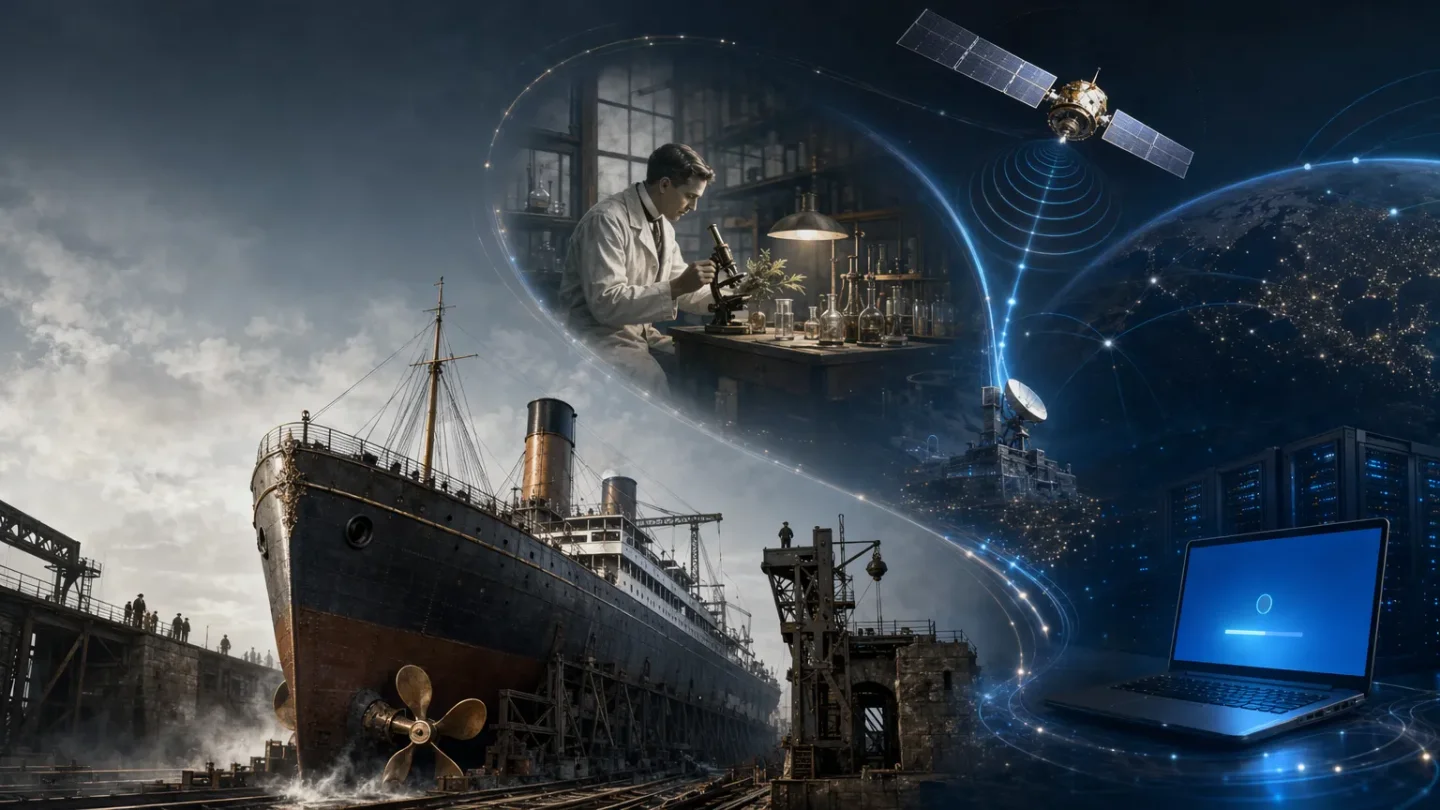
July 19 offers four different versions of a business breakthrough: a ship that made a technical leap, an executive-sponsored research project, a signal that turned into a product franchise, and a software update that reached too many systems at once. The common lesson is not that bold decisions are good or bad. It is that the management question changes as a decision moves from demonstration to infrastructure.
A launch proves that something can happen. A business has to answer what happens next: who finances the learning, where the capability lives, how the result reaches customers, and what the blast radius is when the system fails.
1843: SS Great Britain, and the cost of being first
On July 19, 1843, Isambard Kingdom Brunel’s SS Great Britain was launched in Bristol after four years of construction. It was the largest ship in the world and the first ocean-going steamship with an iron hull and screw propulsion. Brunel had persuaded the company’s board to abandon a wooden paddle-steamer design for iron, which promised greater strength, lower weight, more room for cargo and passengers, and a longer range. 1
That is a classic product decision: trade a familiar architecture for a new one because the new architecture changes the economics, not merely the specification. The ship was not a prototype in the modern sense. It was a capital-intensive commitment to a different operating model.
The early outcome was less tidy. The ship’s long construction period and high cost left its owners exposed. After the vessel ran aground in Dundrum Bay in 1846, the company spent its remaining funds refloating her and was forced out of business. 2 The asset itself had a much longer life: the Bristol Dockyards records that it sailed more than 1,000,000 nautical miles during its working life and served in several roles before its eventual preservation. 1
The decision mirror: Do not use the survival of a flagship product to prove the durability of the company that built it. Before funding a technically superior launch, test the balance sheet and operating plan against the first serious failure. The question is not only whether the asset can work. It is whether the organization can remain solvent long enough to learn how to use it.
1942: Ford and Carver, when curiosity needs an institution
On July 19, 1942, agricultural scientist George Washington Carver arrived in Dearborn to work with Henry Ford around the industrial uses of renewable plant materials. Their shared interest centered on turning agricultural research into practical materials; the work included experiments with soybeans and processes for extracting oil and fiber. 3
Ford did not leave the relationship as a private conversation between a famous executive and a famous scientist. Two days later, Greenfield Village opened a George Washington Carver Memorial and National Laboratory. The Henry Ford’s collections also record Ford naming a Ford Motor Company nutrition laboratory for Carver in 1942. 4
The important outcome is not a convenient claim that the project produced a blockbuster Ford product. The evidence supports something more durable and less theatrical: leadership created a physical home, a research agenda, and continued access for a capability whose commercial payoff was not immediate. Ford’s support continued through practical interventions, including arranging an elevator for Carver’s laboratory, according to The Henry Ford’s historical account. 3
The decision mirror: Long-horizon R&D fails when it is treated as a speech, a budget line, or a founder’s personal fascination. If the capability matters, give it an institutional address: a team, a sponsor, access to equipment, and a path for learning to survive changes in quarterly priorities. A research bet does not need a near-term product to be accountable, but it does need a mechanism that compounds knowledge.
1977: The first GPS signal, and the value of a transferable proof
In the early hours of July 19, 1977, Rockwell Collins engineers in Cedar Rapids, Iowa, successfully received and decoded a signal from NTS-2, the first GPS satellite. The receiving station was roughly six feet tall and required an engineer on the roof to keep adjusting the antenna. 5
The memorable part is the signal. The business significance was the handoff. Soon after the successful reception, the U.S. Air Force awarded Rockwell Collins the NAVSTAR GPS user-equipment contract. GPS World reports that the milestone was the first of many wins that positioned the company as a leader in aerospace and defense GPS products; it later introduced more than 50 GPS products and delivered more than one million receivers for commercial avionics and government applications. 5
This is how a technical demonstration becomes a business wedge. The proof did not merely show that a satellite could transmit. It showed that Rockwell Collins could turn a government-led system into usable equipment, then repeat that capability across products and customers.
The decision mirror: Ask whether your proof transfers. A demo that impresses the room but cannot become a contract, a deployable product, or a repeatable capability is still a demo. The strongest early milestone is the one that removes a specific customer uncertainty and opens the next commercial step.
2024: CrowdStrike, when a routine update becomes infrastructure
At 04:09 UTC on July 19, 2024, CrowdStrike released a sensor configuration update for its Falcon software. Certain Windows systems that were online when the update was released crashed; CrowdStrike’s filing said the event was not caused by a cyberattack. The company identified and isolated the issue, then reverted the update at 05:27 UTC while working to restore affected customers. 6
The incident’s scale was not explained by the percentage of machines affected alone. Microsoft estimated that 8.5 million Windows devices were affected, less than 1% of all Windows machines, but said the event exposed the high interconnection of cloud providers, software platforms, security vendors, other software suppliers, and customers. 7 CISA described the disruption as a widespread outage caused by the Falcon content update, documented that remediation guidance and a fix were being deployed, and warned that threat actors were using the confusion for phishing activity. 8
The lesson is larger than “test your code.” Once a product sits in the critical path of thousands of organizations, a content update is part of the infrastructure contract. The customer is not only buying detection. The customer is trusting the vendor to change a live system without turning the change itself into a systemic event.
The decision mirror: For any product with privileged access or broad distribution, make release control part of the product design. What is the canary population? Can the update be rolled back without physical access? Who owns recovery when the customer’s normal tools are unavailable? And what secondary risks appear when the market is trying to recover at the same time?
The managerial test for July 19
These four cases point to four different handoffs:
- From invention to solvency: SS Great Britain shows that a breakthrough asset can outlive the financing model that created it.
- From curiosity to capability: Ford and Carver show that a strategic research idea needs an institution, not just executive enthusiasm.
- From proof to repeatability: The first GPS signal mattered because it opened a path to contracts, products, and a market position.
- From distribution to responsibility: CrowdStrike shows that reach multiplies both customer value and operational exposure.
Before approving today’s launch, acquisition, platform bet, or major update, ask which of these handoffs is still unresolved. The milestone will make the announcement. The handoff will determine the business.
参考ソース
- 1Brunel’s SS Great Britain, 1843
- 2The launch of SS Great Britain
- 3Seventy-five Years of the George Washington Carver Cabin
- 4George Washington Carver and Henry Ford at the Carver Nutrition Laboratory
- 5First GPS signal received 40 years ago this month
- 6CrowdStrike Holdings, Inc. Form 8-K
- 7Helping our customers through the CrowdStrike outage
- 8Widespread IT Outage Due to CrowdStrike Update
関連コンテンツ
- ログインするとコメントできます。
More from this channel
- July 23 in business history: The first signal is not the business
- July 22 in business history: The structure is part of the bet
- July 21 in business history: The operating model decides the outcome
- July 20 in business history: The boundary is part of the bet
- July 18 in business history: The commitment is the product
- July 17 in Business History: The First Move Is Not the Whole Bet
- July 16 in Business History: Build the mechanism, then make the promise
- July 15 in Business History: Before Scale, Test the System