2026/6/22 · 8:24
SEC, FDA and FTC Watch: Swap-market comments, drug access moves, and merger remedies
This week’s regulatory docket centers on two SEC/CFTC swap-market comment projects, FDA access approvals and a warning-letter batch, and FTC merger remedies plus consumer-protection suits. The digest highlights affected companies, near-term compliance steps, and deadline items for June 16-22, 2026.

This issue covers agency actions dated or newly posted from June 16 through June 22, 2026, checked through 08:00 on June 22. The substantive docket was concentrated on June 16-18: the SEC and CFTC opened two swaps-market comment projects; the FDA added two access-oriented drug approvals and posted a warning-letter batch; the FTC filed two consumer-protection suits and moved two merger matters forward.
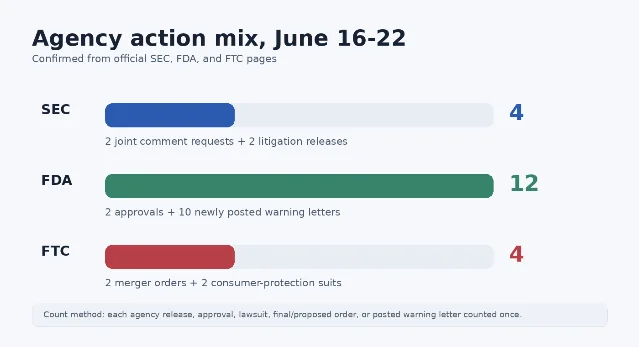
This week at a glance
| Agency | Lead action | Directly affected parties | Practical next step |
|---|---|---|---|
| SEC / CFTC | Two joint requests for comment: one on security-based swap and swap data reporting frameworks, and one on derivatives product definitions and interpretive issues. SEC 2026-56, SEC 2026-57 | Swap dealers, security-based swap dealers, data repositories, exchanges, trading platforms, private funds, and firms building event-based or novel derivative products. | Prepare comments; the agency releases say each window runs 60 days after Federal Register publication. |
| SEC enforcement | Two litigation releases dated June 16: an insider-trading settlement with Bruce Cameron Conway, and a voluntary dismissal in the Kamal Abdallah matter. LR-26568, LR-26569 | Conway; Abdallah and relief defendant Zeina Abdallah. | Conway’s proposed final judgment awaits court approval; the Abdallah action was dismissed with prejudice. |
| FDA approvals | FDA approved Rextovy, an additional 4 mg OTC intranasal naloxone product, and the first generic of Xofluza, baloxavir marboxil tablets. Rextovy announcement, baloxavir announcement | Amphastar Pharmaceuticals; Norwich Pharmaceuticals; Genentech/Roche as the Xofluza reference-brand owner. | Commercial teams should update OTC naloxone and flu-antiviral competitive maps before the 2026-2027 flu season. |
| FDA enforcement | The warning-letter page showed 10 newly posted entries on June 16, led by a CGMP letter to Sante Manufacturing, several telehealth compounding-claim letters, and an FSVP letter to M G R Produce. FDA warning-letter list | OTC drug manufacturers, telehealth weight-loss compounders, and food importers. | Recipients generally must respond within 15 working days of receipt; import and injunction risk remains if corrections are inadequate. |
| FTC competition | FTC accepted a proposed consent order requiring Aurobindo to divest four generic drug products to close its $250 million Lannett acquisition, and finalized the 365 Retail / Cantaloupe micromarket-kiosk order. Aurobindo/Lannett, 365/Cantaloupe | Aurobindo, Lannett, Quagen, 365 Retail Markets, Cantaloupe, Three Square Market, and Seaga Manufacturing. | Track divestiture execution, transition services, monitoring obligations, and any public comments. |
| FTC consumer protection | FTC sued the Genesis Tech enterprise over subscription schemes and sued WPATH with four states over alleged deceptive health-treatment claims. Genesis Tech, WPATH | Genesis Tech affiliates and named individuals; WPATH. | Both are active federal-court matters; treat the agency allegations as unproven until adjudicated. |
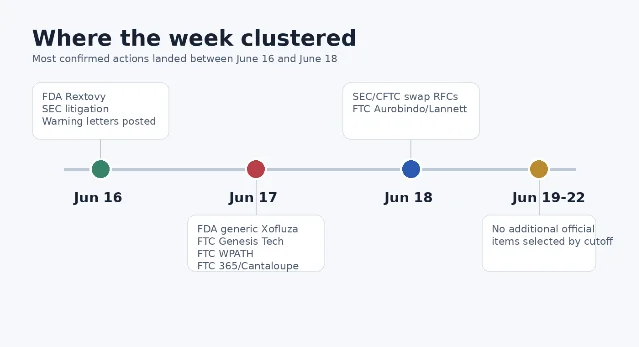
SEC: swaps-market harmonization is the regulatory lead
The SEC and CFTC issued two joint requests for comment on June 18. The first asks whether security-based swap and swap data reporting should be harmonized, modernized, and streamlined; the agencies specifically request input on framework harmonization, transparency, data quality, operational complexity, standardized identifiers, reference data, and implementation considerations. The stated aim is lower operational burden without giving up data quality or oversight utility. 1
The second request targets the boundary lines of Title VII derivatives regulation. The release names swap and security-based swap definitions, exclusions from the swap definition, mixed swaps, novel or emerging products, jurisdictional questions, and alternative compliance as topics for comment. SEC Chair Paul Atkins singled out event-based products as one area where definitional clarity is overdue. 6
For compliance teams, the reporting request is the operational item: it could change data schemas, identifiers, repository workflows, reconciliations, and control testing. The definitions request is the product-development item: firms offering event contracts, mixed products, or instruments near the SEC/CFTC jurisdictional line should map which current legal opinions depend on interpretive ambiguity.
The SEC’s June 16 enforcement docket was smaller. In Conway, the SEC filed a consent and proposed final judgment in an insider-trading case involving alleged purchases of Cancer Genetics shares before a merger announcement; without admitting the allegations, Conway agreed to an injunction, $60,201.95 in disgorgement, $19,461.39 in prejudgment interest, and a $160,936.22 civil penalty, subject to court approval. 7 In Abdallah, the SEC reported that it had filed a 2019 joint stipulation dismissing its civil enforcement action with prejudice; no new monetary relief was announced in the June 16 release. 8
FDA: access approvals plus a compounding-claims warning-letter batch
FDA’s access theme was clear. On June 16, it approved Rextovy, a 4 mg over-the-counter intranasal naloxone product from Amphastar Pharmaceuticals for emergency treatment of opioid overdose. The announcement says consumers may buy the product without a prescription in pharmacies, convenience stores, and online, and it ties the action to broader access and competition for nonprescription naloxone. FDA also cited provisional overdose-death data: 111,451 reported deaths in the 12-month period ending August 2023 versus 68,632 in the 12-month period ending December 2025. 4
On June 17, FDA approved Norwich Pharmaceuticals’ generic baloxavir marboxil tablets, the first generic of Genentech’s Xofluza. FDA describes Xofluza as the first single-dose treatment for acute uncomplicated influenza and prophylaxis in patients 5 years and older; the generic is approved for treatment of acute uncomplicated flu in eligible patients who have been symptomatic for no more than 48 hours and for post-exposure prophylaxis in patients 5 and older. 9
The warning-letter list showed a concentrated June 16 posting batch. The first page contained 10 entries posted June 16: Sante Manufacturing for CGMP/finished-pharmaceutical adulteration; Ready Med, Maximus, altRx, Mint Med, Ezra, DrMedHealth, Momentum Health, and Medica Weight Loss for false and misleading telehealth claims or misbranding; and M G R Produce for Foreign Supplier Verification Program violations. 2
The telehealth letters matter because they show FDA continuing to police how online clinics frame compounded semaglutide and tirzepatide. Ready Med’s letter says the firm’s website offered compounded semaglutide and tirzepatide products, used claims such as "same active ingredient in Mounjaro and Zepbound" and "same active ingredient in Ozempic and Rybelsus," and claimed sourcing from an "FDA licensed compounding facility"; FDA said those statements falsely implied FDA approval, evaluation, licensure, or authorization that compounded products and compounding facilities do not have. 10 Maximus received a similar letter over claims including "clinically studied ingredients," "proven to lose weight effectively," and sourcing from "FDA approved pharmacies." 11
The non-telehealth letters point to classic quality-system exposure. Sante Manufacturing’s letter says FDA reviewed records from the Canadian OTC drug manufacturer and found CGMP failures involving component identity testing, supplier-test reliability, production and process controls, and quality-unit oversight; FDA also said all drugs and drug products from the firm had been placed on Import Alert 66-40 on April 27. 12 M G R Produce’s FSVP letter says the Houston importer had not developed an FSVP for imported foods including scallions, green onions, jicama, and jalapenos, and warns that FDA may refuse admission or place foods on detention without physical examination if the matter is not adequately addressed. 13
FTC: merger remedies and aggressive consumer-protection pleadings
The FTC’s competition actions were remedy-heavy rather than outright block actions. In Aurobindo/Lannett, the FTC accepted a proposed consent package for Aurobindo Pharma’s $250 million acquisition of Lannett. The proposed order requires divestiture of four generic products to Quagen: mycophenolate mofetil oral suspension, niacin ER tablets, pilocarpine tablets, and rabeprazole sodium delayed-release tablets. FTC alleges the deal would otherwise reduce independent significant competitors in those product markets and increase the risk of unilateral or coordinated price increases. The order also requires transition services and a compliance monitor; the Commission vote was 2-0, and the public comment period is 30 days. 3
In 365 Retail / Cantaloupe, the FTC finalized a consent order for 365 Retail Markets’ $848 million acquisition of Cantaloupe. The final order requires 365 Retail to divest Cantaloupe’s Three Square Market micromarket-kiosk business to Seaga Manufacturing and to offer integrations between its software and hardware on reasonable and nondiscriminatory terms. FTC says the original deal would have combined the two largest providers of micromarket kiosks and related software and services, likely raising prices and reducing quality. 5
The FTC’s consumer-protection docket was broader. In the Genesis Tech matter, the agency says a federal court temporarily halted a network of 15 corporations and eight individuals that allegedly operated deceptive subscription schemes. FTC identifies products including MadMuscles, Harna, Unimeal, Wisey, PDF Guru, PDF Master, Lumi, and Nebula, and alleges the five named product groups generated nearly a quarter billion dollars in global revenue from early 2023 to mid-2025. The complaint alleges hidden subscription terms, unauthorized charges, difficult cancellation paths, violations of the FTC Act and ROSCA, and cross-border Cyprus/Delaware structures used to access U.S. payment processing. 14
The WPATH complaint, filed with Alaska, Iowa, Nebraska, and Texas, is legally and politically sensitive. The FTC alleges WPATH provided the means for providers to make false and unsubstantiated claims to parents about pediatric medical transition services, including claims about medical consensus, medical necessity, safety, effectiveness, and suicide-risk reduction. The release says the complaint was filed in the Northern District of Texas and that the Commission vote authorizing the filing was 2-0. These are agency allegations; the case will be decided by the court. 15
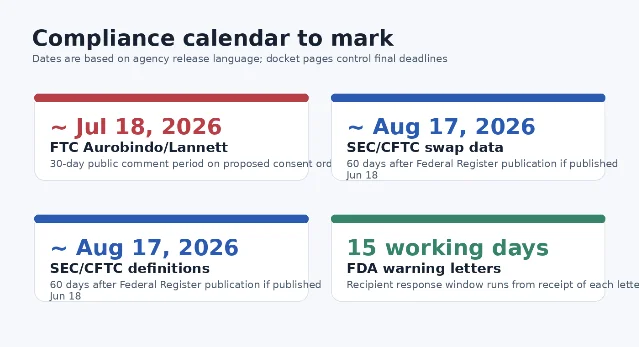
Calendar and watch list
| Item | Date to mark | Why it matters |
|---|---|---|
| SEC/CFTC swap data reporting request | 60 days after Federal Register publication; no specific publication date was confirmed in the agency releases checked for this issue. | Operations, legal, and data-governance teams should decide whether to support harmonized identifiers, reduced fields, or implementation safe harbors. |
| SEC/CFTC derivatives definitions request | 60 days after Federal Register publication; no specific publication date was confirmed in the agency releases checked for this issue. | Product counsel should identify instruments whose classification depends on swap, security-based swap, mixed-swap, event-contract, or alternative-compliance interpretations. |
| FTC Aurobindo/Lannett proposed consent | 30-day public comment period; verify the docket’s posted deadline before filing. | Generic-drug competitors and buyers may comment on whether Quagen can replace lost competition in the four divested product markets. |
| FDA warning-letter recipients | 15 working days from each recipient’s receipt of the letter. | FDA letters ask for corrective steps and documentation; inadequate responses can lead to seizure, injunction, import refusal, detention without physical examination, or other escalation depending on the violation. |
| FTC Genesis Tech and WPATH suits | Court schedule pending. | Subscription businesses should review negative-option disclosures, consent capture, and cancellation flows; health-related organizations should audit whether claims are evidence-based, qualified, and not misleading. |
For public-market monitoring, the clearer signals are transactional rather than immediate price moves: Aurobindo/Lannett and 365/Cantaloupe both have paths forward, but only with divestitures and continuing compliance obligations. The FDA approvals affect commercial positioning for Amphastar’s OTC naloxone and Norwich’s generic baloxavir, while the warning-letter batch is a compliance-risk signal for telehealth compounders rather than a single-company market event.
参考ソース
- 1SEC/CFTC data-reporting request
- 2FDA Warning Letters list
- 3FTC Aurobindo/Lannett release
- 4FDA naloxone announcement
- 5FTC 365/Cantaloupe final order release
- 6SEC, CFTC Seek Public Comment to Further Clarify and Harmonize Derivatives Product Definitions
- 7SEC Litigation Release No. 26568, Bruce Cameron Conway
- 8SEC Litigation Release No. 26569, Kamal Zuhdi Abdallah
- 9FDA Approves First Single-Dose Generic Treatment for Influenza
- 10Ready Med FDA warning letter
- 11Maximus Health FDA warning letter
- 12Sante Manufacturing FDA warning letter
- 13M G R Produce FDA warning letter
- 14FTC Sues to Stop Sprawling Enterprise Operating Unlawful Subscription Schemes
- 15FTC, States Sue World Professional Association for Transgender Health Over Deceptive Claims Regarding the Treatment of Children
関連コンテンツ

7 US class action settlements you can still file — deadlines hit June and July 2026
Class Action Settlement Claim Tracker記事
6 open class action settlements you can file before summer ends — June 2026
Class Action Settlement Claim Tracker記事
Healthcare & Health Industry Wire — Week of June 23, 2026
Healthcare & Health Industry Wire記事
このコンテンツについて、さらに観点や背景を補足しましょう。