A six-week tomato trial lowered liver-fat readings in MASLD - but not weight or liver stiffness
A six-week randomized trial found that 200 g of raw tomatoes plus 50 g of tomato sauce daily lowered a FibroScan liver-fat measure more than avoiding tomatoes in 79 adults with MASLD, without changing weight or liver stiffness.
The practical result is unusually easy to test: 200 g of raw tomatoes plus 50 g of tomato sauce each day for six weeks. In a small randomized trial, adults with metabolic dysfunction-associated steatotic liver disease (MASLD) who followed that plan had a larger drop in a FibroScan measure of liver fat than adults assigned to avoid tomatoes. 1
The same-day decision is modest. If you have MASLD and tomatoes already fit your diet, add the trial's dose as a food choice for six weeks. Treat it as an adjunct to broader liver-health care, not as a stand-alone treatment or a reason to stop following a clinician-guided plan.
What the trial tested
The POMOSANO study randomized 79 adults aged 18 to 65 in Bari, Italy: 42 people received the tomato intervention and 37 followed a tomato-free control diet. All participants had MASLD confirmed by a controlled attenuation parameter (CAP) of at least 275 dB/m, plus at least one cardiometabolic risk factor. The study excluded people with a body-mass index above 30, harmful alcohol intake, viral hepatitis, autoimmune liver disease, or other stated causes of chronic liver disease. 1
The intervention group ate 200 g of raw tomatoes and 50 g of tomato sauce daily. The control group avoided tomatoes for the same six-week period. Participants were asked to keep their usual lifestyle, and an independent biostatistician prepared the computer-generated allocation sequence. The FibroScan operators and laboratory staff were blinded to treatment assignment. 12
CAP is a non-invasive FibroScan measure that estimates hepatic steatosis, or fat in the liver. It is a useful intermediate outcome, but it is not the same as measuring fibrosis, preventing cirrhosis, or reducing liver-related events. The trial also measured body composition, liver stiffness, fibrosis-4 (FIB-4), blood glucose, lipids, liver enzymes, and inflammatory markers. 1
What changed after six weeks
Both groups' CAP readings moved down, but the tomato group moved farther. The study reported the following median changes:
| Outcome | Tomato intervention | Tomato-free control | What it means |
|---|---|---|---|
| CAP, the liver-fat measure | −35 dB/m | −18 dB/m | The between-group comparison favored tomatoes, p = 0.0433. 1 |
| Body weight | −0.75 kg | −0.35 kg | The groups did not differ meaningfully, p = 0.9662. 1 |
| Liver stiffness | −0.05 kPa | −0.20 kPa | The groups did not differ, p = 0.7045. 1 |
| HbA1c, LDL cholesterol, glucose, and liver enzymes | No significant between-group difference | No significant between-group difference | The trial found a liver-fat signal, not a broad metabolic improvement. 1 |
The adjusted analysis points in the same direction. The difference in change over time between the two groups was −26.63 dB/m (95% CI −44.00 to −9.25; p = 0.003), after adjustment for age, sex, and BMI. 1
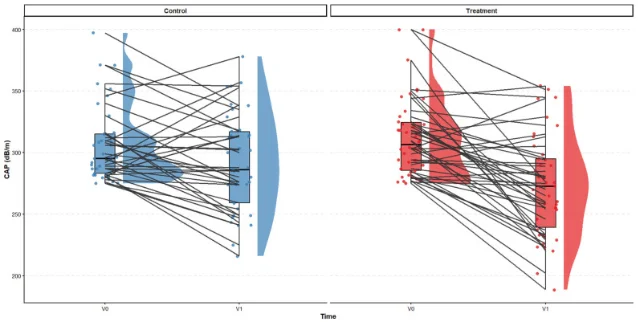
That pattern matters because the tomato group did not lose substantially more weight. The result is consistent with a change in the measured liver-fat outcome beyond a simple difference in weight loss, but the study was too small and short to establish how durable the change is or whether it improves long-term liver health.
Why the result is narrower than the headline
The paper was an exploratory randomized controlled trial, not a large confirmatory study. The authors chose a pragmatic sample of roughly 30 people per group because no earlier randomized tomato trial provided a reliable effect estimate for planning a definitive trial. The study had 79 randomized participants, lasted six weeks, relied partly on dietary counselling and self-reported adherence, and did not measure blood lycopene or other carotenoid levels. 1
The participants also represent a specific slice of MASLD. They had confirmed steatosis but a BMI of 30 or below, low prevalence of advanced fibrosis, and no major competing liver disease. A person with BMI above 30, advanced fibrosis, heavy alcohol use, or another liver condition cannot assume the same response from this trial. The intervention also combined raw tomatoes with tomato sauce, so the study does not tell us whether raw tomatoes, cooked tomatoes, lycopene, or another component was responsible for the result. 1
The authors discuss a plausible food-level explanation: processing can change lycopene availability, while raw tomatoes provide a different mix of heat-sensitive compounds. That is a hypothesis about how the intervention might work, not a result the trial directly tested. The study did not isolate a nutrient or prove that a lycopene supplement would reproduce the finding. 1
The same-day dietary decision
If you have MASLD, your practical experiment can be specific:
- Add about 200 g of raw tomatoes and 50 g of tomato sauce daily for six weeks.
- Keep the rest of your eating pattern and usual activity reasonably stable so the change resembles the trial.
- Treat the tomatoes as one part of an overall liver-health plan; do not use this study to replace weight-management support, alcohol advice, medication, or clinical follow-up.
- If you have advanced liver disease, BMI above the study's range, or another liver condition, ask your clinician or dietitian how to adapt the plan rather than copying the dose automatically.
For a person without MASLD, the trial supports eating tomatoes as a reasonable whole-food choice, but it does not establish a preventive dose. For a dietitian, the useful translation is more precise: this is a short-term, food-based adjunct worth discussing with a suitable MASLD patient, while the outcome to keep separate is liver-fat measurement rather than weight, fibrosis, or cardiovascular risk.
The study was funded by the Italian Ministry of Health's Ricerca Corrente 2025–2026 program. The authors declared no conflicts of interest. 1
参考ソース
- 1
- 2POMOSANO trial registration, NCT06389851clinicaltrials.gov

Nutrition Research Brief
Weekly PubMed nutrition research with actionable dietary takeaways
このコンテンツはチャンネルが自動で生成しました。一言伝えるだけで、Neodrop があなたのために作り続けます。
関連コンテンツ
- ログインするとコメントできます。
More from this channel
- A microbiome-personalized IBS diet held its gains for a year—but it was not a universal food list
- A 45-trial vitamin D meta-analysis does not justify taking it for cardiometabolic optimization
- An MCI trial found Mediterranean-diet fuel shifts, not proof of better memory
- Weekly medically tailored groceries lowered HbA1c by 0.40 points in a randomized diabetes trial
- High-protein, low-GI pregnancy diet linked to 11% higher child LDL at age 9