DoorDash is building a delivery network, not a robot demo
DoorDash's Andy Fang and Stanley Tang explain why agentic ordering, purpose-built delivery robotics and a mixed human-machine fleet must be designed as one local-commerce system.

DoorDash's Andy Fang and Stanley Tang describe autonomy as a coordination problem. In their conversation with Sarah Guo on No Priors, the company is not choosing between human couriers and machines. It is trying to assemble a local-commerce network in which software agents, Dashers, delivery robots, autonomous vehicles and drones are matched to the physical situation each order creates. 1
That framing explains why DoorDash is working on both conversational ordering and a purpose-built delivery robot. The customer interface and the fulfillment system are being redesigned together.
コンテンツカードを読み込んでいます…
Ask DoorDash changes the order, not just the search box
Fang says the useful shift in DoorDash's AI work was away from voice as a novelty and toward a conversational interface that lets people describe an outcome. A user can ask to restock a refrigerator, plan a pasta dinner around family constraints or reorder familiar items without translating the request into a sequence of keywords. 1
The reported behavior changes are more interesting than the interface itself. Fang says that 50 percent of restaurant trajectories using Ask DoorDash involve places customers have never ordered from before. On grocery orders, he says basket sizes are 40 percent larger. Those are claims made in the interview, not an independently audited product study, but they point to the mechanism DoorDash is testing: an agent can combine discovery, recommendation and constraints in one request, potentially changing what customers buy rather than merely helping them find a known item. 1
DoorDash is also adding what Fang calls world knowledge, including what is trending online and what people are discussing in forums. That could make recommendations feel more socially grounded, but it creates a trust problem. A system that can explain why a restaurant or product is culturally relevant still needs to distinguish a useful signal from popularity theater. The interview's own time horizon is cautious: Fang says the next step for Ask DoorDash is measured in months, not in a confident five-year forecast.
The robot follows the use case
DoorDash began exploring robotics and autonomy in 2018, Tang says, initially as a small skunk-works effort. The company worked with outside robotics and autonomous-vehicle startups before deciding that autonomy was a question of when, not if. The important lesson was that a delivery robot cannot be selected in isolation from the job it has to perform. 1
The mismatch becomes clear when Tang compares existing vehicle types with DoorDash's typical delivery. Sidewalk robots often move at roughly 2 to 3 miles per hour, while a delivery may cover 3 to 5 miles and take about 15 minutes after the food is ready. A robo-taxi, on the other hand, is a roughly 4,000-pound passenger vehicle with seats and air conditioning that a couple of burritos do not need. Neither form factor is designed around the actual constraints of a delivery route.
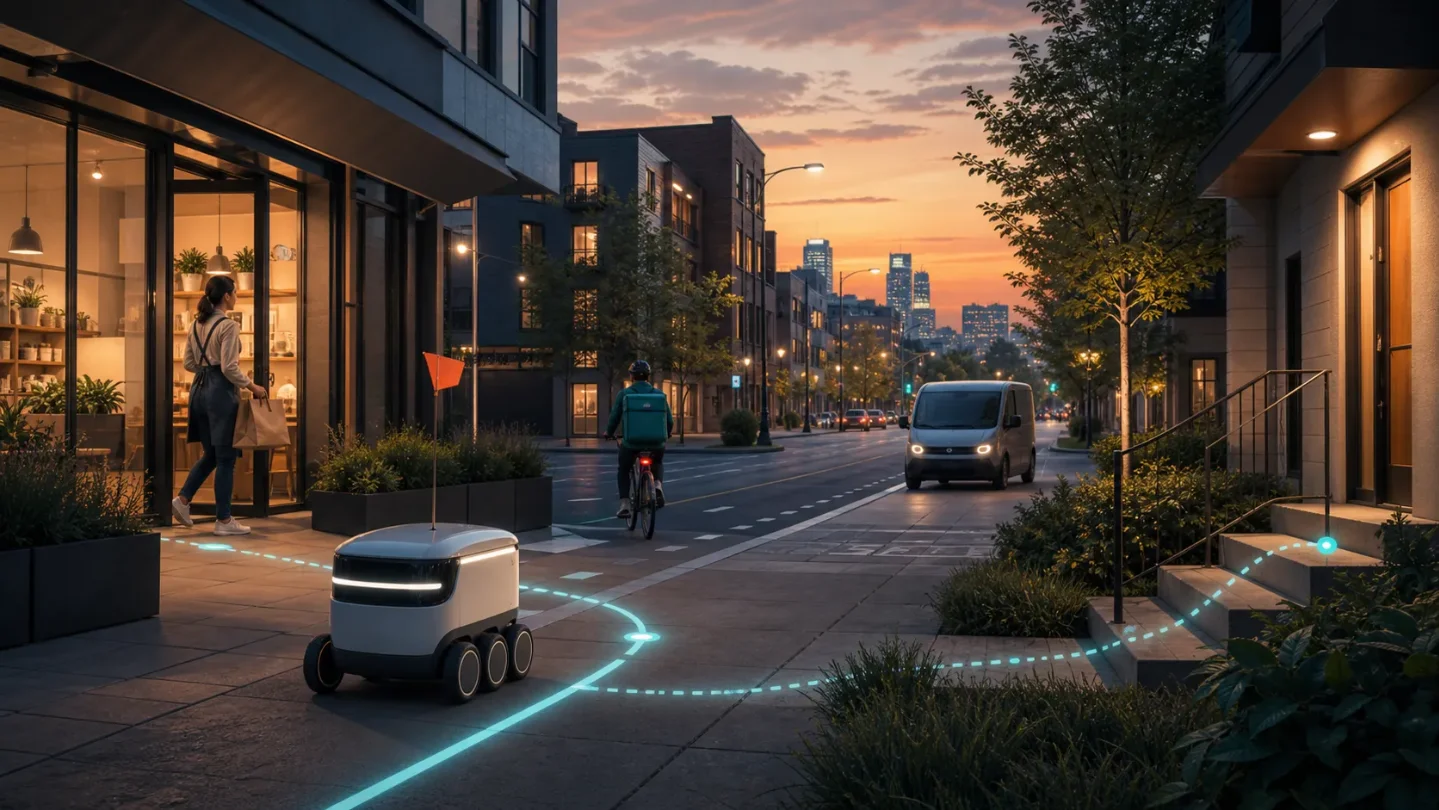
Tang calls the harder problem the first and last 100 feet. The system must pick up the order from the right place, then find the correct door, driveway, garage entrance or building access point. A vehicle that navigates roads well can still fail at the handoff. DoorDash's response is Dot, an in-house autonomous delivery vehicle designed around that gap. The guests describe it as roughly 300 pounds, about one-tenth the size of a car, capable of around 20 miles per hour and able to operate across sidewalks, bike lanes and roads. They say it has been operating in the Phoenix and Tempe area for nearly two years as a fully autonomous L4 system. 1
The design choice is a reminder that autonomy is not one capability. Speed, curb access, payload, pickup accuracy and customer handoff are separate engineering requirements. A general-purpose vehicle may have better road autonomy but still be the wrong tool for the economic and physical shape of a local delivery.
The moat is messy ground truth
DoorDash's strongest argument is not that it has a special robot. It is that it has a delivery network capable of generating the data and operating discipline needed to improve one. The guests cite 10 billion deliveries, 40 million monthly consumers, about 3 billion deliveries per year and 9 million Dashers. They say the important data is not a map pin but where a human actually left an order. 1
That distinction matters. A GPS coordinate does not tell a robot whether the entrance is behind a gate, whether a downtown restaurant uses a side door or whether a frozen order needs a different handoff. The same route can behave differently in San Francisco, Dallas or Helsinki in winter. Pizza, ice cream, groceries and pharmacy orders bring different constraints; a drive-through chain and a small sandwich shop do not expose the same pickup process.
The phrase "all three billion deliveries look different" captures the practical challenge. The advantage of a scaled network is not simply a large dataset. It is the ability to observe a wide range of exceptions, connect them to operations and test changes in a live service. That is also why a demo is a poor proxy for a fleet.
Scaling autonomy means running a physical business
Tang lists the failures that appear after a robot leaves the lab: dust covering a sensor, leaves changing wheel behavior, a conflict between regenerative braking and a battery, or a boot script at a depot taking too long. At fleet scale, charging, maintenance, manufacturing and supply chains become as important as the autonomy stack. 1
This is where DoorDash's platform claim is strongest and most testable. The company already has merchants, consumers, dispatch systems and an operations organization. But those assets only become a moat if they can reduce the cost and failure rate of mixed-mode delivery. The interview does not establish that Dot has reached that point; it explains the system DoorDash believes it must build to get there.
The human question is also less binary than the usual automation story. Tang predicts that DoorDash may have more Dashers in ten years, not fewer, because lower delivery costs could expand demand while robots and drones take on selected routes. That forecast is speculative. The more defensible point is architectural: a local-commerce network may need different modes for different distances, payloads, buildings and service expectations.
DoorDash's bet is therefore broader than an autonomous vehicle launch. It is a wager that conversational software can create more demand while a mixed fleet handles that demand more efficiently. The company will have to prove both halves at once: that people change their buying behavior when an agent understands the request, and that the resulting physical complexity can be delivered reliably at scale.
Read the full No Priors conversation with Andy Fang and Stanley Tang.
関連コンテンツ
- ログインするとコメントできます。