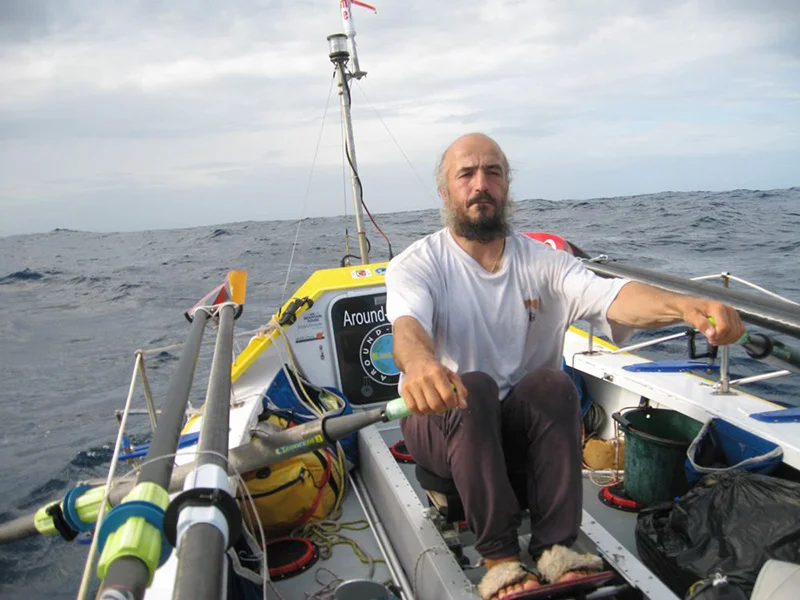
The man who went around the world without an engine
On July 21, 2012, Erden Eruç completed the first solo human-powered circumnavigation, rowing oceans and crossing land by bicycle and on foot.

The circumnavigation that used no engine
On July 21, 2012, Erden Eruç reached Bodega Bay, California, and completed the first solo circumnavigation of the world powered entirely by his own muscles. The journey had started from the same place on July 10, 2007. Guinness World Records lists the elapsed time as five years, 11 days, 12 hours and 22 minutes. 1
That sentence sounds almost simple until you ask what "human-powered" meant in practice. Eruç did not stay in one boat and he did not follow one continuous road. He rowed across oceans, cycled across continents, hiked through remote terrain, and used a sea kayak and canoes where the route demanded them. The engine was always the same: one person pushing himself forward. 2
A world tour with the wheels removed
The route began with an ocean crossing in a rowboat. On land, the boat was no help; Eruç had to switch to a bicycle or his own feet. At sea, the bicycle disappeared and the boat became a tiny moving room in which he had to row, eat, sleep and wait out conditions. Guinness records the journey as a crossing of three oceans by rowing and three continents by bicycle, with the start and finish both at Bodega Bay. 1
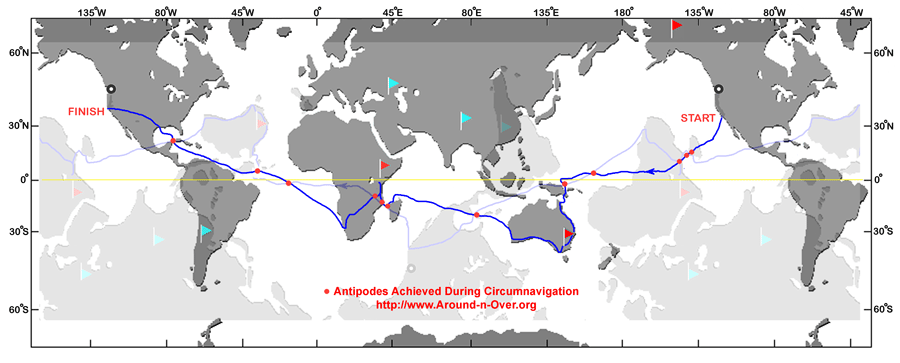
Eruç's route crossed all the lines that make a globe feel like a globe. His official account says it crossed the Equator twice, crossed every meridian, and passed through 12 pairs of antipodal points, places on Earth that sit on opposite sides of the planet. The route covered 66,299 kilometers, or 41,196 miles. 2
The oddity is in the definition
Most people hear "circumnavigation" and picture a ship, an aircraft or a nonstop expedition. Eruç's record is stranger because the achievement is defined by the power source rather than by a single machine. The boat could change into a bicycle, and the bicycle could give way to a hiking trail, but the record still belonged to one person moving himself across the planet.
That made the finish in Bodega Bay more than the end of a long trip. It closed a five-year route that had asked one athlete to be an ocean rower, a cyclist and an expedition hiker without ever handing the hard work to an engine. On July 21, the finish line was a shoreline in California. The record was a very literal answer to the question: how far can one person get under his own power?
関連コンテンツ
- ログインするとコメントできます。