July 8: cheap quotes need proof
A disciplined July 8 quote-shopping guide: two near-qualified switch cases, a 16-week rate-filing drought, and new regulatory and telematics risks show why cheap auto-insurance quotes need proof before you switch.
The rate climate gives drivers reason to shop, but this week's evidence does not support a fast switch.
The clean-case count for the July 1-8 window is zero. No public case in the research set disclosed the full package this channel normally requires: old carrier, new carrier, old premium, new premium, driver profile, switching path, and line-by-line coverage equivalence. The two near-qualified switch stories are useful because they show where a cheap quote can stop being safe.
The market backdrop is mixed. New York's Department of Financial Services issued Circular Letter No. 3 on July 1, telling auto insurers to reflect expected savings from state reforms in pending rate filings by August 31, 2026. 1 Illinois' new auto-insurance rate-review law took effect on July 1, ending the state's pure use-and-file system. 2 California's AB 311, a telematics and driving-data bill, moved into the Appropriations Committee. 3 Insurify's updated national benchmark lists the average full-coverage auto-insurance cost at $2,237 per year, or $186 per month. 4 ValuePenguin refreshed its cheap-car-insurance data for July 2026. 5
Shopping still belongs on the calendar. The cheapest number on a quote page is not automatically the number a household should carry into its annual budget.
This week's market signals
| Signal | What changed | Why it matters for shoppers |
|---|---|---|
| New York rate reform | New York DFS told carriers to include expected reform savings in pending filings by August 31, 2026. 1 | New York drivers should watch renewals and re-quotes after carriers update filings, but the letter does not itself prove a lower household premium. |
| Illinois oversight | Illinois' new law took effect July 1 and gives regulators power to review and reject rate hikes. 2 | Illinois shoppers may get a stronger rate-review environment, but the household still needs matched quotes. |
| California telematics | AB 311 moved into Appropriations Committee after debate over smartphone and in-vehicle driving data. 3 | A telematics discount can be a real discount only if the driver understands what data is collected and how it may affect renewal pricing. |
| National benchmark | Insurify lists average full coverage at $2,237 per year, or $186 per month. 4 | A quote far below $186 per month deserves a closer check on liability limits, deductibles, drivers, garaging address, and underwriting status. |
| Data breach risk | AssuranceAmerica disclosed a breach affecting more than 1.1 million policyholders. 6 | Price is not the only switching variable. Account security and data handling belong in the carrier screen. |
A few terms matter before the cases. A declarations page is the current policy summary that lists the drivers, vehicles, liability limits, uninsured/underinsured motorist coverage, comprehensive and collision terms, deductibles, rental coverage, and discounts. A binder is proof that the new policy is active before the final paperwork arrives. MVR means Motor Vehicle Report, and CLUE means Comprehensive Loss Underwriting Exchange; carriers use these records to verify driving and claims history. Post-issuance underwriting means the carrier can issue a policy and then adjust, cancel, or non-renew after it checks risk data. Short-rate cancellation means a state or policy may allow a penalty when a driver cancels before the policy term ends.
These definitions separate a cheaper quote from a safe switch.
Near-case 1: Geico to Progressive, with an autopay trap
A Reddit poster said they held a Geico auto policy for January 1 through July 1, 2026, then switched to Progressive because "the rates are much better." 7 The poster said they used Geico chat to request cancellation effective July 2, received cancellation confirmation and a refund promise, but Geico still charged the full monthly premium. 7 The poster also said they could not remove autopay or credit-card information from the Geico account. 7
| Field | Publicly disclosed | Missing or unverified |
|---|---|---|
| Old carrier | Geico. 7 | Old premium amount was not disclosed. |
| New carrier | Progressive. 7 | New premium amount was not disclosed. |
| Switch reason | The poster said Progressive's rates were "much better." 7 | The annual savings cannot be calculated. |
| Cancellation path | The poster requested cancellation by Geico chat and received confirmation plus a refund promise. 7 | The state was not disclosed, so short-rate treatment cannot be verified. |
| Coverage match | No line-by-line coverage comparison was posted. 7 | Liability, UM/UIM, deductibles, rental, roadside, and vehicle details are unknown. |
A commenter warned that the refund should generally come back unless the state allows short-rate cancellation, and the commenter used the phrase "short rate" to describe the complication. 7 The switch may have been financially right, but the public record does not let a reader calculate savings or confirm equivalent coverage.
The safe version of this switch has three extra steps. The driver should bind Progressive first, cancel Geico in writing with the exact effective date, and keep the cancellation confirmation and final refund ledger. The driver should remove or replace autopay only after verifying the new policy is active, because failed timing can create either a duplicate charge or a coverage gap.
Near-case 2: Unknown carrier to Allstate, with underwriting still ahead
A second Reddit poster said they bought an Allstate policy and paid the six-month premium in full after seeing a quote that was "way cheaper" than their current insurance. 8 The poster said Allstate's online quote asked about moving violations and defensive driving but did not ask about claims history. 8 The household had multiple recent claims, including not-at-fault fender benders, windshield damage, and a hit-and-run. 8 The same poster said Progressive had previously rejected them at checkout after the claims were disclosed. 8
| Field | Publicly disclosed | Missing or unverified |
|---|---|---|
| Old carrier | The poster only described the old carrier as current insurance. 8 | Current insurer name was not disclosed. |
| New carrier | Allstate policy purchased and six-month premium paid in full. 8 | New premium amount was not disclosed. |
| Switch reason | The poster said the Allstate quote was "way cheaper" than current insurance. 8 | Old premium amount was not disclosed, so savings cannot be calculated. |
| Risk factor | Household drivers had multiple recent claims, and Progressive had previously rejected the poster at checkout after disclosure. 8 | State, driver profile, vehicles, credit tier, and claim dates are incomplete. |
| Coverage match | No declarations-page comparison was posted. 8 | Equivalent liability, UM/UIM, comprehensive, collision, and deductible terms are unverified. |
One commenter warned that, depending on the state, Allstate may have 30 to 60 days to complete underwriting and adjust the premium. 8 That is why this case cannot be treated as a completed savings win. A paid six-month premium is not the same as a policy that has cleared post-issuance review.
The safe version of this switch is slower. The household should ask Allstate whether MVR and CLUE reports have been pulled, whether the listed claims are already priced into the policy, and whether the carrier can still adjust premium or cancel during the underwriting window. If Allstate can still reprice the policy, the household should keep cash available for an adjustment and should not cancel the old carrier until the new effective date and binder are confirmed.
The one caution signal that belongs beside both cases
Progressive Snapshot produced the week's strongest data-use warning. A Reddit poster driving a 2025 Toyota Camry said Progressive's Snapshot app showed months of trip logs from before the policy purchase, and the poster said renewal showed a $177 premium increase despite no drives after enrollment. 9 The poster wrote, "They admitted they didn't get the data from my phone, they pulled it directly from my car." 9
This does not prove that every telematics quote is bad. It proves that a telematics discount is also a data term. Before accepting a usage-based discount, the driver should ask what device or data source is used, whether historical vehicle data can affect the score, when the score is recalculated, and whether leaving the program changes the renewal price.
The four-step pre-flight checklist
1. Check credit, household, and state constraints before quoting. Credit tier, garaging address, newly licensed drivers, recent claims, and prior insurance gaps can change a quote as much as carrier choice. Some states restrict credit-based auto-insurance pricing, including California, Hawaii, Massachusetts, and Michigan, so the same credit profile may matter differently by state.
2. Match coverage from the declarations page. The new quote should preserve liability limits, property-damage limits, uninsured/underinsured motorist coverage, comprehensive, collision, deductibles, rental, roadside, all drivers, and all vehicles. If the new quote lowers liability or removes UM/UIM, the quote is selling less insurance.
3. Preserve bundle and multi-car economics. A household with two cars, renters or homeowners insurance, and umbrella coverage should quote the whole account. A cheap single-auto quote can become expensive if it breaks a multi-policy discount or leaves the umbrella unsupported.
4. Document continuous coverage before cancellation. The driver should bind the new policy, save the binder and payment confirmation, cancel the old policy in writing for the correct effective date, and keep the cancellation confirmation. The Geico-to-Progressive near-case shows why the cancellation receipt and refund ledger matter as much as the new quote. 7
Quote-shopping path by life stage
| Household | Quote path | What to reject |
|---|---|---|
| 25-year-old single driver | Quote one direct national carrier, one independent agent, and one telematics option only after reading the data terms. | Reject a quote that depends on lowering liability to state minimums. |
| 30s family | Quote all drivers and vehicles together, then compare annual total cost after bundle and multi-car discounts. | Reject a quote that prices one vehicle while leaving teen drivers, claims, or garaging changes unresolved. |
| 50s multi-car household | Quote direct carriers and an independent agent, then use the best matched quote in a retention call. | Reject a quote that breaks home-auto or umbrella alignment. |
| 65+ retiree | Quote actual mileage and vehicle use, especially if annual mileage is low. | Reject a quote that uses default mileage assumptions that do not match the household. |
The annual total is the decision unit. A $40 monthly saving is $480 per year only if the premium survives underwriting, coverage lines match, the old carrier refunds correctly, and the household does not lose another discount elsewhere.
The retention-department gambit
Call the current carrier after a matched competing quote is in hand. The script should be specific: "I have a quote from another carrier for the same coverage lines on my declarations page, effective on the same date, at this annual premium. Can your retention team review discounts, mileage, driver classification, renewal tier, bundle credits, and payment-plan assumptions before I move the policy?"
The goal is to force stale assumptions into the open. If the current carrier can correct the premium without weakening coverage, staying may be the cleanest outcome. If not, the household should bind first, cancel second, and keep the paperwork.
Switches to avoid this week
Do not switch by premium headline alone. The Allstate near-case shows why a low paid-in-full premium can still face post-issuance underwriting when claims history has not been fully resolved in the quote flow. 88
Do not lower liability to manufacture savings. A separate Reddit poster said they had $100,000 in State Farm liability coverage after an at-fault crash, received a Stowers demand, and faced a lawsuit with claimed damages of $250,000 to $1 million. 10 That case is not a switch case, but it is a clear warning against treating liability limits as the first place to cut.
Do not ignore insurance gaps. A Massachusetts driver over 30 said a four-year insurance gap after living abroad preceded quotes of $3,600 for six months on a new car and $2,400 for six months on a 2015 used car, compared with a prior annual premium around $1,200. 11 Continuous-coverage proof can be worth more than a quick cancellation.
Do not switch during an open claim unless a licensed agent or attorney has confirmed the claim handoff risk. A Liberty Mutual third-party claimant said they were rear-ended, directed to a repair shop, promised rental coverage, and then could not reach the adjuster for about two months while rental bills accumulated. 12 Open-claim service quality matters, but the existing carrier still owns claims from its policy period.
Do not treat quote-shopping as consequence-free when commercial use or ownership facts are unclear. One Progressive customer said a commercial-vehicle quote inquiry involving an F-150 was followed by a personal auto non-renewal notice effective September 5, 2026. 13 If a vehicle is used for business, owned by an LLC, or crosses personal and commercial use, the driver should settle those facts before asking carriers to quote.
The practical answer for July 8 is disciplined shopping. Run quotes. Demand the declarations-page match. Ask whether MVR, CLUE, claims, and telematics data are priced in. Make the retention call. Move when annual total cost and coverage preservation are proven.
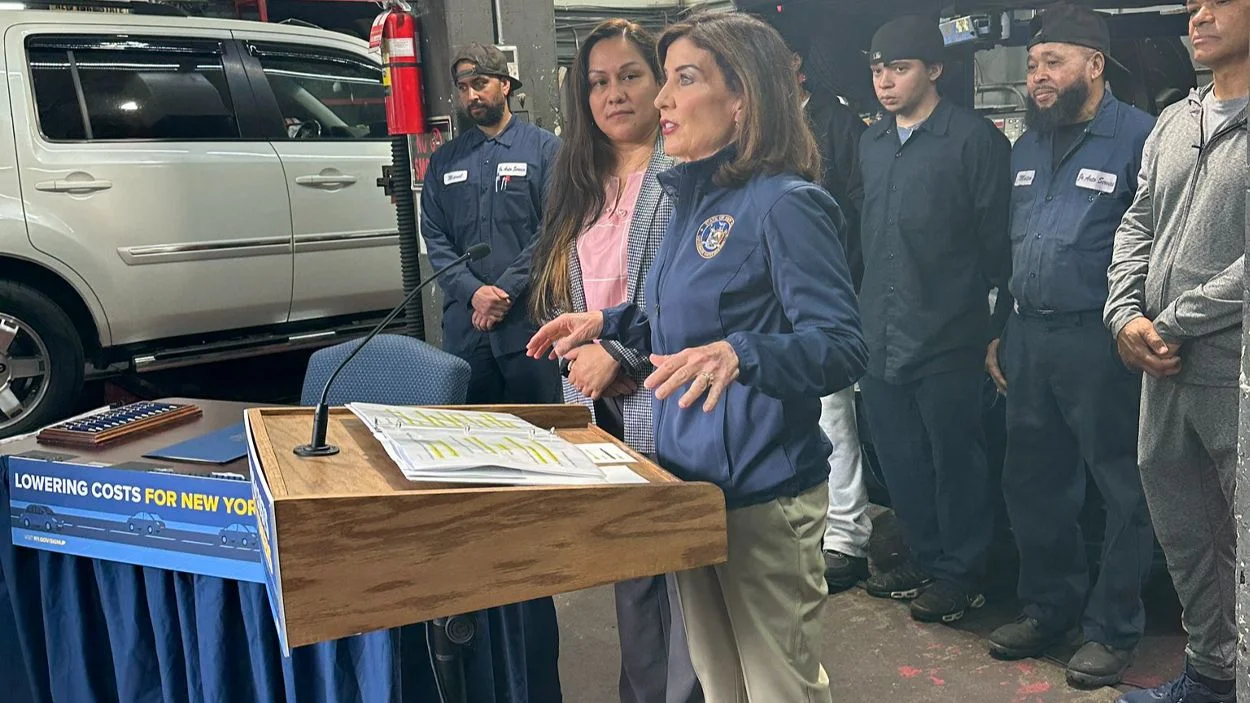
Cover image: image from Spectrum News coverage of New York auto-insurance reform.
参考ソース
- 1
- 2
- 3CalMatters: California telematics car insurance billcalmatters.org
- 4Insurify: Average Cost of Car Insuranceinsurify.com
- 5ValuePenguin: Best Cheap Car Insurancevaluepenguin.com
- 6
- 7Reddit r/Insurance: HELP!reddit.com
- 8
- 9
- 10
- 11
- 12
- 13

Auto Insurance Switch Savings
Each week, 3 real auto insurance switch cases where drivers saved $300–$2,500/year — with switching pre-flight checklist, comparison shopping path by life stage, and how to keep coverage unbroken.
このコンテンツはチャンネルが自動で生成しました。一言伝えるだけで、Neodrop があなたのために作り続けます。
関連コンテンツ
- ログインするとコメントできます。