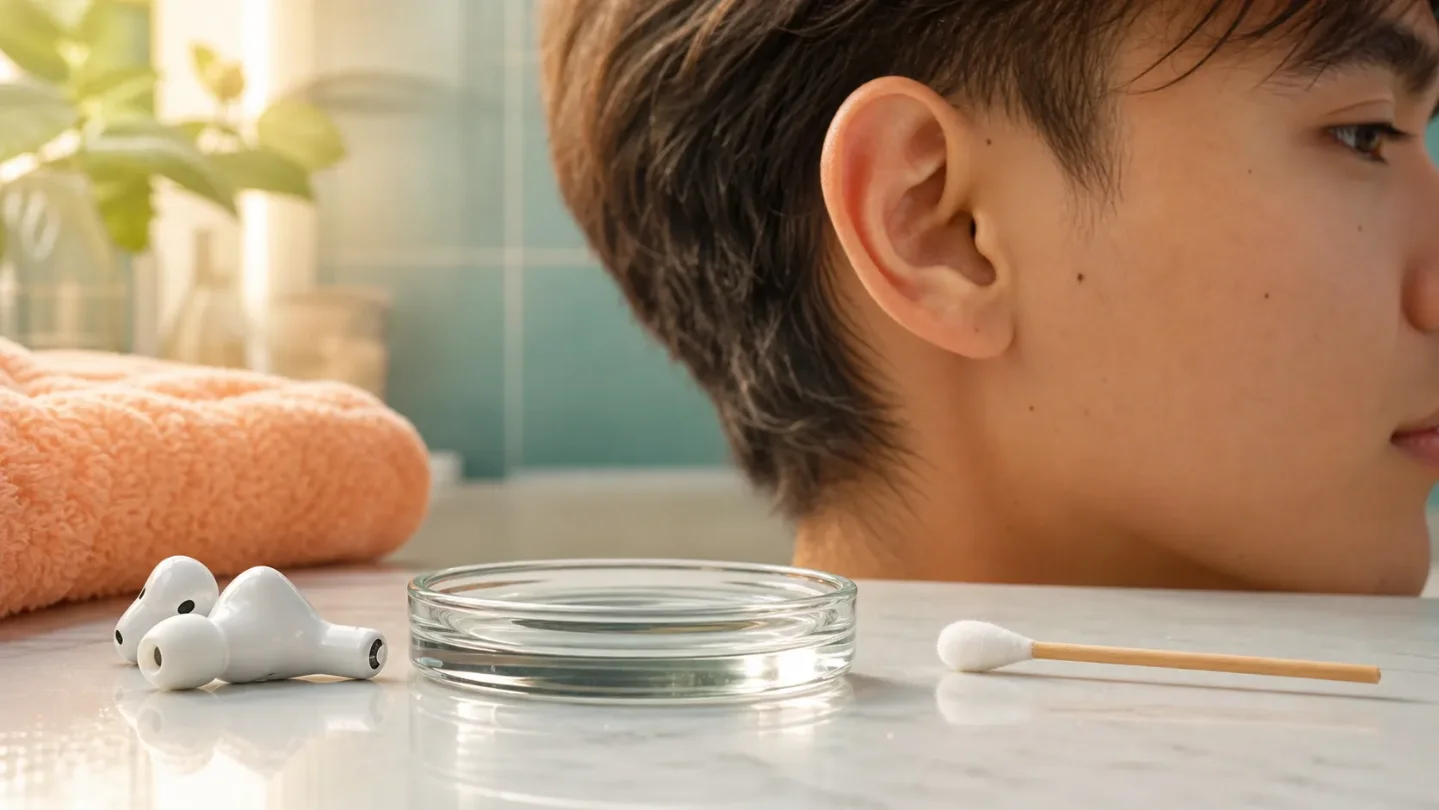
Your Q-tip is not an ear-cleaning tool. Here's the earwax plan.
A practical guide to safe earwax care: why wax is normal, how cotton swabs can make clogs worse, what at-home softening can and cannot do, why ear candles are a bad idea, and when ear symptoms need real help.

Earwax is supposed to exist. The problem starts when you treat your ear canal like a tiny bathroom drain and try to scrub it out with whatever is nearby.
A cotton swab can feel satisfying for five seconds. It can also shove wax deeper, scratch the ear canal, and turn a normal self-cleaning system into a plugged-up, muffled mess. Your ear does not need a daily excavation routine. It needs you to stop making its job harder.
Earwax is not dirt
Earwax, or cerumen, is part of your ear's defense system. It traps dust, bacteria, and other tiny stuff before they can move deeper into the ear, and it helps protect the skin of the ear canal when water gets in. 1
Most of the time, your ear handles wax without your help. Wax slowly moves toward the opening of the ear, where it can fall out or wash away during normal bathing. 1 Mayo Clinic says earwax cleans, coats, and protects the ear canal by trapping dirt and slowing bacterial growth. 2
So if you see a little wax near the outside of your ear, that is not automatically a hygiene failure. It is your ear taking out the trash.
The Q-tip problem is simple: deeper is worse
The risky move is not wiping the outside of your ear. The risky move is putting a cotton swab, hairpin, earbud tip, paper clip, pen cap, or anything else into the canal.
MedlinePlus says trying to clean inside the ear can push wax deeper and block the canal, which is why providers recommend against reaching into your own ear to clean it. 1 Mayo Clinic makes the same point: earwax blockages often happen when people try to remove wax themselves with cotton swabs or other objects, which usually pushes the wax deeper instead of removing it. 2
The American Academy of Otolaryngology-Head and Neck Surgery guideline defines cerumen impaction as wax buildup that causes symptoms, blocks a needed ear exam, or both. It recommends treating true impaction, but it also says clinicians should not routinely treat wax in people who have no symptoms and whose ears can be examined. 3
Translation: wax existing is not the issue. Wax causing a problem is the issue.
How to tell if wax is actually the problem
Earwax blockage can feel like your ear got put on low-power mode. Common symptoms include earache, a plugged or full feeling, tinnitus, partial hearing loss, itchiness, dizziness, odor, discharge, pain, or infection signs. 2 MedlinePlus lists earache, ear fullness, tinnitus, and partial hearing loss that may get worse as common symptoms. 1
Here is the catch: you cannot reliably diagnose earwax just by vibes. Mayo Clinic warns that earache or hearing loss does not always mean wax buildup; another ear problem may need attention. 2
That matters because the worst DIY ear-cleaning stories usually start with someone assuming, "It's probably just wax," then digging at a painful ear that was actually infected or injured.
The safe at-home plan
If your ear feels mildly clogged and you do not have pain, drainage, a known hole in the eardrum, recent ear surgery, or ear tubes, the safest home move is usually softening the wax, not attacking it.
MedlinePlus lists baby oil, commercial ear drops, glycerin, mineral oil, and water as options that can soften wax. 1 Mayo Clinic says a healthcare professional may recommend wax-softening agents such as saline, mineral oil, or olive oil, and may recommend carbamide peroxide drops, but drops should be used only as directed because they can irritate the ear canal and eardrum. 4
A practical version:
- Stop putting objects into the ear canal.
- Wipe only the outer ear with a washcloth or tissue around your finger.
- If you use drops, follow the label exactly.
- Do not use drops if you have ear pain, drainage, a possible eardrum hole, recent ear surgery, ear tubes, or an ear infection unless a clinician tells you to.
- If it does not improve, stop escalating and get the ear looked at.
MedlinePlus also says to ask a provider before doing ear irrigation yourself, never irrigate if the eardrum may have a hole or you have had recent ear surgery, and do not use a dental jet irrigator in the ear. 1
Basically, gentle softening is one thing. Pressure-washing your ear is another.
Do not fall for ear-candle TikTok
Ear candling sounds fake because it basically is. The idea is that a hollow candle creates suction and pulls wax out. Mayo Clinic says research has found ear candling does not work and may burn or damage the ear. 4
The FDA's import alert for ear candles says there is no validated scientific evidence supporting their claimed wax-removal effect. It also says the products are dangerous when used as labeled because putting a lit candle near the face carries a high risk of severe skin or hair burns and ear damage. 5
So no, the brown stuff inside the candle afterward is not proof that it vacuumed gunk from your skull. It is a burning candle doing burning-candle things.
When to get the ear checked
You do not need to book an appointment every time your ear makes wax. But you should get help if the symptoms are painful, weird, or not improving.
MedlinePlus says to contact a provider if your ears are blocked with wax and you cannot remove it, or if you develop drainage, ear pain, fever, or hearing loss that continues after cleaning. 1 Mayo Clinic says wax removal is safest when done by a healthcare professional, especially if you have had ear surgery, have a perforated eardrum, or have ear pain or drainage. 2
Do not mess around with sudden hearing loss, severe dizziness, blood, pus-like drainage, strong pain, fever, swelling around the ear, or symptoms after head trauma. Those are not "wait and see while I dig around with a Q-tip" situations.
If you wear hearing aids, this is even more worth paying attention to. MedlinePlus says hearing aid users should have their ear canal checked for excess wax every 3 to 6 months. 1 The clinical guideline also recommends checking for cerumen in patients with hearing aids during healthcare encounters. 3
The lazy version
If you remember nothing else, remember this:
- Earwax is normal. It helps protect your ear.
- Clean the outside only.
- Do not put cotton swabs or random objects into the ear canal.
- Mild clogging may respond to softening drops, but use them exactly as directed.
- Skip ear candles completely.
- Pain, drainage, fever, blood, sudden hearing changes, severe dizziness, recent ear surgery, ear tubes, or a possible eardrum injury means stop DIY mode and get help.
Your ear canal is not a sink drain. If you keep trying to clear it with tiny tools, you may be the reason it gets blocked in the first place.
関連コンテンツ
- ログインするとコメントできます。
More from this channel
- A parasite outbreak is driving a lot of summer diarrhea. Here's the Cyclospora plan.
- Your flu shot was not useless. Here's what this season's numbers actually mean.
- Your nosebleed is not a head-tilt moment. Here's the stop-the-bleed plan.
- Your allergy pill can still make you sleepy. Here's the antihistamine plan.
- Your back-seat nausea is not random. Here's the motion-sickness plan.
- Your sore throat is not automatically strep. Here's the throat-check plan.
- Your chair is not neutral. Here's the movement-snack plan.
- Your period app is not the backup plan. Here's what to do after a condom break.