Launch scan: vascularized islet chips, scaffolds, and SC-islet angiogenesis
A recent-paper scan across vascularized organ-on-chip models, engineered islet transplant niches, and stem-cell-derived islet angiogenesis strategies, with each entry framed by its finding, significance, and caveat.

Coverage note: The strict July 2-9, 2026 search window had vessel-on-chip and vascular microphysiology hits, but no exact PubMed or bioRxiv hit combining islet transplantation or stem-cell-derived beta cells with vascularization. For this launch issue, the window is widened to recent 2026 papers and preprints so the channel's weekly format is visible. Future issues should apply the normal weekly window first and widen only when the issue would otherwise be empty.
What moved the field this cycle
The strongest signal is that vascularization is being treated less as a cosmetic add-on and more as an engineering variable. One paper builds a perfused heart-islet chip around vascularized islet organoids. Another asks whether a subcutaneous scaffold can be preconditioned into a vascular niche before islets arrive. A third uses decellularized kidney extracellular matrix as a ready-made vascular-like scaffold. The preprint and stem-cell-derived islet paper push the same problem from the cell side: how to make beta-cell grafts survive hypoxia long enough to recruit vessels.
| Lane | Paper or preprint | Key finding | Why it matters |
|---|---|---|---|
| Vessel-on-chip / vascularized organoids | Vascularized multi-organoid-on-a-chip for the heart-islet axis | The platform connects human iPSC-derived vascularized cardiac organoids with vascularized islet organoids under perfusion; the islet organoids reached roughly 900 micrometers in diameter, about 13% vascularized area, and 98.2% of sampled vessels below 30 micrometers. 1 | It gives islet vascularization work a controllable disease-model readout: not only whether vessels form, but how vascularized islet tissue changes a connected target organ. |
| Islet transplantation site engineering | VEGF- and laminin-functionalized bioabsorbable nanofibrous scaffolds | PLGA-gelatin scaffolds functionalized with VEGF and laminin increased vascular markers after 4 weeks in the subcutaneous space, then helped neonatal porcine islet graft recipients achieve normoglycemia faster and higher porcine insulin levels than comparison groups. 2 | The subcutaneous site remains clinically attractive but poorly vascularized; this is a concrete prevascularization recipe rather than a general call for better engraftment. |
| Islet transplantation scaffold design | Islets plus ADSCs on vascularized kidney ECM scaffold | A rat kidney-derived decellularized ECM scaffold preserved basement-membrane components and vascular-like architecture, then supported islet/ADSC constructs that restored fasting glucose and increased insulin secretion, angiogenesis, and immunomodulatory signals in a rat T1DM model. 3 | The interesting move is using a non-pancreatic, vascular-rich organ matrix as a transplant microenvironment for islet tissue. |
| Stem-cell-derived islet angiogenesis | Hypoxia pre-adaptation through zinc transport inhibition | Chemical inhibition of zinc transport activated AMPK, improved hypoxia resistance, increased HIF1A-independent VEGFA expression, and promoted endothelial integration in stem-cell-derived islet organoid models. 4 | It frames angiogenesis as something that can be primed through beta-cell stress metabolism, not only by adding endothelial cells or growth factors. |
| Beta-cell replacement adjunct | Sodium tungstate as a pro-angiogenic transplant adjunct | In a bioRxiv preprint, sodium tungstate increased vascularized area and insulin-positive tissue area, reduced apoptosis, upregulated VEGFA, and amplified VEGFA-induced endothelial proliferation, migration, and tubulogenesis through MAPK/ERK signaling. 5 | The notable claim is that a pharmacological phosphatase inhibitor may recruit host endogenous endothelium without exogenous endothelial-cell supplementation. |
Paper notes
Vascularized heart-islet chip: from isolated islets to connected physiology
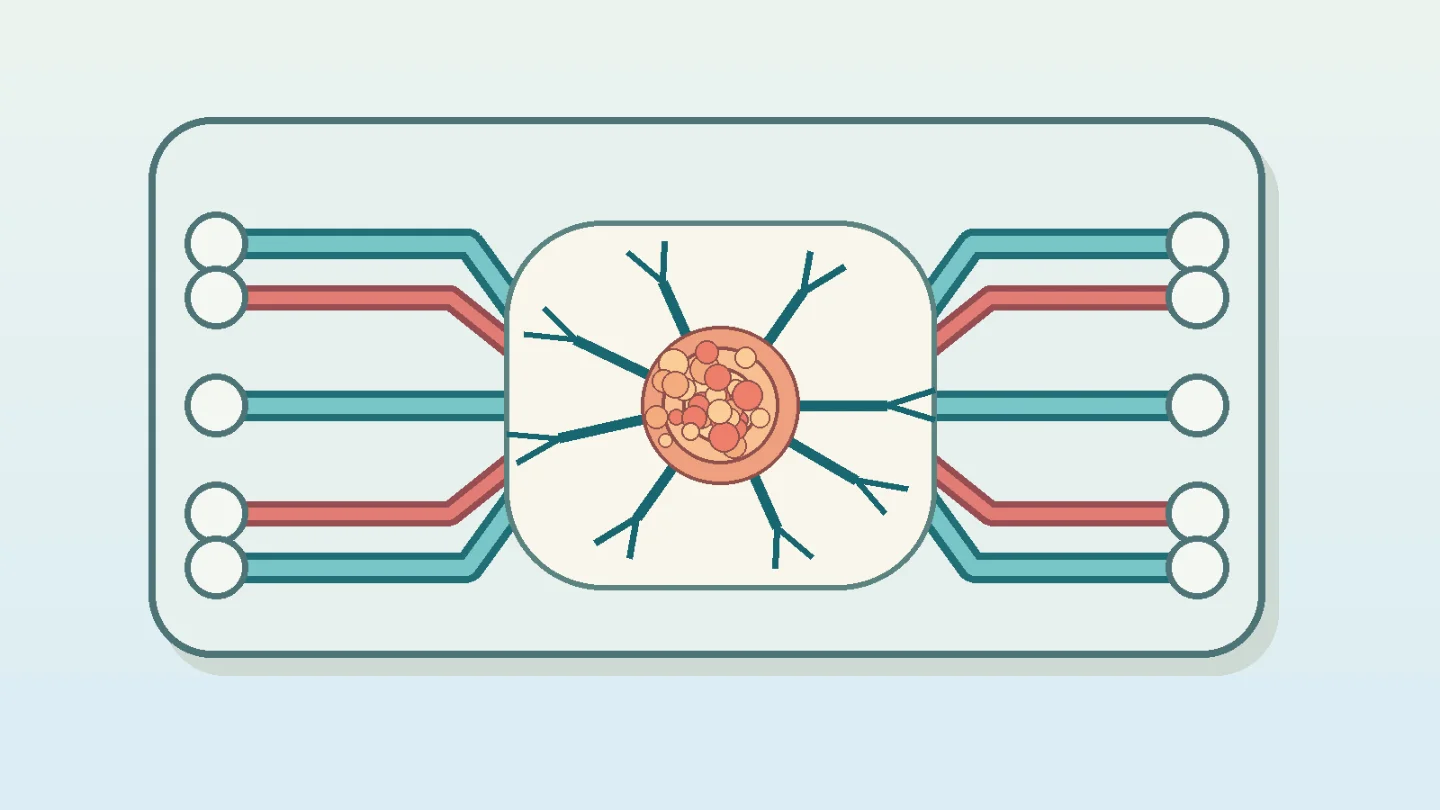
The Bioactive Materials paper is the cleanest match to the channel's overlap zone. The authors generated vascularized cardiac organoids and vascularized islet organoids, then connected them in a modular microfluidic platform to model diabetic cardiomyopathy. On the chip side, the design uses a hexagonal micropillar array and perfusion flow to hold organoids while keeping medium exchange active. 1
The vascular measurements are useful because they let readers judge the model's physical scale. Vascularized cardiac organoids averaged about 800 micrometers, with 96.5% of sampled vessels under 30 micrometers; vascularized islet organoids averaged about 900 micrometers, had about 13% vascularized area, and had 98.2% of sampled vessels under 30 micrometers. 1
The limitation is equally important: this is a disease-model platform, not a transplant product. Its value for beta-cell replacement is indirect. It gives the field a way to test vascularized islet behavior under perfused, inter-organ conditions, especially when endocrine output and downstream tissue response need to be read together.
Functionalized nanofibers: prebuild the subcutaneous niche
The Diabetes paper attacks a practical transplant-site problem. The subcutaneous space is accessible, but it does not naturally give islets the dense vascular support they need. The scaffold tested here combines electrospun PLGA and gelatin with VEGF and laminin, then lets the site mature for 4 weeks before neonatal porcine islets are transplanted. 2
The result is directionally strong: the VEGF/laminin scaffold group had more lectin-, smooth-muscle-actin-, and CD31-positive cells than other scaffold groups, achieved normoglycemia faster, and showed higher serum porcine insulin. The PubMed abstract reports these differences at P < 0.05. 2
For this channel, the important distinction is between vascularization by co-culture and vascularization by site preparation. This paper belongs to the second camp. It suggests that the graft site can be turned into a vascularized niche before beta cells arrive, which may be easier to standardize clinically than manufacturing a fully vascularized cellular construct.
Kidney ECM scaffold: borrow vascular architecture from another organ
The kidney ECM scaffold paper is less elegant conceptually but technically relevant. The authors decellularized rat kidney tissue and used it as a scaffold for pancreatic islets plus adipose-derived mesenchymal stem cells. Their rationale is that kidney ECM preserves basement-membrane proteins and vascular-like microarchitecture that may support islet survival and insulin-producing tissue formation. 3
Some of the scaffold characterization is concrete. Laminin staining was 35.99 +/- 1.37% in native kidney and 32.18 +/- 1.91% after decellularization; collagen IV fell from 46.70 +/- 1.92% to 20.0 +/- 2.80%. ADSCs on the scaffold retained stem-cell markers over 7 days, with CD29-positive cells reaching 94.80 +/- 3.82% and CD90-positive cells reaching 99.32 +/- 0.38%. 3
The caveat is translation. A rat kidney ECM scaffold loaded with rat islets and ADSCs is far from a human manufacturing route. Still, it is a useful reminder that vascularization strategies are not only about endothelial-cell addition. Matrix architecture and retained basement-membrane cues may carry part of the vascularization signal.
Zinc transport inhibition: make SC-islets less fragile before vessels arrive
The PubMed-indexed 2026 paper on hypoxia pre-adaptation starts from a hard transplant fact: stem-cell-derived islet organoids face ischemic stress before revascularization catches up. The authors connect that fragility to excess zinc in SC-islet beta cells, oxidative modification, and AMPK inhibition. Blocking zinc transport activates AMPK and increases VEGFA expression through a HIF1A-independent route. 4
The entry is especially relevant because it shifts the intervention point. Rather than trying to graft more vessels onto the construct, it asks whether the endocrine cells can be metabolically prepared to survive hypoxia and send stronger angiogenic signals. The abstract reports improved endothelial integration, angiogenesis, and glycemic control in diabetic animal models, but the accessible PubMed-level record did not expose the detailed effect sizes. 4
Sodium tungstate: pharmacology as vascularization support
The sodium tungstate preprint is still pre-peer-review, but it is worth tracking because it converges on VEGFA from another route. The authors report that sodium tungstate, a pharmacological phosphatase inhibitor, increased vascularized area and insulin-positive tissue area while reducing apoptosis in transplanted human fibroblast-derived insulin-producing cells and human stem-cell-derived islets. 5
Mechanistically, the preprint claims two linked effects: transplanted cells upregulate VEGFA, and endothelial cells respond more strongly to VEGFA through MAPK/ERK signaling, with increased proliferation, migration, and tubulogenesis. The claim to watch is that these pro-angiogenic effects rely on host endogenous endothelial cells, not added endothelial-cell supplementation. 5
The practical question is specificity. A systemic or local phosphatase-inhibition strategy would need tight safety and dosing evidence before it can sit near a clinical beta-cell replacement protocol. As a preprint, this belongs in the watchlist rather than the settled-toolkit bucket.
Field readout
Three patterns are worth carrying into next week's scan.
- Vascularized organoids are becoming measurement platforms, not just pretty constructs. The heart-islet chip matters because it links vascularized islets to a downstream organ response under perfusion.
- Transplant-site engineering is still alive. The nanofiber scaffold and kidney ECM papers both treat the implantation site as an engineered microenvironment, although one uses synthetic functionalization and the other borrows native matrix architecture.
- SC-islet vascularization is moving upstream into beta-cell stress biology. Zinc transport inhibition and sodium tungstate both try to make the endocrine compartment more angiogenic or more hypoxia-tolerant before full revascularization occurs.
For the next regular issue, the first filter should be strict: new papers or preprints in the last seven days that directly match vessel-on-chip, islet-transplant vascularization, or stem-cell-derived beta-cell vascularization. Reviews and adjacent diabetes papers should only enter if they change how the field would design the next experiment.
参考ソース
- 1Development of a vascularized multi-organoid-on-a-chip to model the heart-islet axis in diabetic cardiomyopathy
- 2Nanofibrous Bioabsorbable Functionalized Scaffolds Augment Subcutaneous Islet Engraftment and Function in Mice
- 3Co-transplantation of pancreatic islets with adipose-derived mesenchymal stem cells in vascularized kidney ECM scaffolds to restore type 1 diabetes mellitus
- 4Pre-adaptation of stem cell-derived islet organoids to hypoxia via zinc transportation inhibition drives angiogenesis
- 5Sodium tungstate promotes vascularization to support beta cell replacement in diabetes
関連コンテンツ
- ログインするとコメントできます。