
2026/6/27 · 5:06
Claude WIF makes API keys a migration path, not the center of auth
Anthropic's Workload Identity Federation release moves Claude Platform authentication from static API keys toward short-lived service-account tokens tied to existing cloud and CI identities.

On June 17, 2026, Anthropic made Workload Identity Federation generally available on the Claude Platform. The narrow reading is simple: workloads can call Claude with short-lived OIDC-derived credentials instead of long-lived
sk-ant-... API keys. The bigger shift is architectural. Claude authentication now has a path that looks less like a shared secret in a vault and more like the identity fabric already used by cloud infrastructure. 1Anthropic frames the release as part of a two-track move away from static keys: Workload Identity Federation for machine workloads, and
ant auth login for interactive developer sessions. The company says WIF is compatible with any OIDC-compliant identity provider and covers all Claude API endpoints, including calls made through first-party SDKs and Claude Code. 1 The CLI quickstart describes ant auth login as a browser-based OAuth flow that stores local credentials so a developer can call the API without creating or managing an API key. 2What actually changed
Before this release, the default operational pattern for many Claude API workloads was familiar: create an API key, place it in CI, a secret manager, a container environment, or a developer machine, then rotate it when policy or incident response demands it. WIF changes the unit of trust. A workload presents a signed JWT from an identity provider the organization already operates, and Anthropic exchanges it for a short-lived Anthropic access token. 3
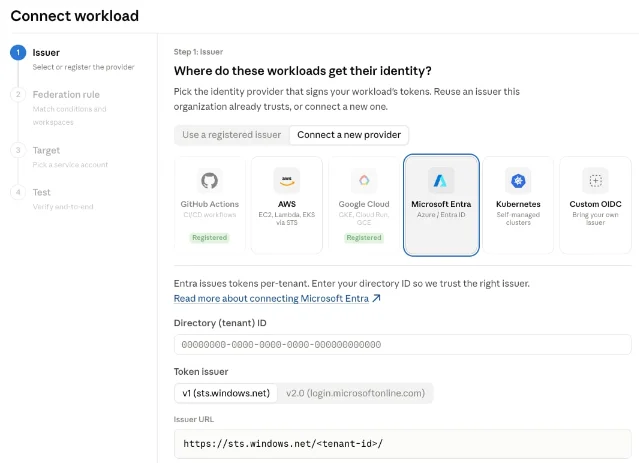
The supported identity sources are broad enough to cover most modern deployment environments. Anthropic names AWS IAM roles, Google Cloud and Kubernetes service accounts, Azure managed identities, GitHub Actions tokens, Okta, Microsoft Entra ID, SPIFFE, and other OIDC-compliant providers as ways a workload can assert its identity. 1 The docs put the same mechanism into one sentence: tokens signed by issuer X, with claims that look like Y, may act as service account Z. 3
That last phrase matters because Anthropic is also introducing service accounts on the Claude Platform. A service account is a named non-human identity inside an Anthropic organization; it has no email, password, or Console login, and federated credentials act on its behalf. 3 Anthropic says this lets each workload have its own identity, roles, and audit trail instead of a shared API key. 1
The security boundary moves upstream
The tempting summary is "no more API keys." That is directionally right, but too blunt. WIF does not make authentication disappear; it moves the hard question to the upstream identity provider. Anthropic's docs are explicit that federated authentication is only as strong as the provider that signs the JWT, and that teams should pair WIF with workload identity binding, conditional access, and audit logging in the IdP. 3
This is still a cleaner failure model for many teams. A leaked API key can remain valid until someone notices and revokes it. A WIF-backed Anthropic token is minted at request time, is scoped through a federation rule, and expires. The docs say the rule sets
token_lifetime_seconds from 60 to 86400 seconds, with a default of 3600 seconds; the Console wizard prefills 600 seconds unless adjusted. 3 Anthropic also bounds the minted token by the remaining lifetime of the upstream IdP JWT, so the Anthropic token does not meaningfully outlive the identity token it came from. 3The exchange path is conventional rather than proprietary magic. The SDK posts the workload's JWT to
POST /v1/oauth/token using the RFC 7523 JWT bearer grant, Anthropic verifies the signature and rule match, then the SDK sends the minted token on API requests and refreshes it before expiry. 3 That matters for enterprise adoption: security teams can reason about the Claude integration with the same mental model they already use for cloud-to-cloud federation.Why this is an agent infrastructure release
WIF is not a model release, but it is relevant to the way Claude is being deployed. Anthropic says WIF covers requests through first-party SDKs and Claude Code. 1 Claude Code is increasingly used in CI-like, repository-bound, and automation-heavy contexts; in those settings, the identity of the workload matters as much as the human who wrote the prompt.
A service account gives an organization a better answer to three questions that API keys blur together:
- Which non-human actor called Claude?
- Which workspace, role, and scope bounded that call?
- Which external identity claim allowed the token exchange?
Anthropic's docs say service accounts become active in a workspace when added as members, and the minted token then follows that workspace's rate limits and usage attribution, the same as an API key. 3 That makes the service account the accounting and governance object, while the federation rule becomes the gate that decides which external workload can act through it.
The federation rule is also where least privilege becomes concrete. A rule can match a
subject_prefix, an audience, exact claim values, a CEL condition expression, or a combination of those matchers. It maps the verified JWT to a target service account and an OAuth scope, with workspace:developer as the default scope. 3 In practice, that means a GitHub Actions workflow, a production Kubernetes service account, and a staging service account do not need to share a Claude credential even if they call the same model.The migration trap: old keys still win
The most practical warning in the docs is not about OIDC. It is about leftovers. Anthropic's credential precedence order checks constructor arguments first, then
ANTHROPIC_API_KEY or ANTHROPIC_AUTH_TOKEN, then an explicit profile, then federation environment variables, then the implicit active profile. 3That means a forgotten
ANTHROPIC_API_KEY in a container environment or CI secret can silently shadow federation. Anthropic's migration instructions therefore tell teams to configure federation in parallel, confirm which credential source wins, unset the API key everywhere it is injected, then revoke the old key in the Claude Console. 3 This is the operational detail that will decide whether WIF is actually adopted or merely configured.The Admin API adds the missing scale path. Anthropic's Admin API manages organization resources such as members, workspaces, API keys, service accounts, federation issuers, and federation rules. 4 The docs specify that service-account, federation-issuer, and federation-rule endpoints require an
org:admin OAuth token; Admin API keys are not accepted for those endpoints. 4 That is a subtle but important separation: the tool that retires static workload keys is itself managed through OAuth-scoped administration rather than another broad static admin key.What to watch next
The release makes Claude Platform authentication more cloud-native, but the open questions are implementation questions. Teams should watch whether their SDKs and deployment templates actually remove API keys from runtime environments, whether each workload gets a distinct service account rather than a shared "Claude automation" bucket, and whether federation rules are narrow enough to make audit logs useful after an incident.
The deeper pattern is consistent with Anthropic's recent enterprise moves: Claude is being packaged less as a chatbot and more as an actor inside existing operational systems. WIF gives that actor a runtime identity that security teams can map, scope, audit, and revoke. If agent deployments keep moving from experiments to production workflows, this kind of plumbing will matter as much as the next benchmark table.
このコンテンツについて、さらに観点や背景を補足しましょう。