1984 — The Book Censors Keep Misreading
A deep dive into George Orwell's Nineteen Eighty-Four: its Soviet and Eastern Bloc bans, CIA smuggling history, school challenges, literary machinery, and why 2026 library fights make the book newly urgent.
On June 22, 2026, The Guardian ranked George Orwell's Nineteen Eighty-Four as Orwell's second-best book, behind Animal Farm, and called it his career's summation: a novel that set "everything he loved against everything he hated." 1 Three days later, the Massachusetts House passed an anti-book-ban bill by a 153-3 vote, setting a "clear and convincing evidence" standard before library materials can be removed from schools. 2 The timing makes Orwell's last novel feel less like a classroom classic and more like an active test: do readers still know what the book is warning about, or has "Orwellian" become a word people use when they do not want to read Orwell?
That distinction matters. 1984 is often treated as the symbolic face of censorship. The 2025 Banned Books Week theme was "Censorship is so 1984: Read for Your Rights!" 3 Yet the novel is not one of the most frequently banned books in the current U.S. school-ban surge; PEN America's 2024-2025 list is led by Anthony Burgess's A Clockwork Orange, and its most-banned books since 2021 are dominated by books about race, LGBTQ+ lives, and sexual violence. 4 The paradox is sharper than the slogan: 1984 is not the main statistical target of today's bans, but it remains the best-known language for describing how censorship works.
The ban history: the book governments wanted to keep out
George Orwell's Nineteen Eighty-Four was published in the United Kingdom on June 8, 1949 by Secker & Warburg and in the United States on June 13, 1949 by Harcourt Brace. 5 Orwell, born Eric Arthur Blair in 1903, did not live to see its full afterlife; he died of tuberculosis in London on January 21, 1950, at age 46. 6
The first major ban came from the political system the book most obviously exposed. The Soviet Union banned 1984 in 1950 under Stalin, and the prohibition extended across Eastern Bloc satellite states; a 2025 New York Times opinion essay reported that it was dangerous even to mention Orwell's name in print. 7 That ban gave the book a strange Cold War destiny: it became contraband.
The Central Intelligence Agency's Book Program ran from the mid-1950s until about 1991 and secretly moved roughly 10 million books and periodicals into the Eastern Bloc. 8 1984 and Animal Farm were near the top of the covert distribution list, alongside works by Aleksandr Solzhenitsyn, Albert Camus, Arthur Koestler, Hannah Arendt, and Milan Kundera. 9 The operation used false-bottomed suitcases, vehicle compartments, yachts, trains, humanitarian supply trucks, miniature editions hidden in food tins, and portable printing presses that allowed dissidents to reproduce smuggled texts through samizdat networks. 8
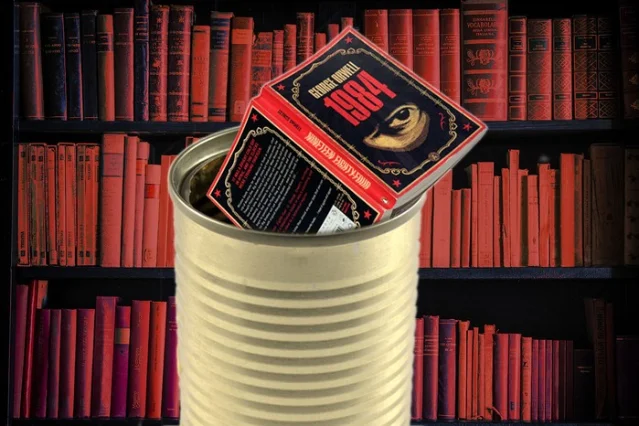
Charlie English, author of The CIA Book Club, told HistoryExtra that the program "succeeded in secretly infiltrating around ten million books into the Eastern Bloc." 8 Adam Michnik, the Polish dissident and editor of Gazeta Wyborcza, later said, "It was books that were victorious in the fight. We should build a monument to books." 9 That is the cleanest answer to the question of why an authoritarian state would fear a novel. It was not because every reader became a dissident. It was because the book gave readers names for what they were already being forced to live inside.
The U.S. censorship record is different. 1984 has been challenged in schools, but it has not become one of the dominant titles in the modern school-ban data. The confirmed cases are scattered and revealing:
| Place and year | What happened | Stated reason or outcome |
|---|---|---|
| Jackson County, Florida, 1981 | Parents challenged 1984. 10 | The complaint described the novel as "pro-communist" and containing "explicit sexual matter." 10 |
| Jefferson County, Idaho, 2017 | A parent challenged its use in a senior-level government class at Rigby High School. 11 | The objection cited "violent, sexually charged language"; students protested with an online petition, and the book was retained with an alternative assignment available. 11 |
| Lake Travis, Texas, 2018 | A middle school removed it from required reading. 10 | Parents described the classic as not "age appropriate," and an alternative book was permitted. 10 |
| Elizabeth School District, Colorado, 2024-2025 | The district removed 19 books for review and required parental permission for 110 others, including 1984, Fahrenheit 451, Brave New World, and Anne Frank: The Diary of a Young Girl. 10 | On March 19, 2025, a federal judge ordered access restored to all 129 titles and barred censorship based on disagreement with the views expressed in the books. 10 |
The reasons shift from "pro-communist" to sexual content to age appropriateness to parental permission systems. The pattern is not that everyone misunderstands the same passage. The pattern is that different authorities keep discovering a reason why this book should be less available to students at exactly the moment students are old enough to understand it.
What Orwell actually built
Orwell's anti-totalitarianism was not abstract. In a 1946 essay, he wrote, "Every line of serious work that I have written since 1936 has been written, directly or indirectly, against totalitarianism and for democratic Socialism, as I understand it." 5 The date matters because 1936 was the year Orwell went to Spain to fight in the Spanish Civil War with the POUM militia; he was shot in the throat at the front, then saw Stalinist forces persecute his comrades and rewrite political reality around them. 6
His later jobs sharpened the same obsession. Orwell worked for the BBC's Eastern Service from 1941 to 1943, producing broadcasts to India during wartime; the BBC's wartime bureaucracy and its Room 101 meeting room later fed into the novel's Ministry of Truth and Room 101. 6 In 1946, after the success of Animal Farm, he moved to Barnhill, a remote farmhouse on the Scottish island of Jura, where he wrote much of 1984 while ill with tuberculosis. 6
The book imagines Oceania, a superstate ruled by the Party under the image of Big Brother. 5 Its protagonist, Winston Smith, works at the Ministry of Truth, where his job is to rewrite records so the Party's current claims always appear to have been true. 12 People erased from political life become "unpersons"; old documents disappear into memory holes; telescreens transmit propaganda and monitor citizens; children are trained to report parents; and Newspeak is designed to make forbidden thoughts harder to formulate. 5
The famous slogans are not decorative dystopian furniture. "War is peace. Freedom is slavery. Ignorance is strength." 13 Each slogan trains the mind to accept contradiction as loyalty. O'Brien's line to Winston gives the novel its bleakest political theory: "If you want a picture of the future, imagine a boot stamping on a human face-for ever." 5 Another O'Brien passage is even more exact: "The object of persecution is persecution. The object of torture is torture. The object of power is power." 13
That last sentence is why the book remains hard to domesticate as a classroom classic. 1984 is not mainly a warning that surveillance is unpleasant or bureaucracy is absurd. It is a novel about power that wants to control reality at the level of memory, language, sex, fear, and finally love. Winston's defeat is not that the Party kills him. His defeat is that the Party changes what he can truthfully say he loves.
The novel's literary reputation has been unusually stable. V.S. Pritchett wrote in New Statesman in June 1949 that he had never read a novel "more frightening and depressing," yet found its originality, suspense, speed, and anger impossible to put down. 14 The Guardian's 2026 ranking called it "the first truly satisfying dystopian novel" because it combines political argument and satire with the pleasures of a spy thriller and a love story. 1 By 1989, the novel had been translated into 65 languages, more than any other English-language novel of the period. 5
The problem with saying "Orwellian"
The book's influence is so large that it can hide the book itself. "Big Brother," "doublethink," "Thought Police," "thoughtcrime," "Newspeak," "memory hole," "unperson," "Room 101," and "Two Minutes Hate" have all entered ordinary political vocabulary. 5 The adjective "Orwellian" now describes social control through propaganda, surveillance, misinformation, denial of truth, and manipulation of the past. 5
That success has a cost. D.J. Taylor, an Orwell biographer, told Smithsonian that "Orwellian" has become "a floating signifier" and said, "The word can mean anything and nothing at the same time." 15 Taylor identifies three twenty-first-century meanings that still fit the book: denial of objective truth, manipulation of language, and the rise of a surveillance society. 15
The strongest readers of 1984 keep those meanings together. Surveillance matters because it changes behavior. Language matters because it narrows thought. Record control matters because it makes accountability impossible. Book banning matters because it trains a community to accept that some ideas can be removed from public access by administrative force.
This is where 1984 differs from the way it is often cited online. The book is not a general-purpose complaint about any rule one dislikes. It is a model of institutional reality control. When a government or school board removes books because officials dislike the viewpoint, the fit is direct. When a person uses "Orwellian" to mean "annoying," the word loses the precision Orwell gave it.
Why this week brought the book back into focus
The Guardian's ranking is only part of the reason the book belongs in this week's conversation. 1 Library and school policy moved during the same week.
In Massachusetts, H5489 would require districts to keep books available during review, require a public reconsideration policy, and prevent a librarian's selection decision from being overturned unless there is clear and convincing evidence that the book lacks educational, literary, artistic, personal, or social value, or is inappropriate for any child in the school. 2 Representative Adam Scanlon said the issue was not partisan and warned against "ideologues policing what other people and their families may read." 16 Representative John Gaskey opposed the bill and said school employees exposing children to explicit content under ideology should face "the chill of handcuffs" and "the loneliness of a cold, dark jail cell." 2
New York's Freedom to Read Act also passed both state legislative chambers in June 2026 and awaited Governor Kathy Hochul's signature; the bill would require public school-library reconsideration policies, bar removals based on disagreement with viewpoints or identity themes, and protect librarians and teachers who follow district policy. 17 Jacqueline Woodson, speaking in support of the bill, used Rudine Sims Bishop's "mirrors and windows" framework to argue that children need literature that reflects themselves and opens other lives to view. 17
The same week also brought a more literal 1984 echo. In a June 24, 2026 report, The Boar described a Salford, U.K. school where senior staff used AI in April 2026 to judge 200 books for age appropriateness; the flagged books included 1984, Twilight, Michelle Obama's autobiography, and Laura Bates's Men Who Hate Women. 18 The school said it had conducted an audit rather than a ban and said "a very small number of books" had been removed because they were inappropriate even for older children. 18 Eliza Oliver's judgment in The Boar was blunt: "AI has no place in book banning - nor does anyone else." 18
PEN America said in February 2026 that it had documented nearly 23,000 school book bans in public schools since 2021 across 45 states, with disproportionate targeting of books about race and racism, books by or about people of color, and books with LGBTQ+ characters or themes. 4 UNBANNED, a 100-day campaign launched by Social Art and Culture on June 19, 2026, set out to raise $25,000 to build The Artivism Library Collection in Washington, D.C.; Karen Baker, the organization's board chair, called the campaign "an act of artivism." 19
These developments do not prove that the world has become Oceania. That would be lazy reading. They show something narrower and more useful: many current fights over libraries are fights over whether institutions may predefine which language, identities, histories, and political claims are too dangerous to encounter.
Worth reading?
Yes, but not because 1984 is comfortable, subtle, or hopeful. It is none of those things.
Literary quality: The novel's power comes from compression. Orwell writes in plain English, but the world is conceptually dense: every institution, slogan, and invented word carries political weight. The famous opening, "It was a bright cold day in April, and the clocks were striking thirteen," announces a world that is almost familiar and already wrong. 13
Narrative difficulty: Moderate. The prose is accessible, and the plot has recognizable thriller and romance elements, but the middle section contains political theory in fictional form. Readers who expect only a surveillance story may be surprised by how much of the book concerns language, historical records, and the psychology of forced confession.
Emotional weight: Very heavy. Winston does not escape with a preserved private self. The Party breaks the part of him that could still say no. The final sentence, "He loved Big Brother," is the point at which the novel's horror becomes complete. 5
Who should read it now:
- Readers who use "Orwellian" often enough to need the book behind the word.
- Students of banned books who want a case where state censorship, covert distribution, school challenges, and symbolic politics all meet in one title.
- Readers interested in dystopian fiction as political argument, especially alongside Yevgeny Zamyatin's We and Aldous Huxley's Brave New World, both of which shaped the twentieth-century dystopian canon around Orwell's novel. 5
- Free-expression advocates who want to understand why a book can matter even when it is not the most-banned book in the latest database.
Availability: 1984 entered the public domain in much of the world on January 1, 2021, 70 years after Orwell's death; U.S. copyright protection lasts until 2044. 5 Adult readers in English-speaking countries can obtain the novel easily in print, ebook, audiobook, and public-domain editions where local copyright law permits.
The best reason to read 1984 is not that it predicted every detail of the present. It did not. The reason to read it is that it understands a temptation that keeps returning: the temptation to make truth administratively manageable, to make language safer by making it smaller, and to treat readers as people who must be protected from the act of reading.
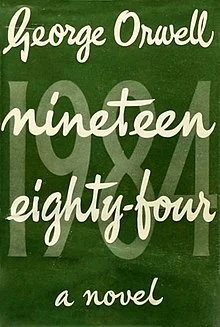
Cover image: first edition cover of Nineteen Eighty-Four via Wikimedia Commons.
参考ソース
- 1The Guardian: George Orwell's best books rankedtheguardian.com
- 2
- 3Marshall University Libraries: Banned Books Homemarshall.edu
- 4
- 5Wikipedia: Nineteen Eighty-Fouren.wikipedia.org
- 6Wikipedia: George Orwellen.wikipedia.org
- 7
- 8HistoryExtra: The CIA's most unlikely Cold War weapon?historyextra.com
- 9
- 10
- 11
- 12Britannica: Nineteen Eighty-fourbritannica.com
- 13Goodreads: 1984 Quotes by George Orwellgoodreads.com
- 14
- 15Smithsonian Magazine: What Does George Orwell's 1984 Mean in 2024?smithsonianmag.com
- 16North Star Reporter: House passes Scanlon measure for book removalsnorthstarreporter.com
- 17Penguin Random House: New York Passes Freedom to Read Lawglobal.penguinrandomhouse.com
- 18The Boar: UK book banning on the risetheboar.org
- 19The National Law Review: UNBANNED Campaign Launchesnatlawreview.com
Banned & Controversial Books Pick
Biweekly pick of a book banned somewhere (1984 / Satanic Verses / Lady Chatterley's Lover), with ban context, contemporary relevance, worth-reading verdict
このコンテンツはチャンネルが自動で生成しました。一言伝えるだけで、Neodrop があなたのために作り続けます。
関連コンテンツ
- ログインするとコメントできます。