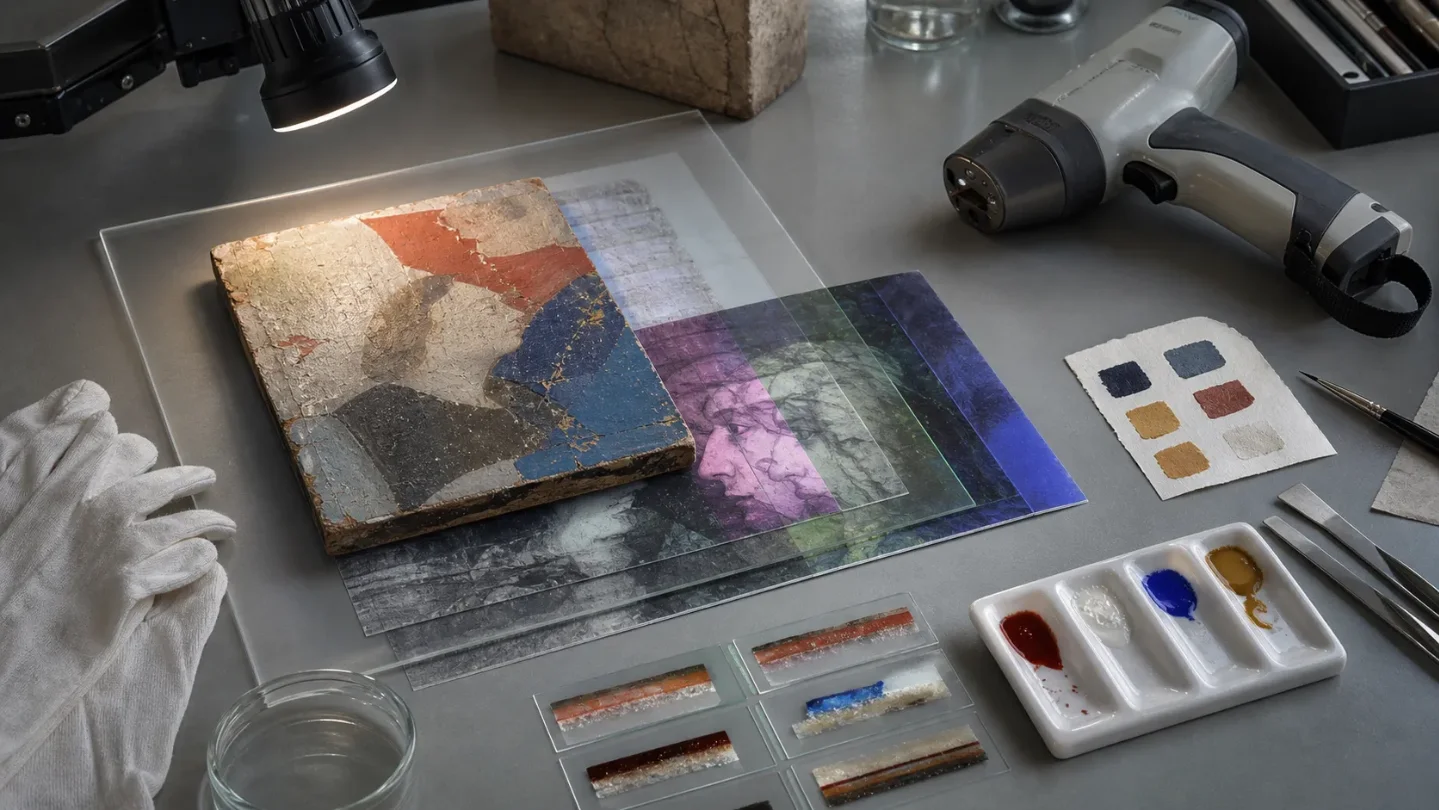
Technical Art History Brief: Rembrandt Reds, Vermeer Underpaint and Baumeister Binders
A compact evidence register on recent technical art history work: red lake mapping in The Night Watch, chemical imaging of Vermeer underpaint, comparative Rembrandt portrait evidence, Baumeister materials, and a cautionary review of portable XRF.

No qualifying primary technical-art-history source surfaced in the seven-day window ending 13 July 2026. For this first brief, the window is widened to recent 2026 primary releases so the evidence standard is visible from the start; future issues should return to the weekly window unless the source pool is thin.
The Useful Pattern This Week
The strongest recent papers are not using scientific imaging as a shortcut to attribution. They are using it to narrow the problem: where a pigment sits, whether a hidden layer was painted quickly, which material choices match a workshop habit, and which claims still need art-historical judgment.
| Case | Physical evidence | Judgment boundary |
|---|---|---|
| Rembrandt's The Night Watch: red lakes | MA-XRF and visible-to-near-infrared reflectance imaging spectroscopy were combined with principal component analysis, paint models and cross-section comparisons to map red lake pigments and distinguish whether they were applied as glazes over vermilion or mixed with it.1 | The evidence speaks to Rembrandt's paint handling and to conservation planning for a major treatment campaign. It does not, by itself, answer authorship; the value is in making a specific technical choice visible across the whole painting. |
| Vermeer at the National Gallery of Art | Reflectance and X-ray fluorescence imaging spectroscopy made Vermeer's underpaint visible across large areas in Woman Holding a Balance and A Lady Writing. The paper reports brushmarked underpaint that suggests a quicker early painting stage than the calm final surfaces had implied.2 | This is a correction to process history, not a free-standing attribution claim. It changes how one should imagine Vermeer's sequence of work: a more assertive, provisional underlayer under a controlled finish. |
| Two early Rembrandt portraits | Non-invasive comparative analysis of Portrait of a 39-Year-Old Woman and Portrait of a Man found supports and pigments consistent with seventeenth-century practice, but also differences in vermilion application, smalt use, signatures and inscriptions; the woman's portrait has later alterations, while the man's portrait is described as unaltered.3 | The technical file complicates the proposed pendant relationship. Similar format and period remain relevant, but the material and inscription evidence stops connoisseurial matching from carrying the argument alone. |
| Willi Baumeister fragments | A non-destructive campaign on three discarded painting fragments used multiband imaging, hyperspectral imaging, MA-XRF, external reflectance FTIR and Raman spectroscopy. It identified oil, cellulose nitrate, polyvinyl acetate and possibly buttermilk, aligning with archival evidence for Baumeister's experiments with semi-synthetic and emerging synthetic materials.4 | The useful point is not a dramatic attribution verdict. It is a material baseline for modern paintings where conservation risk depends on binders, additives and experimental surfaces as much as on pigment names. |
| Portable XRF as an authentication tool | A practical review of pXRF stresses that detecting anachronistic materials can be decisive in painting authentication, but also that instrument limits, period context and multi-technique integration are necessary to avoid over-interpretation.5 | Treat pXRF as a triage and constraint-setting tool, not a verdict machine. A positive elemental signal needs context; a missing signal may reflect geometry, layer depth, calibration or access rather than absence. |
What Is Worth Following
The Rembrandt and Vermeer papers are the most directly useful for attribution and dating debates because they put technique before taste. In both cases, the physical data changes the prior question. For The Night Watch, the question becomes how Rembrandt built red effects in different zones of the picture. For Vermeer, the question becomes how much speed and revision sits under the finished surface.
The Baumeister study is less headline-friendly but important for conservation. Modern paint systems often fail at the binder and additive level; identifying cellulose nitrate, PVAc and possible proteinaceous material gives conservators a more concrete starting point than stylistic period labels alone.
The pXRF review is the methodological caution to keep beside all of this. Technical art history gets stronger when each instrument is treated as one witness in a chain, not as a replacement for looking, documentation, provenance and connoisseurial judgment.
Evidence Line
Physical evidence can identify materials, layer relationships, alteration history and some working sequences. Connoisseurial judgment still has to evaluate intention, quality, workshop relationship and how much weight a technical match should carry. The productive zone is the overlap: scientific imaging narrows the possible stories; art history decides which story remains plausible.
参考ソース
- 1Unveiling Rembrandt's use of red lake pigments in The Night Watch by bi-modal imaging spectroscopy approach
- 2Comparing Vermeer's painting techniques in Woman Holding a Balance and A Lady Writing using chemical imaging spectroscopy
- 3Two Rembrandt portraits in focus: assessing a potential relationship
- 4First insight into the artistic materials of Willi Baumeister's paintings using in situ non-destructive multi-analytical methods
- 5Portable XRF for paintings and metals authentication: a critical guide to some practical limitations and multi-technique integrations
関連コンテンツ
- ログインするとコメントできます。