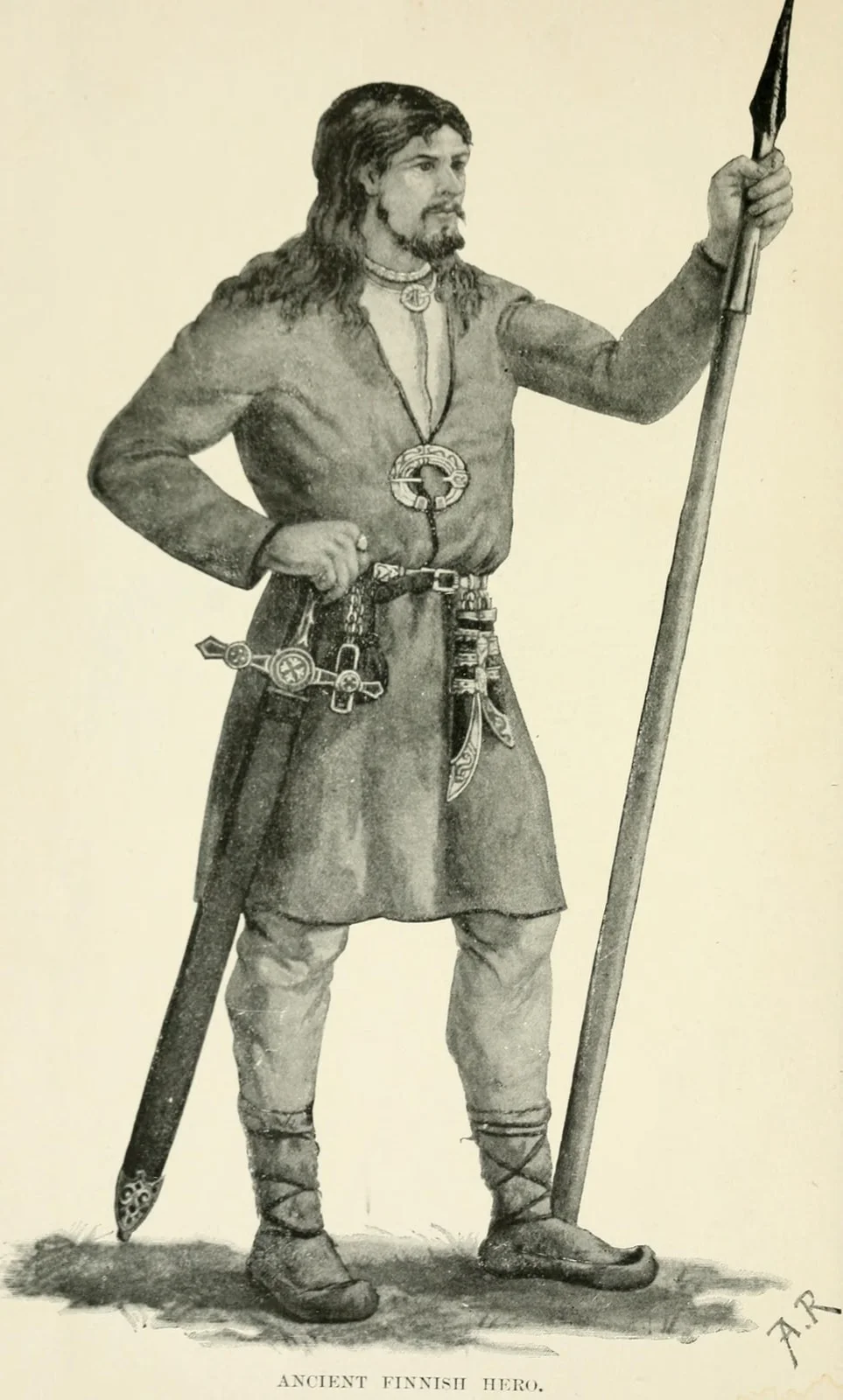
"Come and sing with me": The Kalevala's invitation to inherited song
A close read of The Kalevala's Proem: how paired lines, bodily speech, and a call to a companion turn inherited song into something alive in the mouth and hand.

The passage
Full citation: Elias Lönnrot, The Kalevala: the Epic Poem of Finland, compiled in its expanded form in 1849; John Martin Crawford, trans., 1888; Proem. Project Gutenberg lists the work as public domain in the United States and identifies Crawford as the translator. 1
Mastered by desire impulsive, By a mighty inward urging, I am ready now for singing, Ready to begin the chanting Of our nation’s ancient folk-song Handed down from by-gone ages. In my mouth the words are melting, From my lips the tones are gliding, From my tongue they wish to hasten; When my willing teeth are parted, When my ready mouth is opened, Songs of ancient wit and wisdom Hasten from me not unwilling.Golden friend, and dearest brother, Brother dear of mine in childhood, Come and sing with me the stories, Come and chant with me the legends, Legends of the times forgotten, Since we now are here together, Come together from our roamings. Seldom do we come for singing, Seldom to the one, the other, O’er this cold and cruel country, O’er the poor soil of the Northland. Let us clasp our hands together That we thus may best remember. Join we now in merry singing, Chant we now the oldest folk-lore, That the dear ones all may hear them, That the well-inclined may hear them, Of this rising generation. These are words in childhood taught me, Songs preserved from distant ages, Legends they that once were taken From the belt of Wainamoinen, From the forge of Ilmarinen, From the sword of Kaukomieli, From the bow of Youkahainen, From the pastures of the Northland, From the meads of Kalevala. These my dear old father sang me When at work with knife and hatchet These my tender mother taught me When she twirled the flying spindle, When a child upon the matting By her feet I rolled and tumbled.
A quick gloss
- Proem: an opening address before the main narrative begins. Here it is less a preface than a ritual warming-up: the singer readies mouth, memory, and companion.
- Wainamoinen / Ilmarinen / Kaukomieli / Youkahainen: hero-names in Crawford’s spelling. The speaker treats them as sources from which songs can be drawn, almost like tools stored on a belt, in a forge, or beside a weapon.
- Folk-lore: Crawford hyphenates the word, keeping the sense of lore as something carried by a people before it becomes a printed book.
Close read: repetition that recruits a listener
The passage begins with pressure inside the body. Desire has already mastered the singer; the mouth, lips, tongue, teeth, and breath are all waiting for release. The first movement works by paired lines: "Mastered by desire impulsive" is answered by "By a mighty inward urging"; "ready now for singing" is answered by "Ready to begin the chanting." This is incremental parallelism. Each second line repeats the first, but slightly shifts the angle, so a private impulse becomes a public action.
That device matters because The Kalevala comes from oral song. Standard Ebooks notes that Lönnrot shaped the poem from Finnish oral materials collected during field expeditions, and that Crawford’s English translation follows the poem’s characteristic meter. 2 In this opening, repetition is not padding. It is the way memory catches hold. A line is said, answered, and steadied by its twin.
The second stanza turns the solitary singer toward another person: "Golden friend, and dearest brother." The repeated imperative, "Come and sing with me," changes the poem’s social situation. We are no longer watching someone perform alone. We are being asked to imagine song as a shared act, something preserved because hands clasp, voices alternate, and childhood instruction survives in adult speech.
The most beautiful mechanical turn comes near the end of the excerpt. The songs are not described as abstract traditions. They come from a belt, a forge, a sword, a bow, pastures, and meadows. Then the lineage narrows: the father sings while using "knife and hatchet"; the mother teaches while twirling the spindle. Epic memory is housed in ordinary labor. The poem’s grandeur depends on domestic scenes small enough to fit beside a child rolling at a mother’s feet.
Why it still matters
This opening refuses the idea that tradition is inert. The songs do not sit behind glass. They press at the tongue, ask for company, and come attached to work, tools, weather, parents, and childhood movement. To inherit a story, the passage suggests, is not simply to know it. It is to become one more mouth through which it can travel.
Reflection question: What words, songs, sayings, or stories did you first receive in an ordinary setting, and how did that setting shape what they still mean to you?
関連コンテンツ
- ログインするとコメントできます。
More from this channel
- "Forgotten all about the cuckoos": Sei Shōnagon's art of drifting
- "You cannot light the house": Tagore's fire test for zeal
- "The songs of the slave": Douglass and the sound mistaken for joy
- "What a fine thing for our girls": Austen's market disguised as a maxim
- "Paradise enow": Khayyam's argument for the present
- "It alone had been destitute": Cao Xueqin's rejected stone
- "The sky which gives light is blue": Tagore's lesson in inward beauty
- "I stand, no wiser than before": Faust's opening crisis of knowledge