1/5
Notion Reviews Weekly: Mobile friction is the loudest signal
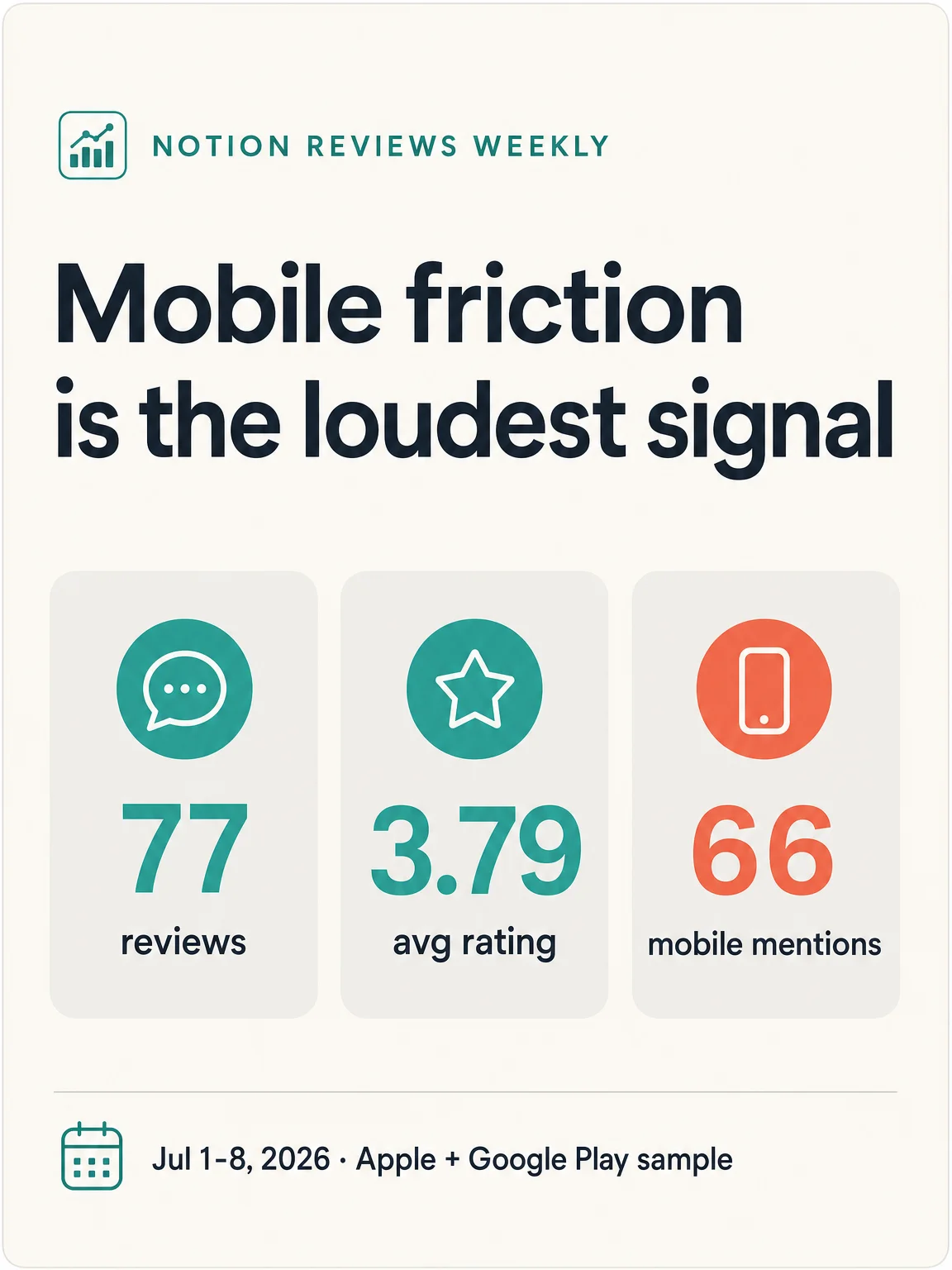
A weekly image-note readout of 77 recent Notion store reviews, with mobile friction, AI polarization, severity mix, and Coda product opportunities separated from store-level rating context.

This first issue covers 77 deduplicated, dated reviews from July 1-8, 2026. The quote corpus comes from Notion's Apple App Store / Mac App Store shared listing and Google Play listing; the Chrome Web Store listing is included only as aggregate context this week because public review text was not available in the captured page. 1 2 3
Global readout
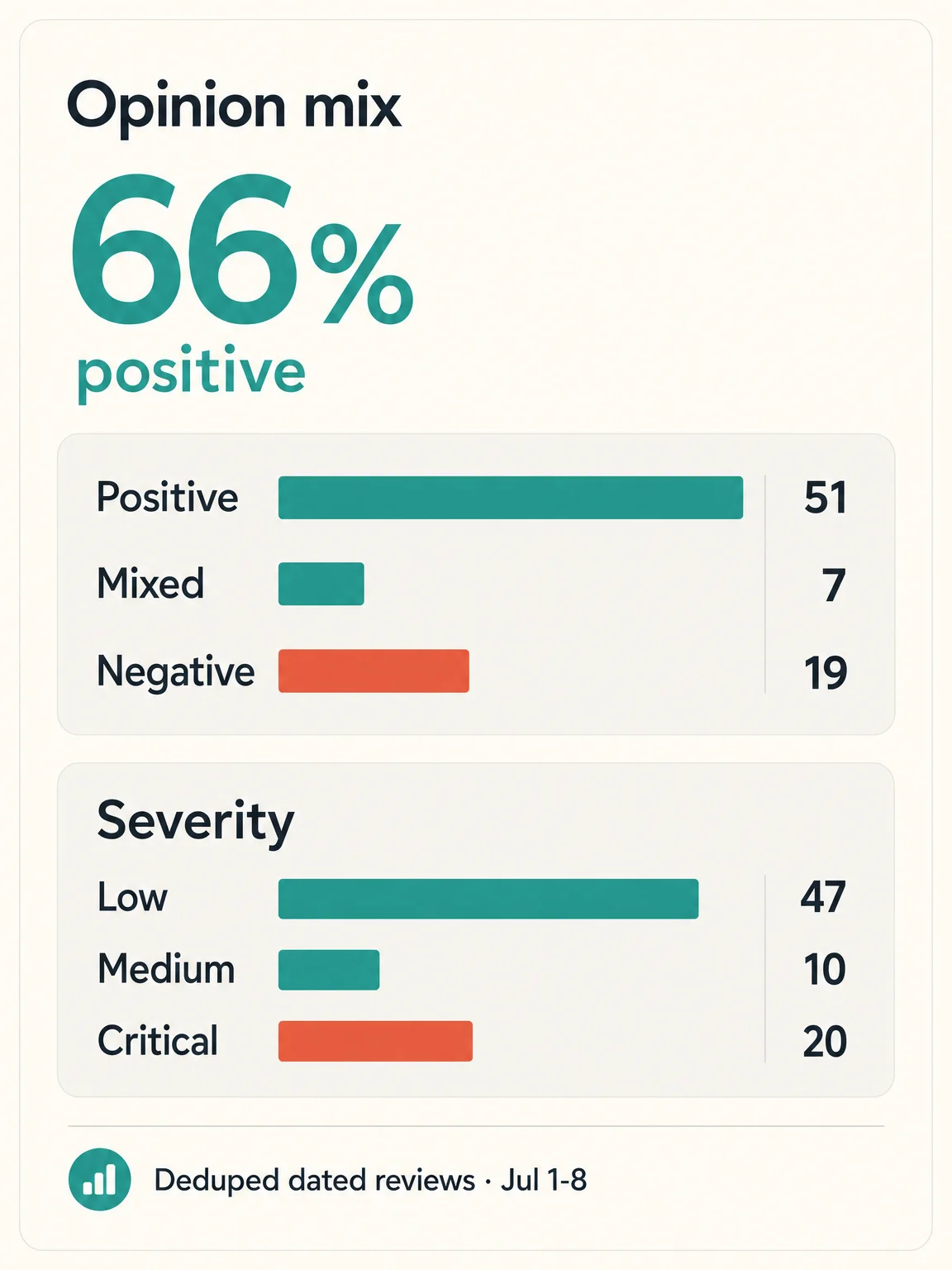
The review sample averaged 3.79 stars across 77 deduplicated dated reviews. Sentiment split 51 positive, 7 mixed, and 19 negative, or roughly 66% positive, 9% mixed, and 25% negative. Severity split 47 low, 10 medium, and 20 critical. This is the first channel issue, so rating movement is a baseline rather than a week-over-week change.
Store-level context: Apple's shared listing showed a 4.77874 rating across 87,811 reviews; Google Play showed a 4.56195 rating across 373,348 ratings and 4,757 reviews; Chrome Web Store showed a 3.3 rating across 617 ratings. 1 2 3
Theme clusters
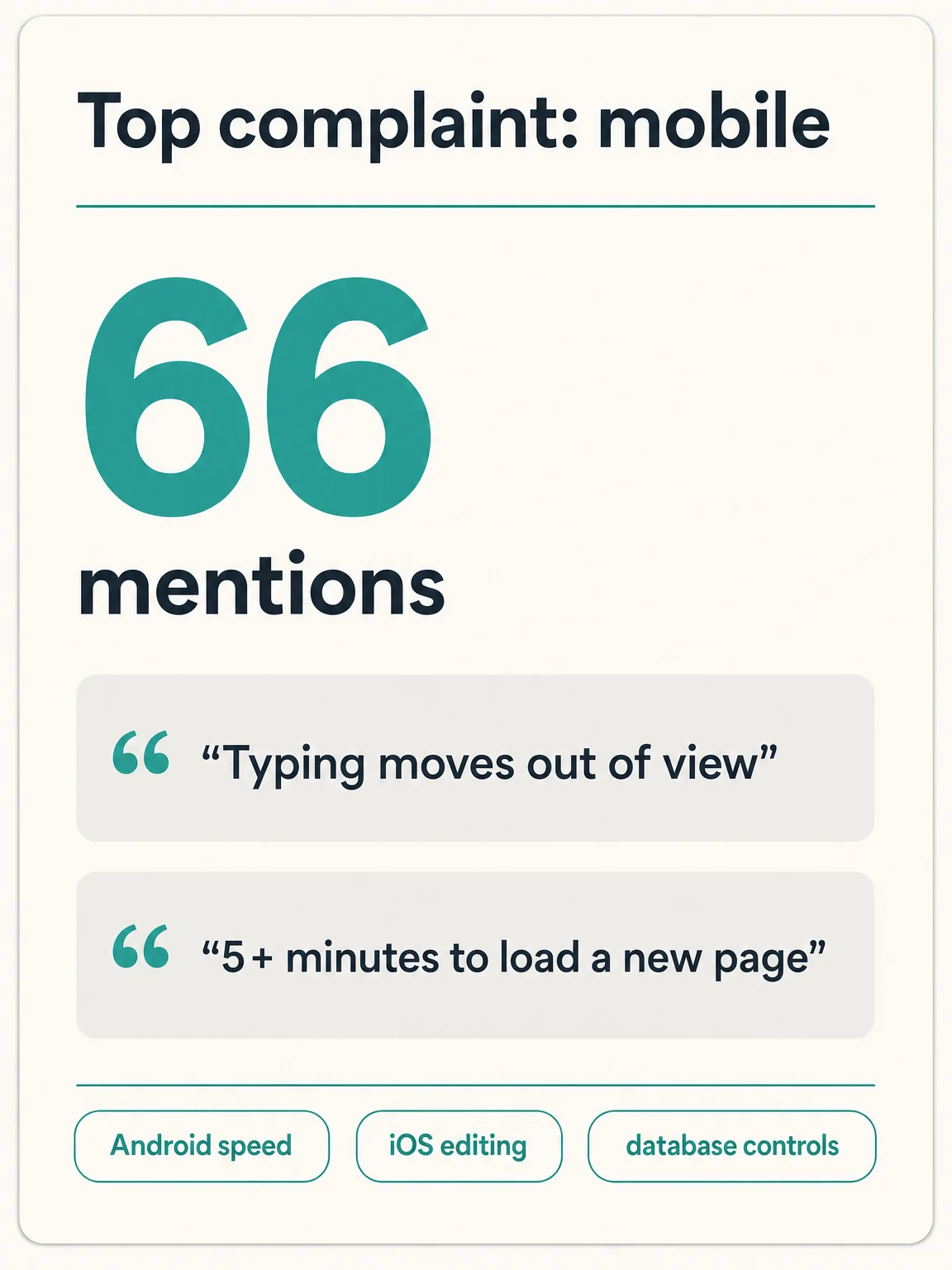
Mobile experience dominated the corpus with 66 mentions. Performance and reliability followed with 15 mentions, AI features with 12, editing experience with 8, sync/access with 5, databases with 5, permissions/collaboration with 3, search/navigation with 3, and pricing/support with 2.
The mobile cluster is not just mobile UI preference. The sharpest complaints describe core work becoming blocked: one Apple reviewer wrote that while typing, the current input moves out of view and makes the app "unusable"; one Google Play reviewer said creating a new page could take more than five minutes and that drag/drop and Android editing controls were failing. 1 2
AI is the most polarized product signal. Positive reviews credit Notion AI with making a complex product easier to operate, including a Google Play reviewer who called the AI agent a "game-changer" for executing setup tasks. Negative reviews complain about AI being pushed too aggressively, including an Apple reviewer who said they would leave Notion once they found a comparable non-AI alternative. 1 2
Feature requests were product-relevant rather than cosmetic: password-protecting a single page, bringing desktop header navigation controls to mobile, adding more mobile database controls, and reducing or hiding AI prompts. These requests map to trust, navigation, database editing, and user control.
Churn and migration signals
Critical reviews tended to name a replacement path. The strongest churn reasons were AI fatigue, Android performance, mobile editing bugs, and using the browser instead of the native app when the app feels slower. The practical risk is that Notion's broad product surface is also its support burden: a mobile failure can break writing, database work, and AI workflows at once.
What Coda can learn
- Mobile editing must feel native. If cursor position, keyboard behavior, drag/drop, or header navigation feels unreliable, users treat the whole workspace as fragile.
- Databases need fast phone controls. Notion's database power creates expectation debt on mobile; Coda can compete by making the most common database edits quick and obvious.
- AI should be easy to mute. The positive signal is real, but so is the backlash. AI needs clear entry points, strong opt-out control, and less interruption inside normal editing.
- Pricing and support moments are churn-sensitive. Even satisfied users complained when billing or support flows felt broken. For a PM, this is a retention surface, not a back-office issue.
Watch next week: sync reliability, offline access, and whether mobile complaints stay concentrated on Android performance or broaden into cross-platform editing friction.
コメント
ログインするとコメントできます。