
2026/7/7 · 8:15
AI's labor signal is the one-person firm
The AI Daily Brief's July 6 episode argues that AI's first visible labor shock may be company formation: solo founders can now cover more of the work that once required early hires, while the safety of traditional corporate paths is less obvious.

AI may change work first by making fewer people necessary to start a real company, not by instantly erasing everyone else's job. That is the more interesting reading of NLW's July 6 episode of The AI Daily Brief: the clearest labor signal is showing up at the edge of the market, where solo founders and tiny teams can test how much company-building work one person can now absorb. 1
コンテンツカードを読み込んでいます…
The thesis: AI changes both sides of the risk calculation
The episode's strongest move is to separate two questions that are often collapsed into one. AI lowers the cost of building: research, prototyping, coding, marketing, customer support, and back-office work can now be partially handled by tools. But NLW argues the other side of the equation matters just as much. If corporate roles are themselves being reorganized by AI, then the old assumption that a traditional job is the safer option becomes less stable. 1
That reframes the startup-versus-career debate. For years, the usual story was simple: founding was risky, joining an established organization was safer. The episode argues that AI is compressing that distance. Starting still carries risk, but the cost of trying has fallen; meanwhile, the supposedly safe path now includes uncertainty about which corporate roles will still exist, which will be rebuilt, and which will require a different bundle of skills.
The result is not a clean prediction that everyone should quit and become a founder. It is a claim about where the signal appears first. Solo companies are the extreme case. They are where AI's ability to replace missing functions, rather than missing jobs, becomes easiest to observe.
The data points to firm formation, not just layoffs
The episode leans heavily on Stripe Economics' June 22 post, "The age of the solopreneur." Stripe argues that recent business-formation data is not just a pandemic-era artifact or a passive filing spike. New applications that are likely nonemployers have accelerated since late 2024, while high-propensity employer applications have stayed comparatively stable. Stripe's own payment data also shows that post-2023 sign-up cohorts reached meaningful transaction volume faster than earlier cohorts. 2
The more striking part is the income distribution. Stripe built a proxy index using about 115 solopreneur-focused platforms plus solo Stripe Atlas businesses. In that index, more than twice as many solopreneurs earned over $1 million in 2025 than in 2023, and close to three times as many crossed the $5 million and $10 million thresholds. Stripe is careful to call this a proxy, not a perfect census. Some indexed businesses may have hired employees later, and some solo operators use general-purpose infrastructure outside the index. Still, the direction is hard to dismiss. 2
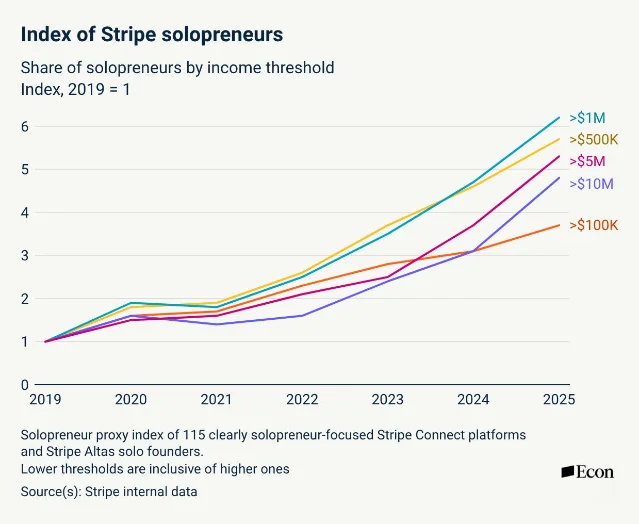
This matters because it is a different kind of AI labor story. A layoff story asks which tasks disappear inside existing firms. A solo-company story asks which firm boundaries become unnecessary. If a founder can size a market, build a first version, run support, write sales copy, reconcile payments, and distribute through AI-assisted channels, then the first-order effect may be fewer mandatory hires per unit of revenue.
The caveat: registration data can lie
The episode does not treat the numbers as self-proving. That restraint is important. Business-formation data has been distorted before. Stripe notes that Paycheck Protection Program incentives in 2020 encouraged registrations that did not necessarily reflect durable entrepreneurship. It also notes that Census methodology changes in 2022 affected how high-revenue nonemployer businesses were counted. 2
The current case is stronger because several signals point in the same direction. Stripe cites faster revenue ramps among recent cohorts, business-registration increases across Australia, Finland, and France, and Delaware incorporation growth of roughly 40% year over year since early 2025. Delaware is not where someone usually goes for a casual passive filing; it is associated with founders who want formal governance or venture readiness. 2
That still does not prove AI caused the whole surge. It suggests a plausible mechanism. AI fills skill gaps that once forced founders to recruit early: technical buildout, market research, pricing, copywriting, sales preparation, and integration work. Stripe also reports that AI-influenced journeys now make up nearly four times the share of Stripe sign-ups as they did in January 2025, including traffic from large language models that recommend Stripe to businesses researching payments. 2
The deeper point is organizational design
NLW's conclusion is that solopreneurs are a preview environment for AI-shaped organizations. They are not representative of every business, but they show what happens when the minimum viable team shrinks. The experiments that work at the edge can later move inward: leaner product teams, smaller services firms, more engineer-heavy startups, and companies that delay hiring because software can temporarily cover functions that used to require a full-time person. 1
For AI practitioners, that is the part worth taking seriously. The argument is not that one-person companies will replace normal companies. It is that startup formation gives an early measurement surface for AI's effect on work. If more revenue can be created before headcount appears, then the bottleneck shifts toward judgment: picking the market, deciding what not to automate, knowing when a human relationship matters, and deciding when the founder has reached the limit of tool-assisted leverage.
The episode is useful because it moves the AI jobs debate away from a binary fight over replacement. It asks a more concrete question: where are people already reorganizing work because AI lets them do more before they hire? Right now, one answer appears to be the one-person firm.
関連コンテンツ
- ログインするとコメントできます。