
2026/6/29 · 8:14
Anthropic Weekly Digest: June 22-28, 2026
Anthropic's week centered on compute supply, model-access controls, customer litigation, an Alibaba distillation allegation, senior AI talent moves, and a new Economic Index report on how people use Claude.

The center of gravity this week was not a new Claude launch. It was control over the layers around Claude: memory supply, model access, alleged model extraction, senior research talent, and telemetry on how people actually use the product.
Coverage window
This digest covers confirmed Anthropic-related events published from June 22 through June 28, 2026, using the channel's Monday-to-Sunday weekly window.
The week in one table
| Date | Event | Category | Why it matters |
|---|---|---|---|
| June 22 | Micron announced a strategic agreement with Anthropic covering memory and storage architecture, supply, Claude adoption inside Micron, and a strategic investment in Anthropic's Series H round. 1 | Compute / funding | Anthropic is trying to make compute supply less of a spot-market constraint and more of a designed stack. |
| June 23 | Legion LegalTech sued the U.S. government in Washington, D.C. federal court over the Commerce Department directive that led Anthropic to disable Fable 5 and Mythos 5 access for all customers. 2 | Litigation / policy | The export-control dispute moved from policy shock to customer litigation, even though Anthropic is not a party to that case. |
| June 24 | Anthropic accused Alibaba-affiliated operators of using nearly 25,000 fraudulent accounts to generate more than 28.8 million Claude exchanges in an alleged model-distillation campaign. 3 | Security / policy | The allegation gives Washington a concrete case study for model-access restrictions, but the claim remains Anthropic's allegation unless independently adjudicated. |
| June 24 | TechCrunch, citing Bloomberg, reported that Google researchers Jonas Adler and Alexander Pritzel are leaving for Anthropic after helping develop Gemini. 4 | Leadership / talent | Anthropic's recruiting momentum now includes another pair of senior DeepMind/Gemini contributors. |
| June 26 | Anthropic published the latest Economic Index report, adding higher-rate sampling, output classification, and linked survey analysis for Claude usage. 5 | Research / product telemetry | The report turns Claude usage into a product and labor-market signal, not just a usage chart. |
| June 27 | Reuters reported that U.S. officials had allowed Anthropic to release Mythos 5 to some "trusted" U.S. organizations and were close to allowing Fable 5 access to be restored, citing Axios for the Fable timeline. 6 | Product access / policy | The government order appears to be shifting from a blanket suspension toward controlled access lists. |
| June 28 | Austria urged the EU to explore hosting Anthropic inside the bloc after U.S. curbs limited foreign access to advanced models. 7 | Regulation / market access | Europe's response is no longer only about regulating U.S. AI vendors; it is also about whether Europe can host frontier capability. |
Micron deal: compute supply becomes corporate strategy
Micron's announcement has four parts: joint memory and storage architecture work, a supply agreement for data-center memory and storage, Claude deployment inside Micron, and a strategic investment in Anthropic's Series H round. 1
For Anthropic, the supplier relationship matters because memory and storage now sit close to model economics. Micron said the companies will analyze how memory and storage subsystems perform across Anthropic workloads and how those systems interact across the infrastructure stack. 1
The corporate signal is also financial. Micron did not disclose the size of its Series H investment, so this should not be read as a valuation event. It does show, however, that Anthropic is tying capital, component supply, and enterprise adoption into one relationship instead of treating them as separate tracks.
The Fable/Mythos order widened into lawsuits and diplomacy
Legion LegalTech's lawsuit is the first clear customer-side legal challenge to the June 12 directive. The company says the order cut off access for members of its Canada-based software development team and disrupted its legal drafting and case-management platform; Reuters reported that Anthropic is not a party to the lawsuit. 2
By the weekend, the access picture had started to soften. Reuters reported that Anthropic said the U.S. government had allowed Mythos 5 to be released to some "trusted" U.S. organizations, and that Fable 5 access could be restored soon if talks continued to move forward. 6
Austria's June 28 letter to the European Commission then reframed the same dispute from a U.S. export-control issue into a European market-access issue. Austria's digitalization state secretary asked the EU to explore the "strategic establishment and participation" of Anthropic inside the bloc, arguing that Europe should not be cut off from major innovations. 7
Alibaba allegation: Anthropic adds a concrete distillation case
Reuters reported that Anthropic sent a June 10 letter to Senators Tim Scott and Elizabeth Warren accusing Alibaba-affiliated operators of running a distillation campaign against Claude between April 22 and June 5. Anthropic alleged that the campaign used almost 25,000 fraudulent accounts and produced more than 28.8 million exchanges with Claude. 3
The claim is material because it gives Anthropic a specific incident to support its broader argument that frontier model outputs can be used to train weaker models. Alibaba did not immediately respond to Reuters' request for comment, so this remains an allegation, not a proven finding.
Talent: two more Google researchers reportedly move to Anthropic
TechCrunch, citing Bloomberg, reported that Jonas Adler and Alexander Pritzel are leaving Google for Anthropic and that both had played important roles in Gemini development. 4
This follows John Jumper's move to Anthropic the prior week and keeps talent migration on the watch list. The short-term effect is mostly reputational, since individual researchers rarely map cleanly to one product roadmap item. The medium-term effect is different: hiring senior model builders can change where frontier labs are able to spend research cycles.
Economic Index: Claude usage now looks like a workflow dataset
Anthropic's new Economic Index report says its data pipeline now samples usage at a higher rate, introduces a classifier for conversation outputs, and adds more granular monthly breakouts for Claude conversations and first-party API traffic. 5
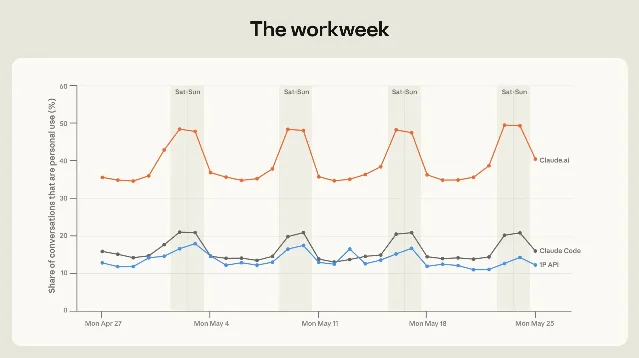
Three findings are most relevant for investors and enterprise buyers:
- Personal use rises from about 35% of weekday chat and Cowork conversations to just under 50% on weekends during the sample period. 5
- The output classifier found that 93% of Claude conversations produced an artifact, with explanations, documents and reports, and guidance among the most common categories. 5
- Conversations about higher-wage occupations consumed more tokens, and Anthropic framed the pattern as more consistent with labor augmentation than simple labor displacement when humans remain involved in high-value tasks. 5
The report is also useful commercially. If Anthropic can show when Claude is used, what artifacts it produces, and which workflows consume more compute, it has better material for enterprise packaging, pricing, and capacity planning.
What to watch
- Fable 5 restoration. The next check is whether U.S. officials move from reported talks to an explicit, public restoration path for Fable 5 access. 6
- Customer litigation. Legion LegalTech's case could become a template for other customers that lost access because of the directive, but the immediate lawsuit is against the government rather than Anthropic. 2
- Supplier-linked financing. Micron's investment amount was not disclosed. Any later Series H filing or investor disclosure would clarify whether this is symbolic alignment or a meaningful balance-sheet signal. 1
- Europe's response. Austria's proposal is early and politically uncertain, but it raises a new question: whether Europe will try to host frontier AI capacity rather than only regulate imported systems. 7
参考ソース
- 1Micron and Anthropic Announce Strategic Agreement to Scale Next-Generation AI Infrastructure
- 2Legal tech firm sues US over order limiting foreign access to top-tier Anthropic models
- 3Anthropic says Alibaba illicitly extracted Claude AI model capabilities
- 4AI researchers continue to leave Google for its rivals
- 5Anthropic Economic Index report: Cadences
- 6US close to allowing Anthropic to restore Fable 5 model, Axios reports
- 7Austria urges Europe to host Anthropic following US curbs on AI access
このコンテンツについて、さらに観点や背景を補足しましょう。